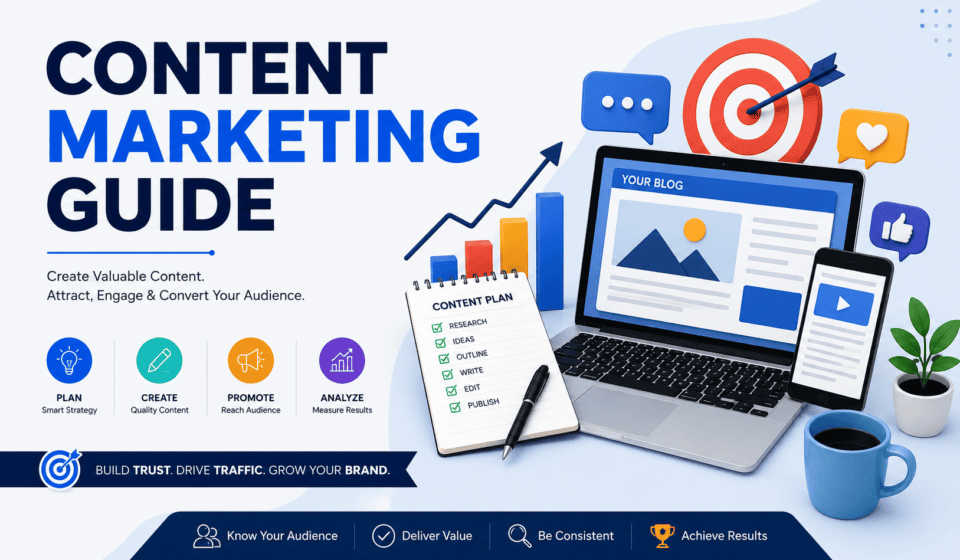

Content marketing has become one of the most powerful ways for businesses, freelancers, coaches, and digital marketers to attract an audience and build long-term trust online. Instead of constantly promoting products or services, content marketing focuses on providing useful information that helps people solve problems, answer questions, and make better decisions.
Whether you are a beginner, freelancer, small business owner, blogger, or digital marketer, understanding content marketing can help you attract more visitors, generate leads, improve search engine visibility, and build a strong online brand.
In this complete content marketing guide, you will learn what content marketing is, why it matters, the different types of content, how to create a content strategy, how SEO fits into content marketing, and how to measure your results.
What Is Content Marketing?
Content marketing is a digital marketing strategy that involves creating and sharing valuable, relevant, and consistent content to attract and engage a specific target audience.
The main goal is not simply to sell something immediately. Instead, content marketing helps build relationships with potential customers by providing useful information throughout their buying journey.
For example, a web designer might publish articles such as:
- How to Create a Professional Website
- 10 Common Web Design Mistakes
- How Much Does a Website Cost?
- WordPress vs. Custom Website Development
- How to Improve Website Speed
These articles can attract people who are interested in websites. Some readers may eventually become clients because the content demonstrates the designer’s knowledge and expertise.
In simple terms:
Content marketing means helping your audience with useful content so they can eventually trust your brand and choose your products or services.
Why Is Content Marketing Important?
People use search engines, social media, blogs, videos, and online communities every day to find information. This creates a huge opportunity for businesses to reach potential customers by publishing useful content.
Here are some of the major benefits of content marketing.
1. Builds Brand Awareness
Publishing valuable content regularly helps people discover your brand.
For example, if you consistently publish helpful articles about digital marketing, people may begin to recognize you as a digital marketing expert.
Over time, your content can make your name or business familiar to your target audience.
2. Builds Trust and Authority
Customers are more likely to work with businesses they trust.
Educational content allows you to demonstrate your knowledge without directly saying that you are an expert.
A detailed tutorial, case study, guide, or video can show potential customers that you understand their problems and know how to solve them.
3. Generates Website Traffic
Search-friendly blog posts can attract visitors from search engines.
For example, someone searching for “how to create a WordPress website” might discover your blog if you have a helpful article targeting that topic.
Unlike some forms of paid advertising, useful content can continue attracting visitors long after it is published.
4. Supports SEO
Content is an important part of search engine optimization.
Publishing useful articles around relevant topics gives search engines more opportunities to understand your website and connect your pages with relevant searches.
A strong content strategy can support:
- Organic traffic
- Keyword rankings
- Internal linking
- Backlinks
- Topical authority
- Website engagement
However, creating content solely for search engines is not a good strategy. Your primary goal should always be to help real people.
5. Generates Leads
Content can be used to turn website visitors into potential customers.
For example, you could offer a free:
- E-book
- Checklist
- Template
- Course
- Webinar
- Consultation
- Email newsletter
A visitor provides their email address in exchange for the resource. You can then continue building a relationship with that person through email marketing.
Types of Content Marketing
Content marketing is not limited to blog posts. Different formats can be used to reach different audiences.
Blog Posts
Blogging is one of the most popular forms of content marketing.
You can create:
- How-to guides
- Tutorials
- List articles
- Beginner guides
- Case studies
- Comparisons
- Industry news
- Frequently asked questions
Blog posts are especially useful for SEO because they allow you to target specific search queries.
Videos
Video content is highly effective for tutorials, product demonstrations, educational content, and personal branding.
For example, a digital marketing trainer could create videos about:
- WordPress tutorials
- SEO basics
- Facebook marketing
- Google Ads
- Freelancing tips
- Website design
You can publish videos on platforms such as YouTube and embed them into your website.
Social Media Content
Social media provides an opportunity to distribute your content and communicate directly with your audience.
Examples include:
- Educational posts
- Short videos
- Infographics
- Quotes
- Tips
- Polls
- Questions
- Behind-the-scenes content
The key is to create content that fits the platform and interests of your audience.
E-books and Guides
Long-form resources can help establish authority.
For example, a web design business could offer a free guide titled:
“The Beginner’s Guide to Creating a Professional Business Website.”
A downloadable guide can also be used as a lead magnet to collect email subscribers.
Case Studies
Case studies show how your product or service helped a real customer.
A good case study can explain:
- The customer’s problem
- The strategy used
- The implementation process
- The results
- The lessons learned
Case studies are particularly useful because they provide evidence rather than simply making promotional claims.
Infographics
Infographics combine information and visual elements to make complicated topics easier to understand.
They can also be useful for social media and link-building because other websites may reference or share useful visual resources.
How to Create a Content Marketing Strategy
Creating random content without a plan can waste time and resources. A content strategy gives your marketing activities direction.
Follow these steps to create a practical content marketing strategy.
Step 1: Define Your Target Audience
Before creating content, determine exactly who you want to reach.
Ask questions such as:
- Who are my ideal customers?
- What problems do they have?
- What questions do they ask?
- What goals are they trying to achieve?
- What level of knowledge do they have?
- Where do they consume content?
For example, a digital marketing trainer may target beginners who want to learn digital marketing and start freelancing.
Knowing your audience makes it easier to create useful and relevant content.
Step 2: Identify Audience Problems
Good content usually solves a problem.
Make a list of the questions your target audience frequently asks.
For example, beginner freelancers may ask:
- How do I start freelancing?
- Which skills should I learn?
- How do I create a portfolio?
- How can I find my first client?
- How should I price my services?
Each question can become a content topic.
Step 3: Perform Keyword Research
Keyword research helps you understand what people search for online.
Look for keywords related to your products, services, industry, and audience problems.
For example, a web design website could target topics such as:
- Web design for beginners
- How to create a website
- WordPress website design
- Responsive web design
- Website design tips
- How to improve website speed
Don’t focus only on high-volume keywords. Long-tail keywords can often be more specific and useful for attracting targeted visitors.
Step 4: Create Content Pillars
Content pillars are broad subjects that your website will consistently cover.
For a digital marketing trainer, content pillars could include:
- Web Design
- WordPress
- SEO
- Content Marketing
- Social Media Marketing
- Email Marketing
- Freelancing
- Digital Marketing
- Personal Branding
- Business Growth
Each pillar can contain many related articles.
This approach helps you build a well-organized content library.
Step 5: Create a Content Calendar
A content calendar helps you stay consistent.
Your calendar can include:
- Topic
- Target keyword
- Content type
- Author
- Publication date
- Target audience
- Content status
- Promotion channels
You don’t need to publish every day. A realistic schedule is more important than an ambitious schedule you cannot maintain.
For example, you could publish two detailed blog posts every week and promote each article through social media and email.
How to Write High-Quality Content
Creating content is easy. Creating content that people actually find useful requires more effort.
Start With a Strong Headline
Your headline should clearly communicate the benefit of reading the article.
Instead of:
“Content Marketing”
consider:
“Content Marketing Guide: How to Attract Customers With Valuable Content.”
A clear headline tells readers what they will learn.
Write an Introduction That Addresses the Problem
Your introduction should quickly explain why the topic matters.
Tell readers what they can expect from the article and how it can help them.
Avoid unnecessary introductions that delay the main information.
Use Clear Headings
Break long articles into logical sections using H2 and H3 headings.
This improves readability and allows readers to scan the article quickly.
Keep Paragraphs Short
Large blocks of text can be difficult to read online.
Use short paragraphs, bullet points, numbered lists, and visual breaks to make your content easier to consume.
Provide Practical Examples
Examples make educational content easier to understand.
Instead of simply explaining a marketing concept, show readers how it can be applied to a real business.
Add Your Own Experience
Original insights can make your content more valuable.
Share:
- Lessons learned
- Examples
- Case studies
- Mistakes
- Personal observations
- Practical recommendations
This can help differentiate your content from generic articles found elsewhere.
Content Marketing and SEO
SEO and content marketing work closely together.
SEO helps people discover your content through search engines, while content provides the information that visitors are looking for.
A basic SEO-focused content process includes:
- Research the topic.
- Identify relevant search terms.
- Understand search intent.
- Create comprehensive content.
- Use keywords naturally.
- Optimize the title and headings.
- Add descriptive URLs.
- Use internal links.
- Optimize images.
- Promote the content.
Don’t repeatedly insert the same keyword into an article. Keyword stuffing can make content difficult to read and may create a poor user experience.
Instead, focus on answering the searcher’s question thoroughly.
Content Distribution
Creating content is only half of content marketing. You also need to distribute it.
After publishing a blog post, consider promoting it through:
- YouTube
- Email newsletters
- Online communities
- Business profiles
- Relevant industry websites
You can also repurpose one piece of content into multiple formats.
For example, a 2,000-word blog post can become:
- A YouTube video
- Five social media posts
- An infographic
- Several short videos
- An email newsletter
- A checklist
- A presentation
This allows you to get more value from the original content.
Measuring Content Marketing Results
You cannot improve what you do not measure.
Important content marketing metrics include:
Organic Traffic
Monitor how many visitors arrive through search engines.
Increasing organic traffic can indicate that your content is becoming more visible.
Engagement
Depending on your platform, you can measure:
- Time spent on page
- Pages per session
- Comments
- Shares
- Video views
- Social interactions
Leads
Track how many visitors become potential customers.
For example, measure newsletter signups, consultation requests, contact-form submissions, or downloads.
Conversions
Ultimately, content marketing should contribute to business objectives.
Depending on your business, conversions might include:
- Product purchases
- Course registrations
- Service inquiries
- Consultation bookings
- Email subscriptions
Don’t judge your content only by page views. A smaller article that generates qualified leads may be more valuable than a highly viewed article that generates no business.
Common Content Marketing Mistakes
Beginners often make several mistakes when starting content marketing.
Creating Content Without Knowing the Audience
If you don’t understand your audience, your content may not solve their actual problems.
Focusing Only on Promotion
Constantly promoting your products can make your content feel like advertising.
Follow the principle of providing value first and selling second.
Publishing Without Consistency
Publishing one article and then disappearing for several months makes it difficult to build momentum.
Create a realistic publishing schedule and follow it.
Ignoring Content Quality
Publishing large amounts of low-quality content is not an effective long-term strategy.
Focus on creating useful, accurate, original, and well-structured resources.
Not Promoting Content
Even excellent content may receive little traffic if nobody knows it exists.
Always include content promotion in your publishing process.
Not Updating Older Content
Information can become outdated.
Review your older articles periodically and update:
- Statistics
- Examples
- Links
- Screenshots
- Recommendations
- Outdated information
Updating existing content can be an efficient part of your overall content strategy.
A Simple Content Marketing Plan for Beginners
If you’re completely new to content marketing, start small.
Month 1: Build the Foundation
Choose your target audience and identify your main content topics.
Create four to eight useful articles answering important questions your audience has.
Month 2: Expand Your Content
Publish additional articles and begin creating related content around your main topics.
Start building internal links between relevant articles.
Month 3: Promote and Improve
Share your content on social media, start an email list, analyze your traffic, and identify your best-performing topics.
Then create more content around the subjects that generate the strongest results.
Over time, your website can develop into a valuable resource for your target audience.
Frequently Asked Questions About Content Marketing
What is the main goal of content marketing?
The main goal is to attract and engage a relevant audience by providing valuable content and eventually encourage actions such as subscriptions, inquiries, purchases, or other business conversions.
Is content marketing only for large businesses?
No. Freelancers, bloggers, coaches, startups, local businesses, and small businesses can all benefit from content marketing.
In fact, useful educational content can help smaller businesses compete by demonstrating their expertise and building trust.
How often should I publish content?
There is no universal publishing frequency. Choose a schedule that you can maintain while protecting content quality. One or two high-quality articles per week can be more valuable than publishing low-quality content every day.
Does content marketing help SEO?
Yes. High-quality, relevant content can support SEO by helping search engines understand your website and giving users useful pages to discover and share. However, SEO involves many factors beyond content alone.
How long does content marketing take to work?
Content marketing is generally a long-term strategy. Results can vary depending on your industry, competition, content quality, website authority, distribution, and consistency. Avoid expecting significant results immediately.
Final Thoughts
Content marketing is one of the most effective long-term strategies for building an online presence. Instead of relying entirely on advertisements or direct promotion, it allows you to attract people by answering their questions and solving their problems.
The process starts with understanding your audience. From there, you can research topics, create valuable content, optimize it for search engines, distribute it across appropriate channels, and measure the results.
The most important lesson is simple:
Don’t create content just because you need to publish something. Create content because your audience needs it.
If you consistently provide useful information, demonstrate your expertise, and build trust with your audience, your content library can become one of your business’s most valuable marketing assets.
Start with one useful article today. Learn from the results, improve your strategy, and continue building. Over time, consistent content marketing can help you increase visibility, attract qualified visitors, generate leads, and grow your business.