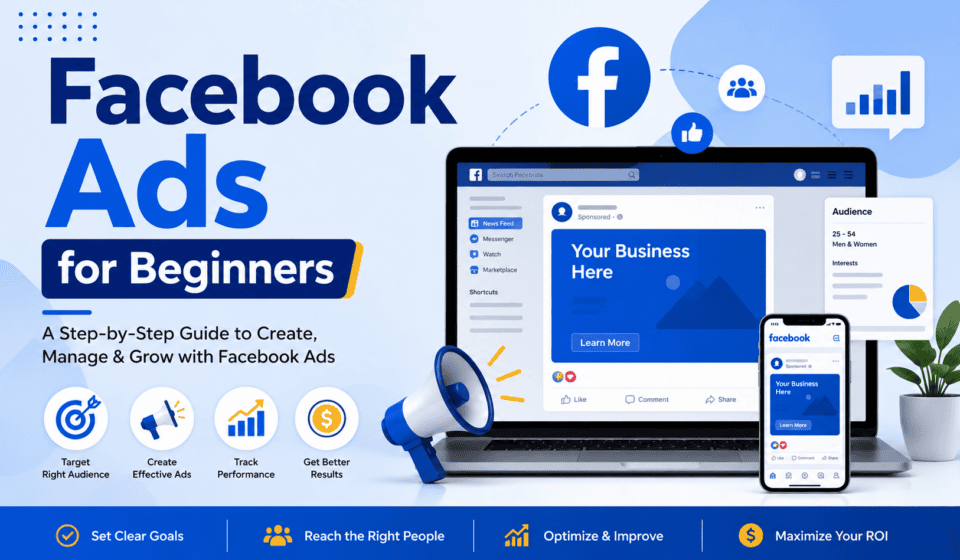

Facebook Ads have become one of the most powerful ways for businesses, freelancers, coaches, and entrepreneurs to reach potential customers online. Whether you want to promote a product, generate leads, increase website traffic, or build awareness for your brand, Facebook advertising can help you reach a highly targeted audience.
However, Facebook Ads can seem confusing when you are just starting. There are campaigns, ad sets, audiences, budgets, placements, objectives, creatives, and many other options to understand.
The good news is that you do not need to be an expert to get started.
In this beginner-friendly guide, you will learn what Facebook Ads are, how they work, how to create your first campaign, how much Facebook Ads cost, how to choose the right audience, and how to improve your results over time.
What Are Facebook Ads?
Facebook Ads are paid advertisements that businesses and individuals can create through Meta’s advertising platform to reach specific audiences on Facebook and other Meta platforms.
Unlike traditional advertising, where you may show an advertisement to a broad audience, Facebook advertising allows you to target people based on factors such as location, age, interests, online behavior, and interactions with your business.
For example, imagine you are a web designer offering website design services. Instead of advertising to everyone in your city, you could create an advertising campaign designed to reach business owners who may need a website.
You can also use Facebook Ads to:
- Promote products or services
- Generate leads
- Increase website traffic
- Get messages from potential customers
- Promote events
- Increase online sales
- Build brand awareness
- Retarget people who have interacted with your business
This level of targeting is one of the biggest advantages of Facebook advertising.
Why Should Beginners Learn Facebook Ads?
Facebook Ads can be valuable for both businesses and digital marketers.
For business owners, advertising can help bring potential customers to their website, social media pages, online store, or sales funnel.
For freelancers and digital marketing students, Facebook Ads are an important skill that can create opportunities for freelance work, agency jobs, and business growth.
Some major benefits include:
1. Reach a Large Audience
Facebook has a massive global user base. This gives businesses access to a huge potential audience.
2. Target Specific People
You can target audiences using different characteristics and signals, depending on the campaign and available targeting options.
3. Start With a Small Budget
You do not necessarily need a large advertising budget to learn. Beginners can start with a controlled budget, test their campaigns, and increase spending when they find something that works.
4. Measure Results
Digital advertising provides measurable data. You can see impressions, clicks, conversions, cost per result, and other performance metrics.
5. Test Different Ideas
You can test different images, videos, headlines, audiences, and offers to discover what performs best.
How Facebook Ads Work
Before creating your first advertisement, it is important to understand the basic structure of a Facebook advertising campaign.
Facebook Ads are generally organized into three levels:
Campaign
The campaign is the highest level.
At the campaign level, you select the overall marketing objective you want to achieve.
Examples may include:
- Awareness
- Traffic
- Engagement
- Leads
- App promotion
- Sales
Your campaign objective should match your business goal.
For example, if your goal is to collect customer inquiries, a lead-focused campaign may be more appropriate than simply optimizing for website visits.
Ad Set
The ad set controls many of the delivery settings.
Depending on the campaign setup, this can include:
- Audience
- Budget
- Schedule
- Placements
- Optimization and delivery settings
This is where you tell Meta who you want to reach and how you want your advertising budget to be used.
Ad
The ad is what your audience actually sees.
It may contain:
- Image
- Video
- Primary text
- Headline
- Call-to-action
- Destination URL
A campaign can contain multiple ads so that you can test different creative ideas.
Understanding this three-level structure will make Facebook Ads Manager much easier to understand.
Step 1: Define Your Advertising Goal
One of the most common mistakes beginners make is creating an advertisement without knowing what they want to achieve.
Before opening Ads Manager, answer this question:
What action do I want people to take?
For example:
- Visit my website
- Send me a message
- Fill out a form
- Purchase a product
- Register for a course
- Book a consultation
- Watch my video
- Learn about my brand
Your goal should determine your campaign strategy.
If you sell an online course, for example, you might want to generate leads or sales rather than simply collect likes.
Step 2: Know Your Target Audience
Audience research is one of the most important parts of successful advertising.
You should understand your ideal customer before spending money.
Ask yourself:
- Who needs my product or service?
- What problem are they trying to solve?
- Where are they located?
- What type of content do they consume?
- What motivates them to buy?
- What objections might prevent them from purchasing?
For example, suppose you offer digital marketing training.
Your potential audience might include:
- University students
- Freelancers
- Small business owners
- Job seekers
- Entrepreneurs
- New digital marketers
However, do not automatically assume that targeting a huge number of interests will produce better results.
A clearly defined audience combined with strong creative and a compelling offer is often more useful than simply adding dozens of unrelated interests.
Step 3: Choose the Right Campaign Objective
Meta’s advertising system uses campaign objectives to guide delivery toward people who are more likely to take the desired action.
For beginners, it is important to understand the difference between common goals.
Awareness
Awareness campaigns are designed to introduce your business or message to people.
They can be useful when your main goal is brand recognition rather than immediate sales.
Traffic
Traffic campaigns are designed to encourage people to visit a destination such as a website or landing page.
This can be useful when website visits are an important part of your marketing strategy.
Engagement
Engagement campaigns can help encourage interactions with content or other forms of engagement supported by the campaign setup.
Leads
Lead campaigns are useful when you want to collect information from potential customers or encourage inquiries.
For example, a coach could use lead advertising to collect registrations for a free consultation.
Sales
Sales campaigns are generally intended to drive purchases or other valuable conversion events.
Choose your objective based on the result that matters to your business—not simply the option that sounds attractive.
Step 4: Set Your Advertising Budget
Your budget determines how much you are willing to spend.
There are generally two common approaches:
Daily Budget
A daily budget controls approximately how much you want to spend per day.
This can be useful when you want to run an ongoing campaign.
Lifetime Budget
A lifetime budget sets the amount you want to spend over a specific period.
This can be useful for campaigns with a defined start and end date.
If you are completely new to Facebook Ads, start with an amount that you can afford to lose while learning.
Do not spend a large amount immediately just because you want fast results.
The purpose of your first campaigns should be to learn what works.
Step 5: Create an Attractive Ad
Your creative is one of the most important elements of your advertisement.
You can have excellent targeting, but if your advertisement does not attract attention or communicate value, people may ignore it.
A good Facebook ad usually needs to answer three questions quickly:
What is this?
Why should I care?
What should I do next?
Use Strong Visuals
Use clear, professional images or videos that support your message.
Avoid overcrowding the design with too much text.
If you are promoting a course, for example, you could show the course interface, instructor, student results, or a relevant educational visual.
Write Clear Ad Copy
Your primary text should focus on the audience’s problem, desired result, or benefit.
Instead of simply saying:
“Buy our digital marketing course.”
You could communicate a stronger value proposition such as:
“Want to build practical digital marketing skills? Learn how to create campaigns, attract customers, and develop real-world marketing skills with structured training.”
The second approach gives the audience more context.
Use a Clear Call-to-Action
Tell people what to do next.
Examples include:
- Learn More
- Sign Up
- Get Quote
- Contact Us
- Shop Now
- Book Now
Your call-to-action should match your campaign goal.
Step 6: Choose Your Placements
Meta can show advertisements in different locations across its platforms.
Depending on your campaign and settings, placements may include areas such as Facebook feeds, Instagram feeds, Stories, Reels, and other placements.
Beginners should avoid assuming that one placement is always best.
Instead, use campaign data to understand where your ads are getting useful results.
The best placement can vary depending on:
- Audience
- Creative format
- Industry
- Campaign objective
- Offer
- Device behavior
Step 7: Add Your Website or Landing Page
If your campaign sends people to a website, make sure the destination page matches your advertisement.
For example, if your ad promotes a specific digital marketing course, do not send users to a generic homepage where they have to search for the course.
Instead, send them to a relevant landing page.
A good landing page should have:
- A clear headline
- Strong value proposition
- Relevant images
- Benefits
- Social proof
- Important details
- A clear call-to-action
- Easy navigation
The advertisement gets the visitor’s attention, but the landing page helps convert that attention into action.
Step 8: Install Tracking and Measure Conversions
Tracking is extremely important if you want to understand whether your advertising is actually producing business results.
For website campaigns, Meta’s tracking tools can help businesses measure actions taken on their websites when implemented correctly.
Depending on your setup, you may want to track events such as:
- Page views
- Lead submissions
- Add to cart
- Purchases
- Registrations
- Other valuable actions
Do not judge an advertising campaign only by likes or comments.
A campaign with fewer likes can be much more profitable than one with thousands of interactions if it produces more qualified customers.
Important Facebook Ads Metrics for Beginners
You do not need to understand every metric when you are starting.
Focus on a few important ones.
Impressions
Impressions represent the number of times your advertisement was displayed.
Reach
Reach refers to the number of people who saw your advertisement.
Click-Through Rate
CTR helps indicate how often people clicked after seeing your ad.
A higher CTR can suggest that your creative and message are attracting attention, although the appropriate benchmark varies by campaign.
Cost Per Result
This tells you how much you are spending to achieve your selected result.
For example, if your goal is leads, you may pay attention to cost per lead.
Conversion Rate
Conversion rate shows what percentage of visitors or users completed the desired action.
Return on Ad Spend
ROAS compares revenue generated with advertising spend.
For example, if you spend $100 and generate $400 in attributed revenue, the ROAS is 4.
However, remember that revenue is not the same as profit. You also need to consider product costs, operating expenses, fees, and other business costs.
Common Facebook Ads Mistakes Beginners Should Avoid
1. Targeting Everyone
A huge audience is not automatically a good audience.
Start with a logical customer profile and refine it using data.
2. Using Weak Creative
A low-quality image, confusing message, or boring headline can reduce performance.
Invest time in your creative.
3. Changing Campaigns Too Quickly
Beginners often panic when they do not immediately see results.
Constantly changing budgets, audiences, ads, and settings can make it difficult to understand what actually works.
Give campaigns enough time and data to evaluate performance appropriately.
4. Focusing Only on Likes
Likes are not necessarily business results.
Focus on the action that supports your business objective.
5. Sending Traffic to a Poor Website
A good ad cannot compensate for a confusing or slow landing page.
Your website experience matters.
6. Not Testing Different Creatives
One advertisement is rarely enough to determine what works.
Test different:
- Images
- Videos
- Headlines
- Hooks
- Offers
- Calls-to-action
Then compare the results.
How Much Do Facebook Ads Cost?
There is no single fixed price for Facebook Ads.
The cost can vary depending on factors such as:
- Audience
- Competition
- Industry
- Campaign objective
- Ad quality
- Seasonality
- Placement
- Budget
- Market
This means two businesses can spend the same amount and receive very different results.
Instead of asking, “How much does Facebook advertising cost?” a better question is:
How much does it cost me to achieve my desired business result?
For example, a business might be willing to pay more for a qualified customer if that customer generates significant profit.
Facebook Ads Testing Strategy for Beginners
Testing is one of the best ways to improve your advertising skills.
Start with a simple structure.
For example, test:
Creative A: Image-based advertisement
Creative B: Video-based advertisement
Keep other important variables reasonably consistent so you can learn from the comparison.
You can also test different messages.
Version A: Focus on a problem.
Version B: Focus on a desired result.
Over time, you can identify which combinations produce better results.
Do not test too many things at once. If you change the audience, creative, offer, landing page, and budget simultaneously, it becomes difficult to identify what caused the change.
How to Improve Facebook Ads Performance
Once your campaign has enough useful data, look for opportunities to improve.
If people are not clicking, review your creative and message.
If people click but do not convert, examine your landing page, offer, pricing, trust signals, and user experience.
If you receive many low-quality leads, review your audience, messaging, and lead qualification process.
Think of advertising as a system:
Ad → Click → Landing Page → Conversion → Customer
If one part is weak, the entire system can suffer.
Facebook Ads for Freelancers
Facebook Ads can also be an excellent service for freelancers to learn.
If you are a beginner digital marketer, you can develop skills in:
- Campaign creation
- Audience research
- Ad copywriting
- Creative strategy
- Campaign optimization
- Conversion tracking
- Reporting
- Client communication
Once you gain practical experience, you can offer Facebook advertising services to small businesses.
However, do not promise guaranteed results to clients.
Advertising performance depends on many factors, including the product, offer, market, website, creative, budget, and competition.
Final Thoughts
Facebook Ads can look complicated when you first open Ads Manager, but the fundamentals are relatively straightforward.
Start by defining a clear business goal. Understand your audience. Choose an appropriate campaign objective. Create useful and engaging advertising creative. Send people to a relevant destination. Track meaningful results and continuously test your ideas.
Most importantly, remember that successful advertising is not about simply spending more money.
It is about understanding your audience and creating a strong connection between the right person, the right message, the right offer, and the right action.
If you are a freelancer, entrepreneur, student, or small business owner, learning Facebook Ads can become a valuable digital marketing skill.
Start small, learn from your data, avoid unnecessary complexity, and improve your campaigns step by step.
With consistent practice, you can move from being a complete beginner to confidently creating and managing Facebook advertising campaigns.