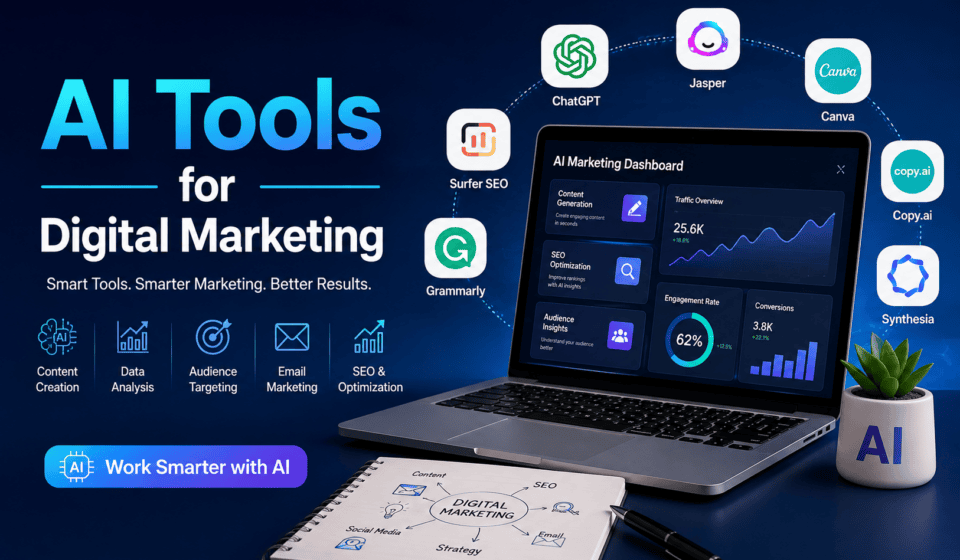

Artificial intelligence (AI) is changing the way businesses approach digital marketing. Tasks that once required hours of research, writing, design, analysis, and optimization can now be completed faster with AI-powered tools.
From creating social media content and writing blog posts to analyzing customer behavior and optimizing advertising campaigns, AI tools can help marketers save time and make better decisions. However, AI is not a replacement for marketers. Instead, it works best as a powerful assistant that helps professionals work more efficiently.
In this guide, we will explore AI tools for digital marketing, how they work, where they can be used, and how freelancers, businesses, and marketing professionals can use them to improve their online marketing strategies.
What Are AI Tools for Digital Marketing?
AI tools for digital marketing are software applications that use artificial intelligence, machine learning, natural language processing, data analysis, or generative AI to help marketers perform marketing tasks.
These tools can assist with:
- Content creation
- SEO research
- Keyword analysis
- Social media marketing
- Email marketing
- Graphic design
- Video creation
- Advertising
- Customer research
- Data analysis
- Marketing automation
- Lead generation
- Conversion optimization
Instead of performing every task manually, marketers can use AI to automate repetitive activities and generate useful insights.
For example, an AI writing assistant can help create a first draft of a blog post, while an AI SEO tool can suggest keywords and content improvements. A marketer can then review, edit, fact-check, and improve the content before publishing it.
Why Are AI Tools Important for Digital Marketing?
Digital marketing involves many different activities. A single marketer may need to research keywords, write articles, create social media posts, design graphics, send emails, monitor analytics, and manage advertising campaigns.
AI can make many of these processes faster.
1. Save Time
One of the biggest benefits of AI is productivity. Tasks that previously took several hours can often be completed much faster with the right AI tools.
For example, marketers can use AI to generate content ideas, summarize research, create social media captions, or organize campaign data.
2. Generate More Content
Businesses need a consistent supply of content to maintain their online presence.
AI can help marketers create:
- Blog post outlines
- Social media captions
- Email drafts
- Product descriptions
- Video scripts
- Ad copy
- Headlines
- Meta descriptions
Human editing is still important, but AI can provide a useful starting point.
3. Improve Marketing Decisions
AI can process large amounts of information and identify patterns that may be difficult to recognize manually.
Marketing teams can use AI-powered analytics to understand customer behavior, identify trends, and evaluate campaign performance.
4. Personalize Customer Experiences
AI can help businesses deliver more relevant experiences to customers.
For example, an online store can use customer behavior and purchase history to recommend relevant products. Email marketers can also use AI to create personalized campaigns for different customer segments.
5. Reduce Repetitive Work
Marketing includes many repetitive activities, such as scheduling posts, organizing data, responding to common questions, and creating variations of advertisements.
AI and automation can reduce the amount of manual work required.
Best AI Tools for Digital Marketing
There are many AI-powered marketing tools available today. The best tool depends on your goals, budget, industry, and marketing strategy.
Here are some important categories and popular examples.
1. AI Tools for Content Creation
Content marketing is one of the areas where generative AI has had a major impact.
AI writing tools can help marketers brainstorm ideas, create outlines, rewrite text, generate drafts, and improve clarity.
OpenAI’s ChatGPT is widely used for brainstorming, content planning, writing assistance, research organization, and many other marketing workflows.
Marketers can use AI to generate:
- Blog ideas
- Article outlines
- Social media content
- Email campaigns
- Ad copy
- Landing page copy
- FAQs
- Video scripts
The best approach is to use AI as an assistant rather than publishing unedited AI-generated content.
A marketer should add original insights, examples, experience, accurate information, and a unique brand voice.
2. AI Tools for SEO
Search engine optimization requires keyword research, competitor analysis, content optimization, technical improvements, and performance monitoring.
AI-powered SEO platforms can help marketers discover keyword opportunities and identify areas where content could be improved.
Tools such as Semrush can assist with keyword research, competitor analysis, SEO monitoring, and content-related workflows.
AI can also help marketers understand search intent.
For example, instead of simply targeting the keyword “digital marketing,” a marketer can analyze related searches and create content around more specific topics such as:
- Digital marketing for small businesses
- Digital marketing tools for beginners
- How to create a digital marketing strategy
- AI tools for digital marketing
- Digital marketing courses for beginners
Long-tail topics can help businesses target users with more specific needs.
3. AI Tools for Social Media Marketing
Social media marketing requires constant content creation and audience engagement.
AI tools can help marketers develop social media strategies and create content for platforms such as Facebook, Instagram, LinkedIn, TikTok, and X.
AI can generate:
- Post ideas
- Captions
- Hashtags
- Content calendars
- Short-form video scripts
- Promotional messages
- Engagement ideas
AI can also help repurpose existing content.
For example, a 2,000-word blog article could become:
- Five LinkedIn posts
- Ten short social media posts
- Three video scripts
- One email newsletter
- Several short educational tips
This allows marketers to get more value from existing content.
4. AI Tools for Graphic Design
Visual content is essential for digital marketing.
AI-powered design platforms can help marketers create social media graphics, advertisements, presentations, thumbnails, banners, and other marketing materials.
Canva provides AI-powered features that can assist with design and content creation.
For marketers who do not have advanced graphic design skills, AI can make visual content creation considerably easier.
However, marketers should maintain consistent branding by using appropriate colors, fonts, logos, imagery, and design guidelines.
5. AI Tools for Email Marketing
Email marketing remains an important channel for businesses.
AI can help marketers create subject lines, email copy, campaign ideas, customer segments, and personalized messages.
For example, an online business could create different email messages for:
- New subscribers
- Existing customers
- Inactive customers
- First-time buyers
- Returning customers
- High-value customers
AI can also help marketers test different subject lines and messages.
The goal is not simply to send more emails. The goal is to send more relevant emails to the right audience at the right time.
6. AI Tools for Advertising
Paid advertising can become expensive when campaigns are poorly optimized.
AI-powered advertising systems can help marketers analyze performance and identify opportunities for optimization.
AI can assist with:
- Ad copy
- Audience targeting
- Creative variations
- Campaign analysis
- Budget optimization
- Conversion analysis
- A/B testing ideas
For example, a marketer could create several versions of an advertisement with different headlines and calls to action, then compare their performance.
AI can help generate the variations, while actual campaign data determines which version performs better.
7. AI Tools for Video Marketing
Video has become one of the most important formats in digital marketing.
AI video tools can assist with:
- Script writing
- Video editing
- Captions
- Voiceovers
- Transcription
- Short-form video creation
- Video repurposing
A marketer can start with a blog article, turn it into a video script, create a short video, and then distribute clips across social media.
This makes content repurposing much easier.
8. AI Chatbots for Customer Support
AI chatbots can help businesses answer common customer questions.
A chatbot can provide information about:
- Products
- Services
- Pricing
- Business hours
- Shipping
- Policies
- Frequently asked questions
Chatbots can also help qualify leads before sending them to a sales representative.
However, businesses should provide a clear way for customers to reach a human when a question is complex or sensitive.
9. AI Tools for Marketing Analytics
Marketing decisions should be based on data whenever possible.
AI-powered analytics tools can help marketers understand:
- Website traffic
- Conversion rates
- Customer behavior
- Campaign performance
- Audience engagement
- Sales trends
For example, a business may discover that visitors from one traffic source have a significantly higher conversion rate than visitors from another source.
The marketer can then investigate why and potentially allocate more resources to the stronger channel.
AI does not replace good marketing judgment. It helps marketers process information and identify potential patterns faster.
How to Use AI Tools Effectively
Having access to AI tools does not automatically create successful marketing campaigns. The results depend heavily on how the tools are used.
Start With a Clear Goal
Before using an AI tool, define what you want to achieve.
For example:
- Increase website traffic
- Generate more leads
- Improve conversion rates
- Grow an email list
- Increase social media engagement
- Improve search visibility
A clear goal makes it easier to select the right AI tool.
Give AI Good Instructions
The quality of AI output depends partly on the quality of your instructions.
Instead of asking:
“Write a blog post about SEO.”
Provide more context:
“Create a beginner-friendly WordPress article about SEO for small business owners. Include practical examples, headings, FAQs, and a clear conclusion.”
More specific instructions generally produce more useful results.
Always Review AI-Generated Content
AI-generated content should be reviewed before publication.
Check for:
- Incorrect facts
- Outdated information
- Repetitive language
- Generic statements
- Unnecessary claims
- Grammar problems
- Brand inconsistencies
Add your own expertise and real-world examples to make the content more valuable.
Combine AI With Human Creativity
AI is powerful, but human creativity remains important.
A strong digital marketing campaign usually combines:
AI + Strategy + Creativity + Human Experience + Data
AI can generate possibilities, but marketers must decide which ideas are useful and appropriate for their audience.
AI and SEO: What Marketers Should Know
AI can make SEO workflows faster, but marketers should avoid creating large amounts of low-quality content simply because AI makes content production easy.
Search engines aim to provide useful results to users. Therefore, marketers should focus on content that demonstrates genuine value.
Good SEO content should:
- Answer the user’s question
- Provide useful information
- Be easy to read
- Use accurate information
- Include relevant examples
- Demonstrate expertise
- Satisfy search intent
- Be regularly updated when necessary
The goal should not be “create as much AI content as possible.”
The better goal is:
Create the best content possible with AI assistance.
AI Tools for Freelancers
AI can be particularly useful for freelancers.
A freelance digital marketer may need to handle many responsibilities alone. AI can help reduce the workload.
For example, a freelancer could use AI to:
- Research a client’s industry.
- Generate content ideas.
- Create a content calendar.
- Draft blog posts.
- Create social media captions.
- Develop email campaigns.
- Analyze campaign data.
- Create reports.
- Brainstorm advertising concepts.
- Repurpose existing content.
This allows freelancers to spend more time on strategy, client communication, and business development.
AI Tools for Small Businesses
Small businesses often have limited marketing budgets.
AI can help small business owners compete more efficiently by reducing the time required for certain marketing tasks.
For example, a local business could use AI to create:
- Blog content
- Social media posts
- Promotional emails
- Product descriptions
- Advertisements
- FAQ content
- Customer support responses
However, businesses should maintain their unique personality. Generic AI-generated content can make a brand sound like everyone else.
Adding local knowledge, customer stories, original photographs, personal experience, and expert advice can make marketing content much stronger.
Common Mistakes When Using AI for Marketing
AI is powerful, but there are several mistakes marketers should avoid.
Mistake 1: Publishing Everything AI Generates
AI output should be treated as a starting point, not automatically as a finished product.
Mistake 2: Ignoring Fact-Checking
AI can produce incorrect or outdated information. Always verify important claims.
Mistake 3: Creating Generic Content
If your content provides nothing unique, it may struggle to stand out.
Mistake 4: Focusing Only on Quantity
Publishing hundreds of low-quality pages is not necessarily better than publishing fewer high-quality resources.
Mistake 5: Forgetting the Audience
Marketing content should solve customer problems. Do not use AI simply because it is available.
The Future of AI in Digital Marketing
AI will likely become increasingly integrated into digital marketing workflows.
Future marketing systems may provide more advanced capabilities for:
- Predictive analytics
- Customer segmentation
- Personalized marketing
- Automated campaign optimization
- Content generation
- Voice search
- Conversational marketing
- Video production
- Marketing automation
As AI becomes more capable, marketers will need to focus increasingly on strategy, creativity, brand building, critical thinking, and customer relationships.
The most successful marketers will probably not be those who simply use the most AI tools. They will be the people who understand how to combine AI with strong marketing fundamentals.
Final Thoughts
AI tools for digital marketing can dramatically improve productivity and help marketers work smarter. From content creation and SEO to social media, email marketing, advertising, analytics, and customer support, AI can assist with many parts of the modern marketing process.
However, AI should not replace strategy or human judgment.
The best approach is to use AI as a marketing assistant. Let it help with research, brainstorming, drafting, analysis, automation, and repetitive tasks, while you focus on strategy, originality, quality, and your audience.
Whether you are a freelancer, digital marketer, business owner, content creator, or marketing student, learning how to use AI effectively can become an important competitive advantage.
Start with one or two AI tools, learn how they fit into your workflow, measure the results, and gradually build an AI-powered marketing system that helps you save time and achieve better results.
Frequently Asked Questions
What are AI tools for digital marketing?
AI tools for digital marketing are software applications that use artificial intelligence to assist with tasks such as content creation, SEO, social media, advertising, analytics, email marketing, and customer support.
Can AI replace digital marketers?
AI can automate many marketing tasks, but it does not completely replace digital marketers. Human strategy, creativity, communication, judgment, and industry expertise remain important.
What is the best AI tool for digital marketing?
There is no single best AI tool for every marketer. The right tool depends on your specific needs, such as content creation, SEO, design, advertising, analytics, or automation.
Can freelancers use AI for digital marketing?
Yes. Freelancers can use AI to speed up research, content creation, social media management, client reporting, brainstorming, and other repetitive marketing tasks.
Is AI-generated content good for SEO?
AI can help create useful SEO content, but quality matters. Content should be accurate, helpful, original, relevant to search intent, and reviewed by a knowledgeable person before publication.
How can beginners start using AI for digital marketing?
Beginners should start with one marketing goal, choose an appropriate AI tool, learn how to write effective prompts, review AI output carefully, and measure the results of their campaigns.
SEO Title: AI Tools for Digital Marketing: Best Tools & Strategies for 2026
Suggested URL Slug: ai-tools-for-digital-marketing
Focus Keyphrase: AI Tools for Digital Marketing
Meta Description: Discover the best AI tools for digital marketing and learn how to use AI for SEO, content, social media, email, ads, and business growth.
Suggested WordPress Categories: Digital Marketing, AI Tools, Marketing Tools, Artificial Intelligence
Suggested Tags: AI Tools, Digital Marketing, AI Marketing, Marketing Automation, SEO Tools, Content Marketing, Social Media Marketing, AI for Business