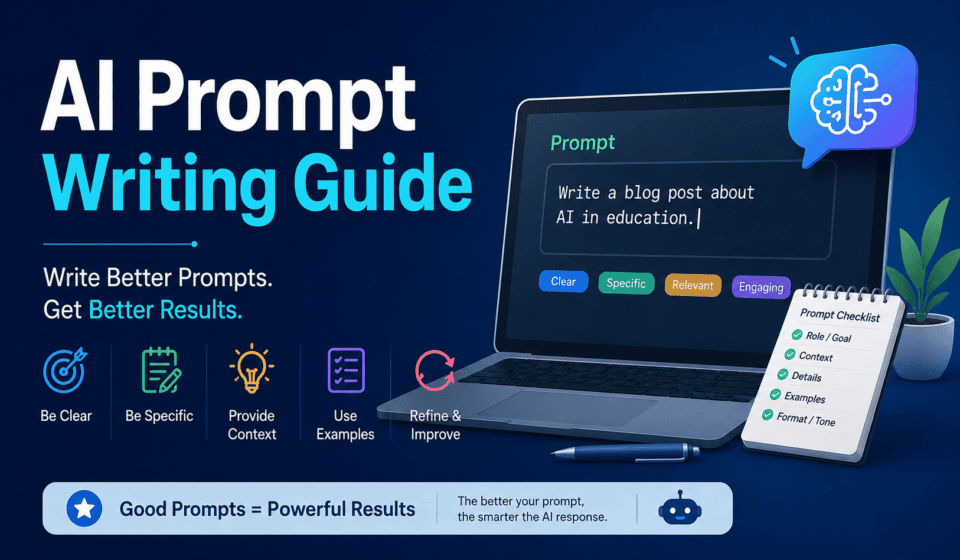

Artificial intelligence has changed the way people work, learn, create content, analyze information, and solve problems. Tools such as ChatGPT, Google Gemini, Claude, Microsoft Copilot, and other AI platforms can perform impressive tasks—but the quality of their output often depends on one important factor: the quality of your prompt.
A prompt is the instruction or question you give to an AI tool. Learning how to write effective prompts can help you get more accurate, useful, relevant, and professional results.
Whether you are a student, freelancer, marketer, business owner, content creator, web designer, developer, or digital marketer, understanding AI prompt writing can significantly improve your productivity.
In this AI Prompt Writing Guide, you will learn what prompts are, how they work, what makes a good prompt, common mistakes to avoid, and practical prompt-writing techniques you can use every day.
What Is an AI Prompt?
An AI prompt is an instruction, question, command, or description provided to an artificial intelligence system to generate a response.
For example, a simple prompt might be:
“Write a blog post about web design.”
The AI can generate an article from this instruction. However, the result may be very general because the prompt does not provide enough information.
A better prompt would be:
“Write a 2,000-word SEO-friendly blog post about responsive web design for beginners. Explain what responsive design is, why it matters, its key principles, common mistakes, and best practices. Use simple English, H2 and H3 headings, examples, bullet points, and a conclusion.”
The second prompt gives the AI much more information about the desired result.
This demonstrates one of the most important principles of prompt writing:
Better instructions usually produce better results.
Why Is Prompt Writing Important?
AI tools are powerful, but they do not automatically know exactly what you want. If your instruction is vague, the AI may make assumptions.
Effective prompt writing helps you control those assumptions.
Good prompts can help you:
- Generate better blog posts
- Create social media content
- Write emails
- Develop marketing campaigns
- Generate website copy
- Create SEO content
- Analyze information
- Summarize documents
- Brainstorm ideas
- Write code
- Create business plans
- Develop educational materials
- Improve existing content
- Generate image ideas
- Research topics
- Automate repetitive tasks
For freelancers and digital marketers, prompt writing can become an important professional skill because it allows you to work with AI more efficiently.
The Basic Structure of a Good AI Prompt
A useful AI prompt commonly contains several important elements:
- Role
- Task
- Context
- Requirements
- Output format
- Audience
- Examples or references
You do not always need every element, but adding relevant information can make your prompts significantly more effective.
1. Define the AI’s Role
Tell the AI what type of expert or perspective it should use.
For example:
“Act as an experienced SEO content writer.”
Or:
“Act as a professional WordPress developer.”
Or:
“Act as a digital marketing consultant specializing in small businesses.”
Defining a role gives the AI useful context about how it should approach the task.
2. Clearly Explain the Task
Tell the AI exactly what you want it to do.
Instead of:
“Tell me about SEO.”
Try:
“Explain the five most important SEO practices for a beginner who is creating their first WordPress website.”
The second prompt defines a specific task.
3. Provide Context
Context helps the AI understand the situation.
For example:
“I am creating a website for a digital marketing trainer who teaches beginners and freelancers.”
Now the AI understands the project better.
You can provide information about:
- Your business
- Your audience
- Your website
- Your industry
- Your goals
- Your location
- Your products or services
- Your existing content
- Your brand style
The more relevant context you provide, the more targeted the response can become.
4. Specify Your Requirements
Tell the AI what the output should include.
For example:
“Include an introduction, five main sections, practical examples, a checklist, common mistakes, and a conclusion.”
You can also specify:
- Word count
- Number of sections
- Keywords
- Reading level
- Tone
- Formatting
- Examples
- Tables
- Bullet points
- FAQs
- Calls to action
For example:
“Write approximately 2,000 words and use short paragraphs suitable for online readers.”
5. Specify the Output Format
One of the easiest ways to improve AI responses is to tell it exactly how you want the answer formatted.
For example:
“Create the answer using H2 and H3 headings, bullet points, numbered lists, and a comparison table.”
Or:
“Return the information as a table with columns for Tool, Best For, Main Feature, and Price.”
Without formatting instructions, the AI may return information in a format that is difficult to use.
6. Identify Your Target Audience
Your content should be appropriate for the people who will read it.
For example:
“Write this article for beginners who have never used AI tools before.”
This is much more useful than simply asking:
“Write an article about AI.”
You can specify an audience such as:
- Beginners
- Students
- Freelancers
- Entrepreneurs
- Developers
- Marketers
- Small business owners
- Teachers
- Content creators
Audience information influences vocabulary, examples, explanations, and complexity.
A Simple AI Prompt Formula
A useful formula for writing prompts is:
Role + Task + Context + Requirements + Format + Audience
For example:
“Act as an experienced SEO writer. Write a 2,000-word article about AI prompt writing for beginners. Explain what AI prompts are, why prompt writing matters, how to create effective prompts, common mistakes, and practical examples. Use simple English, H2 and H3 headings, bullet points, and FAQs. Make the article suitable for a WordPress blog.”
This prompt provides clear instructions without being unnecessarily complicated.
Weak Prompt vs. Strong Prompt
Understanding the difference between weak and strong prompts is one of the best ways to improve your skills.
Weak Prompt
“Write about digital marketing.”
This prompt is extremely broad.
Strong Prompt
“Act as a digital marketing expert. Write a beginner-friendly 1,500-word article explaining digital marketing for small business owners. Cover SEO, social media marketing, email marketing, content marketing, and paid advertising. Include practical examples and a simple action plan. Use clear headings and short paragraphs.”
The second prompt gives the AI:
- A role
- A topic
- A word count
- An audience
- Specific subjects
- Practical requirements
- Formatting instructions
As a result, the AI has a clearer understanding of the expected output.
Use Examples to Get Better Results
Examples can be extremely powerful when writing AI prompts.
Suppose you want the AI to write product descriptions in a particular style. Instead of simply saying:
“Write a product description.”
You can provide an example:
“Write product descriptions in this style: short, persuasive, benefit-focused, and easy to understand. Example: ‘Designed for busy professionals, this lightweight laptop combines powerful performance with all-day battery life.’ Now create a similar description for a wireless keyboard.”
The example gives the AI a pattern to follow.
This technique is often called few-shot prompting when multiple examples are provided.
Give AI Clear Constraints
Constraints tell the AI what it should or should not do.
For example:
“Write a 1,000-word article using simple English. Do not use complicated technical terminology. Avoid repeating the same ideas.”
You can also specify:
- Maximum word count
- Minimum word count
- Number of headings
- Number of examples
- Words to avoid
- Formatting requirements
- Specific information to include
Constraints are particularly useful for professional content creation.
Ask AI to Improve Its Own Output
You do not always need to accept the first response.
AI works particularly well as an iterative tool.
For example, after receiving an article, you can ask:
“Review the article above and identify sections that are unclear, repetitive, or too generic. Then suggest improvements.”
You can then ask:
“Rewrite the article using those improvements while keeping the original structure.”
This creates a workflow where you generate, evaluate, and improve the content.
Use Follow-Up Prompts
You can continue a conversation instead of putting everything into one enormous prompt.
For example:
Prompt 1:
“Give me 20 blog topic ideas about AI for beginners.”
Prompt 2:
“Select the five topics with the strongest potential for search traffic.”
Prompt 3:
“Create an outline for topic number two.”
Prompt 4:
“Write the complete article using this outline.”
Prompt 5:
“Optimize the article for SEO without making it sound unnatural.”
This step-by-step approach can be easier than trying to accomplish everything with a single prompt.
Prompt Writing for SEO Content
AI can be useful for SEO content creation, but your prompt should provide specific instructions.
For example:
“Act as an SEO content strategist. Create a 2,000-word article targeting the keyword ‘AI productivity tools.’ Write for beginners in the United States. Include a compelling introduction, H2 and H3 headings, related terms, practical examples, FAQs, and a conclusion. Keep the content helpful and natural rather than keyword-stuffed.”
You can also ask AI to create:
- SEO titles
- Meta descriptions
- Article outlines
- Keyword clusters
- FAQs
- Internal linking suggestions
- Content briefs
- Featured snippet ideas
- Image alt-text suggestions
However, AI-generated SEO content should be reviewed and fact-checked before publication.
Prompt Writing for WordPress
If you create content for WordPress, you can include publishing requirements directly in your prompt.
For example:
“Create a WordPress-ready article about website security. Use an SEO-friendly title, introduction, H2 and H3 headings, bullet points, numbered lists, FAQ section, conclusion, meta description, suggested URL slug, and five image alt-text ideas.”
This can save time during your publishing workflow.
You can also ask AI to create:
- WordPress excerpts
- Category suggestions
- Tags
- Meta descriptions
- Image prompts
- Internal link ideas
- Calls to action
Prompt Writing for Social Media
AI prompts can also help create social media content.
Instead of:
“Write a Facebook post about SEO.”
Try:
“Act as a social media marketing expert. Write five Facebook posts explaining simple SEO tips for small business owners. Keep each post under 100 words, start with an attention-grabbing hook, provide one practical tip, and finish with a question encouraging engagement.”
This creates much more specific content.
Common AI Prompt Writing Mistakes
Even experienced users can make mistakes when writing prompts.
1. Being Too Vague
A prompt like:
“Make my website better.”
does not provide enough information.
Instead, explain what you want to improve.
2. Giving Too Many Conflicting Instructions
If your prompt asks for a short article but also requests 15 detailed sections, the instructions may conflict.
Keep your requirements logical and consistent.
3. Not Providing Context
AI cannot automatically know your business, audience, or objectives.
Provide relevant background information.
4. Not Defining the Output
If you need a table, list, article, email, or checklist, say so.
5. Accepting the First Answer
The first response is not necessarily the best response.
Use follow-up prompts to improve it.
6. Forgetting to Fact-Check
AI systems can sometimes produce incorrect, outdated, or misleading information.
Important facts should be verified using reliable sources.
Advanced Prompt Writing Techniques
Once you understand the basics, you can experiment with more advanced approaches.
Chain-of-Thought Style Instructions
For complex tasks, you can ask the AI to work through the problem carefully and provide a concise explanation or final result. You generally do not need to request hidden internal reasoning; instead, ask for the key assumptions, steps, or justification that are useful to you.
For example:
“Analyze these three marketing strategies, explain the key factors you considered, and recommend the best option.”
Role-Based Prompting
Assigning a professional role can help establish the perspective you want.
Examples include:
- SEO strategist
- UX designer
- Business consultant
- Copywriter
- Web developer
- Teacher
- Career coach
- Marketing strategist
Structured Output Prompting
You can request a specific structure:
“Return the answer in JSON format with the fields: title, summary, keywords, and recommendations.”
Or:
“Create a table comparing five AI writing tools.”
Structured output is particularly useful for workflows and automation.
A Reusable Master Prompt Template
You can create a reusable template for your daily AI tasks.
Use this structure:
Role: Act as a [professional role].
Task: [Clearly explain what you want].
Context: [Provide relevant background information].
Audience: [Describe who will use or read the output].
Requirements: [List important requirements].
Tone: [Professional, friendly, educational, persuasive, etc.].
Format: [Article, table, list, email, etc.].
Length: [Desired length].
Goal: [Explain the result you want to achieve].
For example:
“Act as an experienced content strategist. Create a 2,000-word educational article about AI prompt writing. The target audience is beginners, freelancers, and digital marketers. Explain prompt fundamentals, provide practical examples, discuss common mistakes, and include advanced techniques. Use simple English, clear H2 and H3 headings, bullet points, and an FAQ section. Make the article useful for a WordPress website.”
10 Practical AI Prompt Examples
Here are some prompts you can use and customize.
1. Blog Writing
“Write a 2,000-word SEO-friendly blog post about [topic] for beginners. Use clear headings, examples, bullet points, FAQs, and a conclusion.”
2. Content Ideas
“Give me 30 blog post ideas about [topic] for [target audience]. Prioritize practical and searchable topics.”
3. SEO
“Create an SEO content brief for the keyword [keyword], including search intent, suggested headings, related topics, FAQs, and internal linking opportunities.”
4. Social Media
“Create 10 social media posts about [topic]. Make each post educational, concise, and engaging.”
5. Email
“Write a professional email to [audience] explaining [situation]. Keep it polite, concise, and action-oriented.”
6. Website Copy
“Write homepage copy for a [business type]. Include a headline, subheadline, benefits, services, trust section, CTA, and FAQ.”
7. Learning
“Teach me [topic] as a complete beginner. Explain the concepts step by step and provide simple examples.”
8. Research
“Create a research checklist for evaluating [topic]. Separate reliable evidence from assumptions and identify information that should be verified.”
9. Editing
“Review the following content for grammar, clarity, repetition, readability, and logical flow. Then provide an improved version.”
10. Brainstorming
“Generate 25 creative ideas for [project]. Group them by difficulty and potential impact.”
Best Practices for AI Prompt Writing
To consistently get better results, follow these principles:
Be specific. Clearly explain what you want.
Provide context. Give the AI the information it needs.
Define the audience. Explain who the output is for.
Specify the format. Tell the AI how you want the answer presented.
Use examples. Show the AI what good output looks like.
Set constraints. Specify length, structure, style, and requirements.
Iterate. Improve the result through follow-up prompts.
Verify important information. Never blindly trust AI-generated facts.
Avoid unnecessary complexity. A clear prompt is often better than an extremely long prompt filled with irrelevant information.
Final Thoughts
AI prompt writing is becoming an important digital skill. You do not need to be a programmer to write effective prompts. The most important skill is learning how to communicate your requirements clearly.
A strong prompt tells the AI what you want, provides enough context to understand the task, defines the target audience, establishes useful constraints, and explains how the final answer should be formatted.
The best way to improve is to practice.
Start with simple prompts, review the results, identify what is missing, and refine your instructions. Over time, you will develop reusable prompts that can help you create content, improve websites, develop marketing campaigns, analyze information, learn new skills, and automate repetitive tasks.
Remember this simple formula:
Clear Prompt + Relevant Context + Specific Requirements + Good Format = Better AI Results
As AI tools continue to become more capable, knowing how to communicate effectively with them can give freelancers, marketers, entrepreneurs, students, and professionals a significant productivity advantage.
The goal of prompt writing is not simply to make AI generate more text. The goal is to communicate your objective clearly enough that AI can help you achieve it more effectively.
Frequently Asked Questions About AI Prompt Writing
What is prompt writing?
Prompt writing is the process of creating clear instructions or questions for an AI system to produce a desired result.
How can I write a good AI prompt?
Start by clearly describing the task. Then provide relevant context, identify the target audience, specify requirements, and explain the desired output format.
Do longer prompts always produce better results?
No. A longer prompt is not automatically better. Relevant and specific information is more important than unnecessary detail.
What should I include in an AI prompt?
Depending on the task, include the role, task, context, audience, requirements, tone, format, examples, and desired length.
Can AI prompts help with SEO?
Yes. AI prompts can assist with SEO content planning, outlines, keyword organization, meta descriptions, FAQs, content briefs, and other tasks. Human review and fact-checking are still important.
Should I use the same prompt every time?
You can create reusable prompt templates, but customize them for each project. Adding specific context usually produces more relevant results.
Can beginners learn prompt writing?
Absolutely. Prompt writing is primarily about clear communication. Beginners can improve quickly by practicing with simple tasks and refining their prompts based on the results.