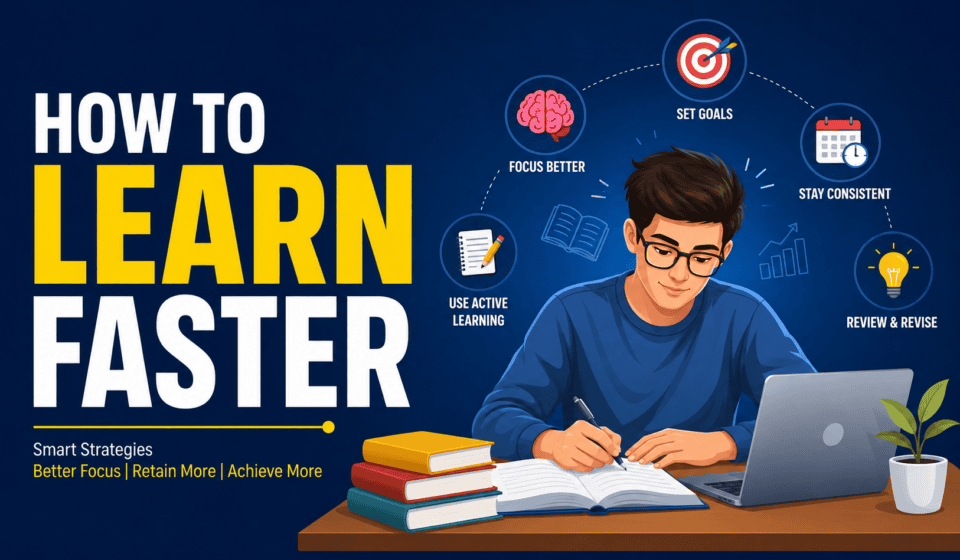

Learning faster is not about spending more hours studying. It is about using better strategies to understand information, remember it longer, and apply what you learn in real situations.
Whether you are learning web design, digital marketing, programming, a new language, business skills, or preparing for an exam, the ability to learn efficiently can give you a major advantage.
Many people spend hours watching tutorials, reading books, or taking courses but struggle to remember what they learned. The problem is often not a lack of intelligence. It is the learning method.
In this guide, you will discover 15 practical strategies to learn faster and more effectively, improve your memory, stay focused, and turn new information into useful skills.
What Does It Mean to Learn Faster?
Learning faster does not simply mean memorizing information quickly. True fast learning means being able to:
- Understand new concepts quickly
- Remember important information
- Connect new knowledge with what you already know
- Practice skills effectively
- Identify and correct mistakes
- Apply knowledge in real-world situations
- Continue improving over time
For example, watching 20 hours of web design tutorials does not necessarily make you a better web designer. Building a website after learning the fundamentals is much more effective because you are actively applying your knowledge.
The goal should therefore be better learning, not simply faster consumption of information.
1. Set a Clear Learning Goal
One of the biggest mistakes people make is starting to learn without knowing exactly what they want to achieve.
Instead of saying:
“I want to learn digital marketing.”
Create a specific goal:
“I want to learn how to create and manage a Google Ads campaign for a small business.”
A clear goal gives your learning process direction.
Before starting a course, book, or tutorial, ask yourself:
- What exactly do I want to learn?
- Why do I need this skill?
- What should I be able to do after learning it?
- How will I know that I have succeeded?
The more specific your goal, the easier it becomes to decide what information is important and what can be ignored.
Example
Instead of:
Learn WordPress
Try:
Build a responsive five-page WordPress website for a local business within 30 days.
This gives you a practical target and makes your learning process much more focused.
2. Learn by Doing
One of the fastest ways to learn a skill is to practice it.
Reading and watching tutorials can introduce you to a subject, but practice helps you actually understand it.
If you are learning:
- Web design → Build websites
- Graphic design → Create designs
- Programming → Write code
- SEO → Optimize websites
- Photography → Take photographs
- Writing → Write articles
- Digital marketing → Create campaigns
Do not wait until you feel completely ready.
Start practicing while you are still learning.
The 20/80 Learning Approach
You can think of your learning time as:
20% learning + 80% practicing
This is not a universal mathematical rule, but it represents an important principle: practical application is essential for skill development.
When you make mistakes during practice, you discover what you actually understand and what you still need to learn.
3. Use Active Recall
Active recall is one of the most useful techniques for remembering information.
Instead of repeatedly reading the same material, close the book or tutorial and try to remember what you just learned.
For example, after learning about CSS, ask yourself:
- What is CSS?
- What is the difference between a class and an ID?
- How does the CSS box model work?
- Can I write a simple CSS rule without looking at an example?
The important part is trying to retrieve the information from memory.
You can use:
- Flashcards
- Questions and answers
- Practice tests
- Self-quizzing
- Blank-page recall
- Explaining concepts from memory
The harder your brain has to work to retrieve information, the more actively you are engaging with the material.
4. Use Spaced Repetition
Trying to learn everything in one sitting is usually inefficient.
Instead, review information at increasing intervals.
For example:
Day 1: Learn the concept
Day 2: Review it
Day 4: Review again
Day 7: Test yourself
Day 14: Review again
Day 30: Test your knowledge
This approach is called spaced repetition.
It helps you fight the natural forgetting process by bringing information back into your attention before it completely disappears from memory.
Spaced repetition works particularly well for:
- Vocabulary
- Definitions
- Facts
- Formulas
- Keyboard shortcuts
- Technical concepts
- Professional terminology
The key is not simply rereading. Try to recall the information before checking the answer.
5. Break Complex Topics Into Smaller Parts
Large subjects can feel overwhelming.
Instead of trying to learn everything at once, divide the topic into smaller sections.
For example, if you want to learn web development, you could organize it like this:
- HTML
- CSS
- Responsive design
- JavaScript
- Git and version control
- Front-end frameworks
- APIs
- Deployment
- Accessibility
- Website performance
Then divide each topic into smaller skills.
This technique is sometimes called chunking.
Your brain can work with smaller, meaningful groups of information more easily than a large collection of unrelated facts.
6. Focus on the Most Important Information
You do not need to learn everything about a subject immediately.
Start with the fundamentals that provide the greatest value.
Ask:
“What are the 20% of concepts that will help me understand 80% of this subject?”
For example, if you are learning SEO, you might initially focus on:
- Search intent
- Keyword research
- On-page SEO
- Content quality
- Internal linking
- Technical SEO basics
- Backlinks
- Performance measurement
Once you understand the fundamentals, you can explore advanced topics.
This prevents you from becoming overwhelmed by unnecessary details.
7. Explain What You Learn
One of the best tests of understanding is explaining a concept to someone else.
After learning something, imagine that you are teaching it to a complete beginner.
Explain it using simple language.
For example:
“Responsive web design means creating websites that automatically adapt to different screen sizes, such as phones, tablets, and desktop computers.”
If you cannot explain something simply, you may not understand it deeply enough yet.
You can practice this technique by:
- Teaching a friend
- Writing a blog post
- Recording yourself explaining a topic
- Creating a presentation
- Teaching students
- Writing your own notes
Teaching forces you to organize your thoughts and identify gaps in your knowledge.
8. Avoid Multitasking
Multitasking can make learning slower.
If you are studying while checking social media, replying to messages, watching videos, and switching between multiple tabs, your attention is constantly being divided.
Instead, use focused learning sessions.
For example:
45 minutes: Focused learning
10 minutes: Break
45 minutes: Practice
10 minutes: Break
During the focused session:
- Turn off unnecessary notifications
- Put your phone away
- Close unrelated browser tabs
- Use headphones if helpful
- Work on one specific task
Deep concentration can make a relatively short learning session more productive than several distracted hours.
9. Use the Feynman Technique
The Feynman Technique is a simple method for finding gaps in your understanding.
Follow these four steps:
Step 1: Choose a concept
Pick something you want to understand.
Step 2: Explain it simply
Pretend you are explaining it to a child or complete beginner.
Step 3: Identify gaps
Notice where your explanation becomes confusing or incomplete.
Step 4: Review and simplify
Return to your learning material, fill the gaps, and explain the concept again.
For example, if you are learning how search engines work, try explaining crawling, indexing, and ranking without looking at your notes.
If you cannot explain the difference clearly, you know what you need to study next.
10. Build Projects
Projects are one of the most powerful ways to accelerate learning.
Instead of learning skills separately, combine them into something useful.
For example, if you are learning WordPress, create a complete website.
If you are learning digital marketing, create a marketing campaign for a fictional business.
If you are learning graphic design, create a complete brand identity.
If you are learning programming, build a small application.
Projects force you to solve problems that tutorials may not cover.
They also give you something tangible to show potential clients or employers.
For freelancers, project-based learning can be particularly valuable because it connects education directly to portfolio development.
11. Learn From Your Mistakes
Mistakes are not evidence that you are bad at learning.
They are information.
When something goes wrong, ask:
- What did I expect to happen?
- What actually happened?
- Why was there a difference?
- What did I misunderstand?
- What should I do differently next time?
Keep a simple mistake log.
For example:
Problem: Website layout broke on mobile.
Cause: Fixed-width container was used.
Lesson: Use responsive units and flexible layouts.
Action: Test the website at multiple screen sizes.
This turns mistakes into permanent lessons.
12. Choose High-Quality Learning Resources
The quality of your learning materials matters.
There is an enormous amount of educational content available online, but not all of it is accurate, current, or useful.
Choose resources carefully.
Look for:
- Experienced instructors
- Updated information
- Practical examples
- Clear explanations
- Exercises
- Real-world projects
- Reliable references
Avoid spending too much time jumping between dozens of courses.
Choose a good primary resource and work through it systematically.
You can supplement it with other resources when you encounter difficult concepts.
13. Take Better Notes
Good notes are not transcripts of everything an instructor says.
Instead, record:
- Important concepts
- Key examples
- Questions
- Mistakes
- Useful shortcuts
- Practical steps
- Your own explanations
Try rewriting information in your own words.
For example, instead of copying:
“Responsive design uses flexible layouts and media queries to accommodate different viewport dimensions.”
You might write:
“Responsive design makes a website adapt to phones, tablets, and desktops.”
Your own explanation is usually easier to remember because you have processed the information rather than simply copied it.
14. Protect Your Sleep and Energy
Learning depends on more than study techniques.
Your physical and mental condition also matters.
Sleep is especially important because memory consolidation occurs during sleep.
If you regularly sacrifice sleep to study for longer hours, the additional study time may become less productive.
Try to maintain:
- A consistent sleep schedule
- Regular physical activity
- Adequate hydration
- Nutritious meals
- Short breaks during study
- Time away from screens
You should also learn when your concentration is strongest.
Some people focus better in the morning, while others prefer afternoon or evening sessions.
Identify your most productive period and use it for difficult learning tasks.
15. Review and Measure Your Progress
If you do not measure your progress, it can be difficult to know whether your learning strategy is working.
At the end of each week, ask yourself:
- What did I learn?
- What can I now do that I could not do before?
- What do I still find difficult?
- Which mistakes did I make?
- What should I practice next?
Create small milestones.
For example:
Week 1: Understand HTML fundamentals
Week 2: Build a basic webpage
Week 3: Learn CSS fundamentals
Week 4: Create a responsive webpage
Progress becomes easier to see when your goals are measurable.
A Simple Daily System for Learning Faster
You do not need to study for eight hours every day.
A consistent one- to two-hour learning routine can be extremely effective.
Here is an example:
10 Minutes — Review
Review yesterday’s material using active recall.
25 Minutes — Learn
Study one focused concept.
40 Minutes — Practice
Apply what you learned through exercises or a project.
10 Minutes — Break
Step away from the computer and rest.
25 Minutes — Practice Again
Solve a different problem or continue your project.
10 Minutes — Teach
Explain what you learned in your own words.
5 Minutes — Plan
Write down what you will learn tomorrow.
This system combines several powerful learning principles without requiring extremely long study sessions.
Common Mistakes That Make Learning Slower
If you want to learn faster, avoid these common mistakes.
Passive Learning
Watching tutorials for hours without practicing creates the illusion of progress.
Solution: Practice immediately.
Information Overload
Trying to learn too many topics simultaneously can reduce focus.
Solution: Concentrate on one primary skill at a time.
Constantly Switching Courses
Starting a new course whenever something becomes difficult prevents deep learning.
Solution: Finish your current learning path before switching resources.
Studying Without Testing Yourself
Reading notes repeatedly can create familiarity without real understanding.
Solution: Use active recall and practice tests.
Ignoring Fundamentals
Jumping into advanced topics before understanding the basics creates confusion.
Solution: Build a strong foundation first.
Chasing Perfection
Waiting until you understand everything before practicing can slow you down.
Solution: Start with imperfect knowledge and improve through experience.
How to Learn a New Skill Faster
You can combine the strategies above into a simple process.
Step 1: Define the outcome
Decide exactly what you want to accomplish.
Step 2: Identify the fundamentals
Find the most important concepts you need first.
Step 3: Choose one quality resource
Avoid overwhelming yourself with too many courses.
Step 4: Learn a small concept
Study one manageable topic.
Step 5: Practice immediately
Use the concept in a real exercise.
Step 6: Test yourself
Try to recall the information without looking at your notes.
Step 7: Explain it
Teach the concept in simple language.
Step 8: Build something
Apply multiple concepts to a real project.
Step 9: Review regularly
Use spaced repetition to maintain your knowledge.
Step 10: Identify weaknesses
Find what you still cannot do and practice it.
This cycle can be repeated for almost any skill.
Final Thoughts: Learn Smarter, Not Just Harder
Learning faster is not about rushing through books, courses, or tutorials. It is about creating a learning system that helps you understand, remember, practice, and apply information effectively.
Set clear goals. Focus on one subject at a time. Use active recall and spaced repetition. Practice what you learn. Build real projects. Teach others. Learn from mistakes and review your progress regularly.
Most importantly, remember that consistency beats intensity.
You do not need to become an expert overnight. Even a focused learning session every day can produce significant results when you follow an effective process.
Whether you are a student, freelancer, entrepreneur, employee, or professional, improving your ability to learn can improve almost every other skill you develop.
The fastest learners are not necessarily the people who study the longest. They are the people who know how to learn effectively.
Start with one skill, choose one clear goal, and begin practicing today.