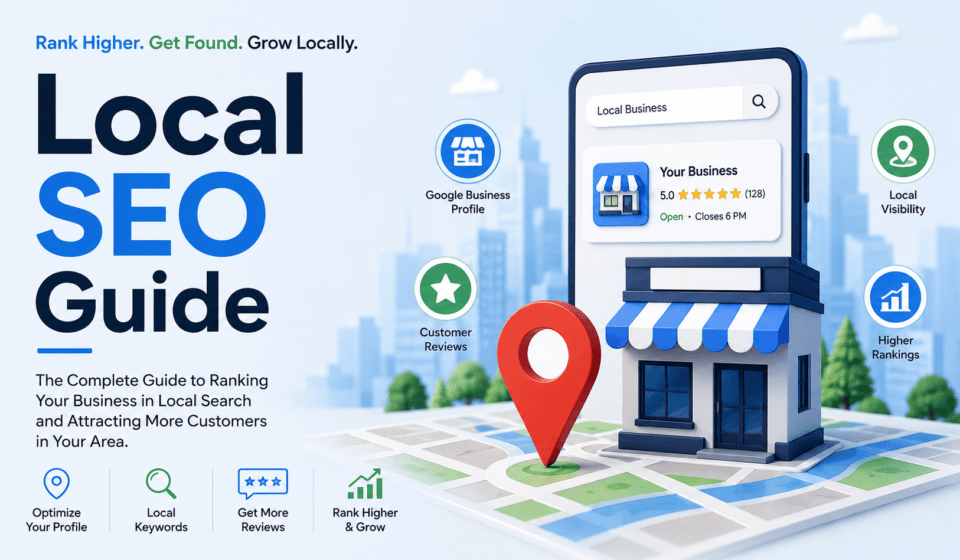

If you own a local business, getting found online by customers in your area is essential. Whether you run a restaurant, web design agency, dental clinic, training center, law firm, salon, repair service, or freelance business, potential customers are increasingly using Google to find local products and services.
This is where Local SEO comes in.
Local SEO, or Local Search Engine Optimization, is the process of optimizing your website and online presence so that your business appears prominently when people search for products or services in a specific geographic area.
For example, someone searching for “web designer near me,” “digital marketing trainer in Bogra,” or “best restaurant in Dhaka” is performing a local search. Businesses that have optimized their online presence for these searches have a better opportunity to attract those customers.
In this complete Local SEO guide, you’ll learn what Local SEO is, why it matters, how Google local search works, and the most important steps you can take to improve your local rankings.
What Is Local SEO?
Local SEO is a branch of SEO focused on improving a business’s visibility in geographically related searches.
Traditional SEO often targets searches such as:
- “How to build a website”
- “Best WordPress plugins”
- “Digital marketing strategies”
Local SEO targets searches that include a location or have local intent, such as:
- “Web designer in Bogra”
- “SEO agency near me”
- “Best restaurant in Dhaka”
- “Digital marketing trainer in Bangladesh”
- “Laptop repair shop near me”
Google tries to provide users with businesses that are relevant to their search and location. Local SEO helps your business provide Google with the information and signals it needs to understand your business, services, location, and relevance.
Why Is Local SEO Important?
Local SEO can be extremely valuable for small businesses because it helps you reach people who are actively looking for what you offer.
Imagine you operate a local web design business. Someone in your city searches for “WordPress web designer near me.” If your business appears among the top local results, that person may visit your website, call you, request a quotation, or visit your office.
Some major benefits of Local SEO include:
1. Increased Local Visibility
Local SEO can help your business appear in Google Search and Google Maps when people search for relevant services.
2. More Website Traffic
A higher position in local search results can send more targeted visitors to your website.
3. More Phone Calls and Enquiries
Local searches often have strong buying intent. Someone searching for a nearby service may be ready to contact a business.
4. Increased Foot Traffic
For businesses with physical locations, appearing in local search and Maps can encourage customers to visit.
5. Better Brand Awareness
Even when users don’t immediately contact you, repeated visibility in local search results can increase recognition and trust.
6. Competitive Advantage
A well-optimized local presence can help a small business compete with larger companies in its service area.
How Does Local SEO Work?
Google considers several factors when determining which local businesses to show for a search.
A useful way to understand local search is through three major concepts:
Relevance, distance, and prominence.
Relevance
Relevance refers to how well a business matches what the user is searching for.
For example, if someone searches for “WordPress training,” a business that clearly offers WordPress training is more relevant than a business that only offers general computer services.
Your business information, website content, categories, services, and other signals should clearly communicate what your business does.
Distance
Google considers how close a business is to the searcher or the location included in the search.
For example, when someone searches for “coffee shop near me,” Google is likely to prioritize relevant businesses located reasonably close to the user’s location.
Prominence
Prominence refers to how well-known or authoritative a business appears to be.
Factors that can contribute to prominence include online reviews, links from other websites, citations, brand mentions, website authority, and overall online presence.
Google Business Profile: The Foundation of Local SEO
One of the most important elements of Local SEO is your Google Business Profile.
A Google Business Profile allows businesses to provide important information about themselves, including:
- Business name
- Business category
- Address
- Phone number
- Website
- Opening hours
- Business description
- Services
- Photos
- Reviews
- Products, where applicable
Your profile can appear in Google Search and Google Maps, making it one of the most important assets for local businesses.
How to Optimize Your Google Business Profile
Start by claiming and verifying your business profile.
Then complete as much relevant information as possible.
Choose the Correct Primary Category
Your primary category helps Google understand what your business primarily offers.
Choose the category that most accurately represents your main business activity. You can also add relevant secondary categories when appropriate.
Keep Your Business Information Accurate
Make sure your business name, address, phone number, website, and opening hours are accurate.
Incorrect information can create confusion for both customers and search engines.
Add High-Quality Photos
Photos can make your profile more attractive and help potential customers understand your business.
Depending on your business, consider adding:
- Logo
- Exterior photos
- Interior photos
- Team photos
- Product photos
- Service photos
- Work samples
Keep your photos professional and relevant.
Add Your Services
Use the services section to explain what you offer.
For example, a digital marketing trainer might list:
- SEO Training
- WordPress Training
- Local SEO Training
- Social Media Marketing
- Website Design Training
- Freelancing Training
Keyword Research for Local SEO
Keyword research is another important part of Local SEO.
You need to discover what potential customers are actually searching for.
Instead of targeting only broad keywords such as “web design,” consider local variations such as:
- Web designer in Bogra
- Web design services in Bogra
- WordPress developer in Bogra
- Freelancing trainer in Bogra
- SEO consultant in Bogra
You can also target service-based searches that imply local intent.
Types of Local Keywords
Location-Based Keywords
These include a specific city, area, region, or neighborhood.
Examples:
- SEO agency in Dhaka
- Web designer in Chittagong
- Digital marketing trainer in Bogra
“Near Me” Keywords
Examples include:
- SEO consultant near me
- Restaurant near me
- Web designer near me
You don’t need to create unnatural pages stuffed with “near me.” Instead, build a strong local presence and clearly communicate your service area.
Service + Location Keywords
These combine your service with a location.
For example:
“WordPress training in Bogra”
This can be a highly relevant keyword if you provide WordPress training in that area.
Optimize Your Website for Local SEO
Your website should clearly communicate who you are, what you offer, and where you serve customers.
Create a Strong Homepage
Your homepage should clearly mention your primary services and location where appropriate.
For example:
“Professional Web Design and Digital Marketing Training in Bogra”
This immediately communicates the business type and geographic focus.
Avoid excessive keyword repetition. Write naturally for users first.
Create Location Pages
If your business genuinely serves multiple locations, you may create useful location-specific pages.
For example:
- Web Design Services in Bogra
- Web Design Services in Rajshahi
- Web Design Services in Dhaka
However, don’t simply copy the same page and replace the city name. Each page should contain genuinely useful, location-specific information.
You might include:
- Services available in that location
- Local customer examples
- Service areas
- Relevant FAQs
- Local testimonials
- Directions or location information
- Unique content about serving customers there
Optimize Your NAP Information
NAP stands for:
Name, Address, Phone Number
Your business information should be accurate and consistent across your important online profiles.
For example, if your business is listed as:
ABC Digital Academy
on your website, avoid using completely different business names across other major directories unless there is a legitimate reason.
Consistency helps reduce confusion and makes it easier for customers and search engines to connect different mentions of your business.
Get More Customer Reviews
Online reviews are extremely important for local businesses.
Customers often check reviews before deciding whether to contact or visit a business.
Encourage genuine customers to leave honest reviews about their experiences.
After completing a project or service, you can politely ask:
“If you were happy with our service, we’d appreciate it if you could share your experience in a Google review.”
Never buy fake reviews or create reviews yourself. Authentic customer feedback is much more valuable.
Respond to Reviews
Don’t simply collect reviews and ignore them.
Respond professionally to both positive and negative reviews.
For positive reviews, thank the customer.
For negative reviews, remain professional and try to resolve the underlying problem.
Your responses also demonstrate that you care about customer experience.
Build Local Citations
A local citation is a mention of your business’s information on another website or directory.
Citations may include your:
- Business name
- Address
- Phone number
- Website
Examples can include relevant business directories, local organizations, industry directories, chambers of commerce, and other legitimate platforms.
Focus on quality and relevance rather than quantity.
Getting listed on hundreds of low-quality websites isn’t necessarily better than having a smaller number of trustworthy, relevant citations.
Build Local Backlinks
Backlinks are links from other websites to your website.
Local backlinks can be particularly useful for strengthening your connection to a geographic area.
You might earn local links by:
- Sponsoring a legitimate local event
- Joining a local business organization
- Publishing useful local resources
- Partnering with complementary businesses
- Contributing expert articles to relevant websites
- Supporting local community projects
- Getting featured in local publications
The goal should be earning useful, relevant links rather than buying large quantities of low-quality backlinks.
Create Local Content
Content marketing can support your Local SEO strategy.
Instead of publishing only general articles, create content that is genuinely useful to people in your target area.
For example, a web designer in Bangladesh could publish:
- Best Website Design Practices for Small Businesses in Bangladesh
- How Local Businesses in Bogra Can Get More Customers Online
- Local SEO Tips for Bangladeshi Small Businesses
- How to Create a Google Business Profile
- Website Cost for Small Businesses in Bangladesh
Local content can help demonstrate expertise while targeting relevant search topics.
Use Local Business Schema Markup
Schema markup is structured data that helps search engines better understand information on your website.
For local businesses, relevant structured data may communicate information such as:
- Business name
- Address
- Phone number
- Opening hours
- Website
- Geographic information
- Business type
Implementing appropriate structured data can improve how search engines interpret your business information.
However, schema markup should accurately represent visible information on your website. Don’t add misleading or inaccurate data simply to try to influence search results.
Make Your Website Mobile-Friendly
Many local searches happen on smartphones.
A potential customer might search for a business while traveling, shopping, or looking for a nearby service.
Your website should therefore work well on mobile devices.
Check that:
- Text is easy to read
- Buttons are easy to tap
- Navigation is simple
- Pages load quickly
- Forms work correctly
- Contact information is easy to find
- The website doesn’t require unnecessary zooming
A good mobile experience can improve usability and help visitors take action.
Improve Website Speed
Website performance is important for both users and search engines.
Slow websites can frustrate visitors and increase the likelihood that they leave before contacting you.
To improve performance, consider:
- Compressing images
- Using modern image formats
- Removing unnecessary plugins
- Using reliable hosting
- Enabling browser caching
- Reducing unnecessary scripts
- Keeping WordPress and plugins updated
Always test your website after making performance changes.
Create Dedicated Contact and Location Information
Make it easy for potential customers to contact you.
Your website should clearly display relevant information such as:
- Phone number
- Email address
- Business address
- Opening hours
- Contact form
- Service area
- Directions, when appropriate
If you have a physical location, consider adding an embedded map and clear directions.
Common Local SEO Mistakes to Avoid
Local SEO doesn’t have to be complicated, but several mistakes can limit your results.
1. Keyword Stuffing
Don’t repeatedly insert the same location keyword into every sentence.
Write naturally and focus on helping users.
2. Fake Reviews
Never create fake reviews or pay people to post misleading reviews.
Authenticity matters.
3. Duplicate Location Pages
Creating dozens of nearly identical city pages can provide little value.
Only create location pages when you can provide genuinely useful information.
4. Incorrect Business Information
Incorrect phone numbers, addresses, opening hours, or business names can damage customer trust.
5. Ignoring Reviews
Reviews are an important part of the customer experience. Monitor and respond to them regularly.
6. Buying Low-Quality Backlinks
Avoid backlink packages that promise hundreds or thousands of links.
Quality and relevance are more important than raw numbers.
7. Neglecting Mobile Users
A website that works well only on desktop computers can lose valuable local customers.
A Simple Local SEO Checklist
Use this checklist to get started:
Google Business Profile
- Claim and verify your profile
- Select the correct primary category
- Add relevant secondary categories
- Complete your business information
- Add services
- Add high-quality photos
- Keep opening hours updated
- Respond to customer reviews
Website
- Include your business location naturally
- Optimize important pages
- Create useful local content
- Make your website mobile-friendly
- Improve page speed
- Add clear contact information
- Use appropriate structured data
Reputation
- Ask genuine customers for reviews
- Respond professionally to reviews
- Monitor your online reputation
- Never create fake reviews
Local Authority
- Build relevant citations
- Earn local backlinks
- Participate in legitimate local organizations
- Publish useful local resources
- Build relationships with relevant businesses
How Long Does Local SEO Take?
Local SEO is not an overnight strategy.
Some improvements may become noticeable relatively quickly, while stronger organic visibility can take months.
The timeline depends on factors such as:
- Competition
- Location
- Website authority
- Business history
- Review profile
- Content quality
- Links and citations
- Search demand
- Technical SEO
Instead of expecting immediate results, focus on building a reliable long-term online presence.
Track important metrics such as website traffic, calls, enquiries, direction requests, rankings, reviews, and conversions.
Final Thoughts
Local SEO is one of the most effective digital marketing strategies for businesses that serve a specific geographic area.
The basic principle is simple: make it easy for Google and potential customers to understand who you are, what you offer, and where you serve.
Start by creating and optimizing your Google Business Profile. Then improve your website, research local keywords, create useful location-focused content, maintain consistent business information, collect genuine customer reviews, build relevant local citations and backlinks, and provide an excellent mobile experience.
Most importantly, don’t treat Local SEO as a one-time task.
Continue updating your business information, publishing helpful content, earning legitimate reviews, improving your website, and monitoring your performance.
With consistent effort, Local SEO can help your business become more visible to people who are actively searching for your products and services in your target area.
For small businesses, freelancers, agencies, trainers, consultants, and service providers, a strong local search presence can become a valuable source of targeted traffic, leads, phone calls, and new customers.