
Launching a new website is exciting, but getting it to appear on Google can feel challenging. A new website usually has little or no authority, few backlinks, limited content, and no established search visibility. The good news is that you do not need to wait years to start ranking.
With the right SEO strategy, high-quality content, technical optimization, keyword research, and consistent promotion, a new website can gradually build visibility and attract organic traffic.
In this guide, you will learn how to rank a new website step by step, from setting up your technical SEO foundation to creating content, building backlinks, improving user experience, and measuring your results.
What Does It Mean to Rank a Website?
When someone searches for something on Google, the search engine displays a list of relevant web pages. These positions are known as search rankings.
For example, if you have a website about web design and someone searches for “best web design tips for beginners,” your goal is to have one of your pages appear among the top search results.
Higher rankings generally give your website more visibility and opportunities to receive organic visitors.
However, ranking is not simply about adding keywords to a page. Search engines consider many factors, including:
- Relevance to the search query
- Content quality
- Website usability
- Technical SEO
- Page speed
- Mobile friendliness
- Internal linking
- Backlinks and website authority
- Search intent
- Overall website trustworthiness
Therefore, ranking a new website requires a complete SEO strategy rather than a single trick.
Step 1: Choose the Right Keywords
Keyword research should be one of the first steps in your SEO strategy.
Keywords are the words and phrases people type into search engines when looking for information, products, or services.
For example, a digital marketing website might target keywords such as:
- Digital marketing for beginners
- How to learn SEO
- WordPress SEO tips
- Local SEO guide
- How to rank a new website
- Best website design practices
If your website is new, avoid focusing exclusively on highly competitive keywords.
Instead, start with long-tail keywords and low-competition search terms.
For example, “SEO” is extremely broad and competitive. A more specific phrase such as “SEO checklist for a new WordPress website” may be easier to target.
Understand Search Intent
Keyword volume is important, but search intent is equally important.
Search intent describes what the user actually wants when searching for a keyword.
Common types include:
Informational intent: The user wants to learn something.
Example: “What is technical SEO?”
Navigational intent: The user wants to find a particular website or page.
Example: “Google Search Console.”
Commercial intent: The user is researching products or services.
Example: “Best SEO tools for small businesses.”
Transactional intent: The user is ready to take an action or make a purchase.
Example: “Hire an SEO consultant.”
Choose keywords that match the purpose of your content. If you understand what searchers want, you can create pages that better satisfy their needs.
Step 2: Create a Strong Website Structure
Before publishing dozens of articles, make sure your website has a logical structure.
A good website structure helps both visitors and search engines understand your content.
For example, a digital marketing training website might have:
Home
→ Web Design
→ Digital Marketing
→ SEO
→ Freelancing
→ WordPress
→ Blog
Each major topic can have related subtopics.
Keep important pages easy to reach. Visitors should not have to click through many pages to find essential information.
Your navigation menu should be simple and organized.
Important pages may include:
- Home
- About
- Services
- Courses or Training
- Blog
- Contact
- Privacy Policy
- Terms and Conditions
A clear structure also makes internal linking easier.
Step 3: Set Up Google Search Console
One of the most important things you can do after launching a new website is connect it to Google Search Console.
Google Search Console helps website owners understand how their websites appear in Google Search.
You can use it to monitor:
- Search queries
- Impressions
- Clicks
- Average position
- Indexed pages
- Indexing problems
- Sitemap status
- Search performance
Submit your website’s XML sitemap through Search Console.
Your sitemap helps search engines discover important URLs on your website.
Remember that submitting a sitemap does not guarantee rankings. It simply helps search engines discover and understand your website more efficiently.
Step 4: Make Your Website Technically SEO-Friendly
Technical SEO is the foundation of your website’s search visibility.
A technically healthy website makes it easier for search engines to crawl, understand, and index your pages.
Check the following areas:
Mobile Friendliness
A large percentage of web traffic comes from mobile devices. Your website should work properly on smartphones and tablets.
Check that:
- Text is easy to read
- Buttons are easy to tap
- Images fit the screen
- Navigation works correctly
- Content does not overflow horizontally
Website Speed
Slow websites can create a poor user experience.
Optimize your website by:
- Compressing images
- Using modern image formats where appropriate
- Removing unnecessary plugins
- Using reliable hosting
- Minimizing unnecessary scripts
- Using browser caching
- Optimizing CSS and JavaScript
Do not sacrifice usability simply to achieve a perfect speed score. Focus on creating a fast and useful experience for real visitors.
HTTPS
Your website should use HTTPS rather than HTTP.
An SSL certificate helps protect information transferred between users and your website and is an essential part of a modern website.
Clean URLs
Use short, descriptive URLs.
For example:
Good:
example.com/how-to-rank-a-new-website/
Less useful:
example.com/page?id=12345
A descriptive URL can help users understand what a page is about.
Step 5: Create High-Quality Content
Content is one of the most important parts of SEO.
However, publishing hundreds of low-quality articles is not a good strategy.
Instead, create content that genuinely helps your target audience.
A good article should:
- Answer the user’s question
- Be easy to read
- Provide useful examples
- Be logically organized
- Use headings and subheadings
- Include relevant images when useful
- Provide accurate information
- Avoid unnecessary repetition
- Offer something valuable to the reader
Think about your audience before writing.
If your website targets beginner freelancers, for example, your content should explain complicated concepts in simple language.
Step 6: Build Topic Authority
Instead of writing random articles about unrelated subjects, organize your content around important topics.
This is often called topical authority.
For example, if your main topic is SEO, you could create a content cluster containing:
- What Is SEO?
- How Search Engines Work
- Keyword Research for Beginners
- On-Page SEO Guide
- Technical SEO Guide
- Local SEO Guide
- Internal Linking Guide
- SEO Content Writing
- How to Build Backlinks
- How to Measure SEO Results
Then connect these articles using internal links.
This creates a useful resource around the topic and helps visitors discover related information.
Step 7: Optimize Your Pages for On-Page SEO
Every important page should be properly optimized.
Start with your page title.
Your title should clearly communicate what the page is about and naturally include the primary keyword when appropriate.
For example:
How to Rank a New Website: Complete SEO Guide
is more descriptive than:
My SEO Tips
Optimize Your Headings
Use headings to organize your content.
Your main title should generally use an H1 heading, while major sections can use H2 headings and supporting sections can use H3 headings.
Do not force keywords into every heading. Make headings useful for readers first.
Optimize Meta Descriptions
A meta description summarizes your page in search results.
Write a compelling description that explains what users will learn or gain from visiting your page.
For example:
“Learn how to rank a new website with keyword research, technical SEO, quality content, backlinks, and a practical SEO strategy.”
A strong meta description can encourage more people to click your result.
Step 8: Use Internal Links
Internal links connect one page on your website to another page on the same website.
For example, an article about website design could link to another article about responsive web design.
Internal linking helps visitors discover additional content and helps search engines understand relationships between pages.
When adding internal links, use descriptive anchor text.
Instead of:
“Click here.”
Use:
“Learn how responsive web design works.”
Create internal links naturally where they provide additional value.
Step 9: Build Quality Backlinks
Backlinks are links from other websites to your website.
They can help search engines understand that other websites find your content useful or trustworthy.
However, not all backlinks are equally valuable.
One relevant, editorially earned link from a respected website can be more valuable than many low-quality links.
Focus on earning backlinks through:
- Helpful original content
- Guest contributions on relevant websites
- Industry resources
- Digital PR
- Useful guides
- Original research
- Statistics and data
- Expert interviews
- Business directories relevant to your location or industry
Avoid buying large numbers of low-quality backlinks or participating in spammy link schemes.
The goal should be quality, relevance, and natural growth.
Step 10: Promote Your Content
Do not simply publish an article and forget about it.
Promote your best content through appropriate channels.
You can share useful articles on:
- X
- Relevant online communities
- Industry forums
- Email newsletters
- Professional networks
If your content is genuinely useful, promotion can help it reach people who may reference or link to it.
Social media activity itself should not be treated as a guaranteed direct ranking factor. Think of social promotion primarily as a way to increase visibility and attract potential readers.
Step 11: Focus on Local SEO if You Serve a Local Market
If you operate a local business, local SEO can be extremely important.
For example, if you provide web design or digital marketing services in a particular city, create useful location-focused pages where appropriate.
Optimize your business information consistently across relevant platforms.
A Google Business Profile can also help eligible local businesses appear in local search and Maps.
Create content that answers local customer questions instead of simply repeating the city name throughout your pages.
For example:
- Web design services in your city
- Digital marketing for local businesses
- Local SEO tips for small businesses
- Website design pricing in your area
Local relevance should be genuine and useful.
Step 12: Improve User Experience
SEO is not only about search engines.
Your website must also satisfy real visitors.
Ask yourself:
- Can visitors quickly understand what the website offers?
- Is the navigation easy?
- Are important buttons easy to find?
- Is the content readable?
- Does the website work well on mobile?
- Are intrusive pop-ups distracting users?
- Can visitors easily contact you?
- Are pages loading quickly?
A visitor who arrives on your website and immediately leaves because the site is confusing or difficult to use is unlikely to become a customer.
Build your website for people first.
Step 13: Update Your Existing Content
SEO does not end when an article is published.
Over time, information changes. New competitors appear. Search intent can change. Your content can become outdated.
Review your important pages periodically.
Update:
- Statistics
- Examples
- Screenshots
- Links
- Outdated information
- Product information
- Recommendations
- Titles when necessary
Do not update content simply to change the publication date. Make meaningful improvements that increase its usefulness.
Step 14: Track Your SEO Performance
You cannot improve what you do not measure.
Use tools such as Google Search Console and analytics software to monitor your website.
Pay attention to:
- Organic traffic
- Impressions
- Click-through rate
- Search queries
- Ranking trends
- Indexed pages
- Top-performing articles
- Pages losing traffic
- Conversion rates
Do not panic if your website does not rank immediately.
SEO often takes time, especially for a new domain.
Instead of checking rankings every few hours, focus on long-term trends.
Step 15: Be Patient and Consistent
One of the biggest SEO mistakes beginners make is expecting immediate results.
A new website has to establish credibility and compete against websites that may have existed for many years.
Your progress may look something like this:
Month 1: Technical setup, keyword research, and initial content.
Month 2–3: Publish useful articles and improve internal linking.
Month 3–6: Continue content creation, promotion, and link building.
Month 6+: Analyze performance, update successful content, expand into related keywords, and strengthen authority.
These are only general expectations. SEO results vary significantly depending on competition, industry, website quality, content, links, search demand, and many other factors.
Common SEO Mistakes to Avoid
If you are trying to rank a new website, avoid these common mistakes:
Keyword Stuffing
Do not repeat the same keyword unnaturally throughout an article.
Write naturally and cover the topic comprehensively.
Publishing AI or Low-Quality Content Without Review
Using AI tools can help with research, outlining, and drafting, but automatically publishing generic content without fact-checking or adding value can produce poor results.
Review, edit, fact-check, and improve every article.
Buying Spammy Backlinks
Thousands of cheap backlinks are not a shortcut to sustainable rankings.
Focus on earning relevant and trustworthy links.
Ignoring Mobile Users
A website that looks great on desktop but is difficult to use on mobile can lose potential visitors.
Creating Duplicate Content
Avoid creating multiple pages targeting nearly identical keywords when they do not serve distinct user needs.
Ignoring Search Intent
A perfectly optimized article can still struggle if it does not answer the question behind the search.
Always ask: What does the searcher actually want?
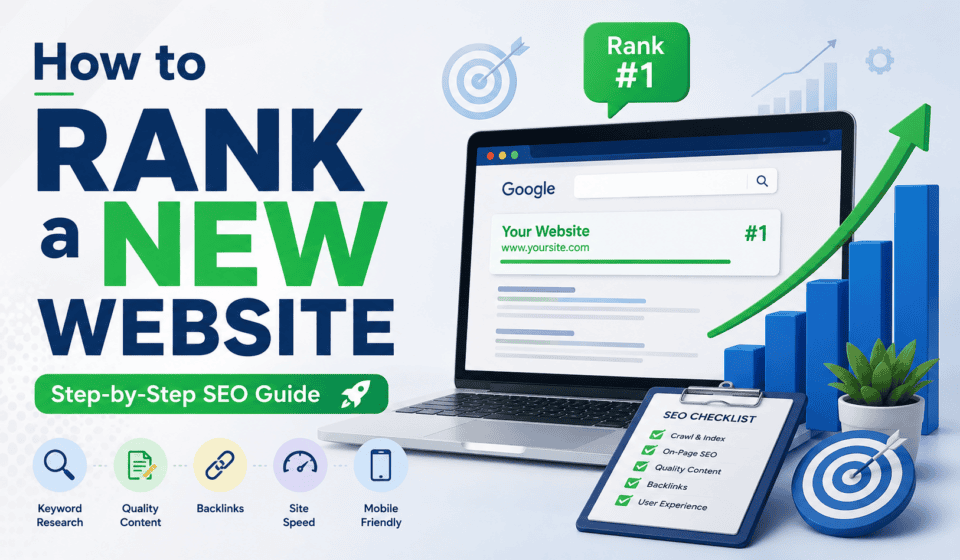
A Simple SEO Checklist for a New Website
Use this checklist when launching your website:
☐ Choose a clear website niche
☐ Research relevant keywords
☐ Understand search intent
☐ Create a logical website structure
☐ Set up Google Search Console
☐ Submit your XML sitemap
☐ Make the website mobile-friendly
☐ Improve page speed
☐ Enable HTTPS
☐ Create useful core pages
☐ Publish high-quality content
☐ Optimize titles and headings
☐ Write useful meta descriptions
☐ Create descriptive URLs
☐ Add internal links
☐ Build relevant backlinks
☐ Promote your content
☐ Optimize for local search if relevant
☐ Monitor SEO performance
☐ Update important content
☐ Continue improving consistently
Final Thoughts
Ranking a new website on Google is not about finding one secret SEO trick. It is about building a website that consistently provides value to users while making it easy for search engines to crawl, understand, and discover your content.
Start with a strong technical foundation. Research keywords carefully. Understand search intent. Publish genuinely useful content. Build a logical internal linking structure. Earn relevant backlinks. Improve your website experience and measure your results.
Most importantly, be consistent.
A new website may not reach the first page of Google overnight, but every useful article, every technical improvement, every relevant backlink, and every better user experience can contribute to long-term growth.
SEO is a long-term investment. Build your website for people first, follow sound search engine optimization practices, and give your website enough time and consistent effort to grow.