
Search engine optimization (SEO) is one of the most effective ways to increase website visibility, attract organic traffic, and reach potential customers without relying entirely on paid advertising. However, SEO is not simply about adding keywords to a webpage and waiting for Google to rank it. Search engines consider hundreds of signals when determining which pages deserve to appear in search results.
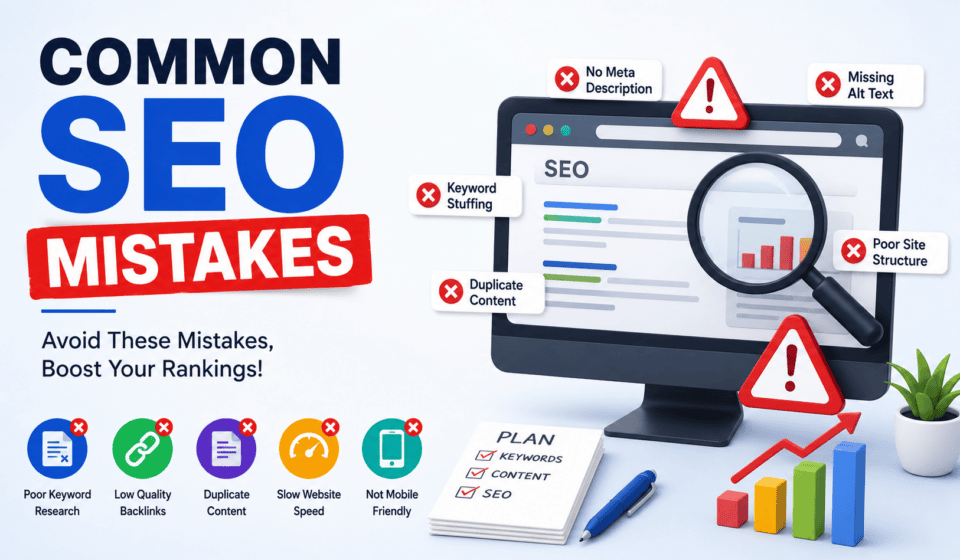
Many website owners, bloggers, freelancers, and beginners make SEO mistakes that prevent their websites from reaching their full potential. Some mistakes are technical, while others involve content, keywords, links, user experience, or unrealistic expectations.
The good news is that most common SEO mistakes can be identified and fixed. In this guide, we’ll explore 15 common SEO mistakes, explain why they matter, and show you how to avoid them.
What Is SEO?
SEO, or Search Engine Optimization, is the process of improving a website and its content so that search engines can understand, index, and rank it more effectively.
A successful SEO strategy usually includes several areas, including:
- Keyword research
- Helpful content creation
- On-page SEO
- Technical SEO
- Internal linking
- Backlink building
- Mobile optimization
- Website speed
- User experience
- Local SEO
SEO is a long-term strategy. Instead of looking for shortcuts, website owners should focus on creating a useful, trustworthy, technically sound website that satisfies what people are searching for.
Let’s look at the most common mistakes you should avoid.
1. Choosing the Wrong Keywords
One of the biggest SEO mistakes beginners make is targeting the wrong keywords.
Some people choose keywords simply because they have a high search volume. However, high-volume keywords are often extremely competitive and may not match the website’s audience or business goals.
For example, a new web design freelancer might try to rank for a broad keyword such as “web design.” Competing against large agencies and established websites could be extremely difficult.
Instead, a more specific keyword such as “affordable WordPress web designer for small businesses” may attract a more relevant audience.
How to avoid this mistake
Research keywords based on:
- Search intent
- Relevance to your business
- Competition
- Search volume
- Your target audience
- Commercial value
Don’t focus only on how many people search for a keyword. Focus on whether those people are likely to need what you offer.
2. Keyword Stuffing
Keyword stuffing means using the same keyword excessively in an attempt to manipulate search rankings.
For example, a poorly optimized paragraph might repeatedly use a phrase like “best web designer in Bangladesh” even when the keyword makes the content difficult to read.
Search engines have become much better at understanding language and context. Repeating a keyword unnecessarily can make content look unnatural and provide a poor user experience.
How to avoid keyword stuffing
Use your primary keyword naturally and include related terms where appropriate. Write primarily for people rather than search engines.
Instead of repeating one keyword dozens of times, answer the reader’s questions comprehensively.
Good SEO content should sound natural.
3. Creating Thin or Low-Quality Content
Publishing content simply to increase the number of pages on your website is another common SEO mistake.
Thin content provides little value to visitors. It may be very short, repetitive, poorly researched, or unable to answer the searcher’s question.
For example, publishing ten short articles that provide almost identical information is generally less useful than creating a few comprehensive resources that genuinely help your audience.
How to avoid this mistake
Before publishing an article, ask:
- Does this answer the user’s question?
- Is the information useful?
- Does it provide enough detail?
- Is it accurate and original?
- Can the reader take action based on it?
- Does it offer something better than competing pages?
Focus on quality rather than publishing large quantities of low-value content.
4. Ignoring Search Intent
Search intent refers to the reason behind a person’s search.
Someone searching for “what is SEO” probably wants an explanation. Someone searching for “best SEO tools” may be comparing products. Someone searching for “buy SEO service” has stronger commercial intent.
If your content doesn’t match the searcher’s intent, it may struggle to perform well even if you use the right keyword.
How to avoid this mistake
Before writing an article, search your target keyword and examine the types of pages appearing in the results.
Determine whether users are looking for:
- Information
- Tutorials
- Product comparisons
- Reviews
- Services
- Products
- Local businesses
Then create content that satisfies that intent.
5. Writing Poor Title Tags and Meta Descriptions
Your title tag and meta description are important because they help users understand what your page is about in search results.
A vague title such as “Home” or “Our Services” provides very little context.
A better title clearly communicates the topic and value of the page.
For example:
Poor:
SEO Tips
Better:
15 Practical SEO Tips to Improve Your Website Rankings
Your meta description should also clearly summarize the page and encourage relevant users to click.
How to avoid this mistake
Create a unique title and meta description for important pages. Include the main topic naturally and make the description useful and compelling.
Avoid keyword stuffing and avoid writing descriptions that don’t accurately represent the page.
6. Ignoring On-Page SEO
On-page SEO includes the elements you can optimize directly on your webpage.
Common on-page SEO elements include:
- Page title
- Headings
- URL
- Content
- Images
- Internal links
- Image alt text
- Meta description
- Content structure
Some beginners focus heavily on backlinks while ignoring the quality and structure of their own website.
How to avoid this mistake
Create a simple on-page SEO checklist for every important page. Make sure the content is well organized, the primary topic is clear, headings are descriptive, and internal links help visitors discover related information.
7. Using Poor URL Structures
Long, confusing URLs can make pages harder for users to understand.
For example:
example.com/page?id=12345&category=7
is less descriptive than:
example.com/seo-mistakes/
A clear URL helps communicate the topic of the page.
How to avoid this mistake
Keep URLs:
- Short
- Descriptive
- Relevant
- Easy to read
Use words that describe the page rather than unnecessary numbers, symbols, or parameters whenever possible.
8. Ignoring Mobile SEO
A large portion of internet users browse websites using smartphones and tablets. If your website looks good on a desktop computer but is difficult to use on mobile devices, you may lose visitors and potential customers.
Common mobile problems include:
- Tiny text
- Buttons that are difficult to tap
- Horizontal scrolling
- Slow-loading pages
- Poorly designed menus
- Content that doesn’t fit the screen
How to avoid this mistake
Use responsive web design and test your website on different screen sizes.
Make sure visitors can easily:
- Read your content
- Navigate your website
- Click buttons
- Complete forms
- Find important information
Mobile usability should be considered from the beginning of the design process.
9. Having a Slow Website
Website speed affects user experience. Visitors are less likely to stay on a website if pages take too long to load.
Slow websites can be caused by:
- Large images
- Poor hosting
- Excessive plugins
- Unoptimized code
- Unnecessary scripts
- Poor caching
- Heavy themes
How to avoid this mistake
Improve performance by:
- Compressing images
- Using modern image formats where appropriate
- Removing unnecessary plugins
- Enabling caching
- Optimizing website code
- Using reliable hosting
- Limiting unnecessary third-party scripts
Regularly test important pages and identify performance problems.
10. Ignoring Internal Links
Internal links connect one page of your website to another page on the same website.
For example, an article about SEO mistakes could link to related articles about keyword research, on-page SEO, website speed, or content marketing.
Internal links help visitors discover related content and can help search engines understand the structure and relationships between your pages.
How to avoid this mistake
Whenever you publish a new article, look for relevant older content that you can link to.
Also review older articles and add links to newer relevant pages.
Use descriptive anchor text instead of generic phrases such as “click here.”
11. Building Low-Quality Backlinks
Backlinks are links from other websites to your website. They can be valuable, but not every backlink is useful.
Some website owners try to build hundreds or thousands of backlinks through spammy directories, automated services, irrelevant websites, or link schemes.
This approach can waste time and may create a poor backlink profile.
How to avoid this mistake
Focus on earning relevant, high-quality links.
You can attract backlinks by creating:
- Original research
- Useful guides
- Statistics
- Case studies
- Infographics
- Expert resources
- Helpful tools
- High-quality tutorials
A smaller number of relevant links can be more valuable than a huge collection of low-quality links.
12. Forgetting Image SEO
Images are an important part of modern websites, but many website owners upload huge images without optimization.
Large images can slow down pages, while poorly named images and missing alternative text can make content less accessible and harder to understand.
How to avoid this mistake
Optimize your images by:
- Compressing them
- Choosing appropriate dimensions
- Using descriptive filenames
- Adding useful alt text where appropriate
- Avoiding unnecessarily large image files
For example, instead of:
IMG12345.jpg
use something descriptive such as:
seo-content-strategy.jpg
Alt text should describe the image when alternative text is needed, rather than simply stuffing keywords into the field.
13. Not Fixing Broken Links and 404 Errors
Broken links create a frustrating experience for visitors. A user may click a link expecting useful information and instead encounter a missing page.
Broken internal links can also make website maintenance more difficult.
How to avoid this mistake
Regularly check your website for:
- Broken internal links
- Broken external links
- Deleted pages
- Incorrect URLs
- Redirect problems
If you permanently move a page, use an appropriate redirect rather than leaving users with a dead link.
However, don’t redirect every missing page to your homepage without considering relevance. The destination should make sense for the original URL.
14. Publishing Duplicate Content
Duplicate or highly similar content can create confusion about which page should be considered the primary version.
For example, an online store might accidentally create multiple URLs showing essentially the same product or category content.
Duplicate content can also happen when website owners copy articles from other websites or publish slightly modified versions of the same article across multiple URLs.
How to avoid this mistake
Create original content whenever possible.
For similar pages, review your website structure and use appropriate canonicalization, redirects, or consolidation strategies when necessary.
The goal is to make it clear which version of a page is the main resource.
15. Expecting Instant SEO Results
Perhaps the biggest SEO mistake is expecting results immediately.
SEO usually takes time. A new website may need months of consistent work before it establishes strong organic visibility, depending on the industry, competition, website quality, content, authority, and many other factors.
Some people publish a few articles, wait several weeks, and conclude that SEO doesn’t work.
How to avoid this mistake
Treat SEO as a long-term marketing strategy.
Track meaningful metrics such as:
- Organic traffic
- Search impressions
- Search clicks
- Keyword visibility
- Conversions
- Leads
- Engagement
- Indexed pages
Use the data to identify what is working and what needs improvement.
SEO Mistakes to Avoid: Quick Checklist
Before publishing or optimizing a webpage, use this checklist:
Keyword Research
- Choose relevant keywords.
- Understand search intent.
- Consider competition.
- Don’t target keywords solely because they have high search volume.
Content
- Create useful, original content.
- Answer the user’s question.
- Avoid keyword stuffing.
- Keep information accurate and up to date.
On-Page SEO
- Write a descriptive title.
- Create a useful meta description.
- Use logical headings.
- Optimize URLs.
- Add relevant internal links.
Technical SEO
- Make the website mobile-friendly.
- Improve page speed.
- Fix broken links.
- Make sure important pages can be crawled and indexed.
- Maintain a clean website structure.
Off-Page SEO
- Focus on relevant, high-quality backlinks.
- Avoid spammy link-building schemes.
- Build content that people naturally want to reference.
How to Improve Your SEO Strategy
Avoiding mistakes is only the beginning. A successful SEO strategy requires consistent improvement.
Start by auditing your website. Identify technical problems, weak pages, missing keywords, poor internal linking, slow pages, and outdated content.
Next, prioritize the problems that can have the greatest impact.
For example, fixing a website-wide technical problem may be more valuable than spending hours adjusting a single meta description.
After making improvements, monitor your results. SEO data can help you understand which pages are attracting visitors, which search queries are generating impressions, and where opportunities exist.
You should also update your content regularly. Search behavior changes, competitors publish new content, and information can become outdated.
Final Thoughts
SEO mistakes can prevent an otherwise excellent website from reaching its full potential. From choosing the wrong keywords and stuffing content with keywords to ignoring mobile optimization, website speed, internal links, and search intent, small problems can add up over time.
The solution isn’t to search for an SEO shortcut. Instead, focus on building a website that is useful, fast, accessible, technically sound, and genuinely helpful to its visitors.
Start with the fundamentals: understand your audience, research relevant topics, create high-quality content, optimize your pages, improve your technical SEO, build meaningful internal links, and earn relevant backlinks.
Most importantly, remember that SEO is a long-term process. Consistency, quality, and continuous improvement are more valuable than trying to manipulate search engines.
If you avoid these common SEO mistakes and focus on providing a great experience for your audience, you can build a stronger foundation for sustainable organic search growth.
Frequently Asked Questions About SEO Mistakes
What is the most common SEO mistake?
One of the most common SEO mistakes is creating content without understanding search intent. Even well-written content may struggle if it doesn’t provide the type of information users are looking for.
Does keyword stuffing improve Google rankings?
No. Keyword stuffing makes content unnatural and can create a poor user experience. Keywords should be used naturally while focusing on providing useful information.
How long does SEO take to work?
SEO timelines vary depending on competition, website authority, content quality, technical health, and many other factors. New websites should generally expect SEO to require consistent effort over an extended period rather than immediate results.
Are backlinks still important for SEO?
Relevant, high-quality backlinks can contribute to a website’s authority and visibility. However, building large numbers of low-quality or manipulative links is not a good SEO strategy.
Should I update old blog posts?
Yes. Reviewing and updating older content can be useful when information has changed, the article is outdated, or there are opportunities to improve its usefulness, structure, internal links, and accuracy.