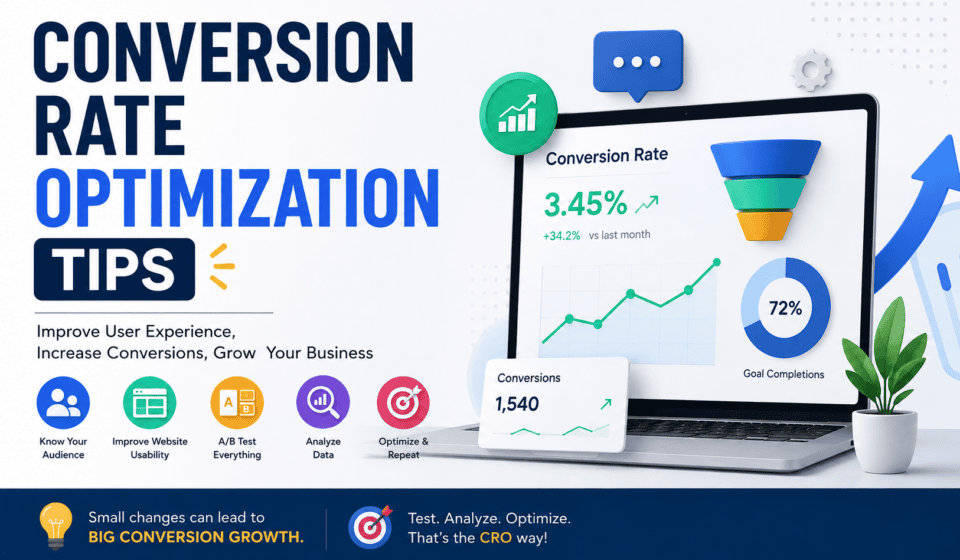

Getting visitors to your website is only half the battle. The real challenge is turning those visitors into leads, subscribers, customers, or clients. This is where Conversion Rate Optimization (CRO) becomes essential.
You may have a beautiful website with excellent traffic, but if visitors leave without taking action, your marketing efforts are not reaching their full potential. Conversion Rate Optimization helps you understand what prevents visitors from taking action and improves your website so more users complete your desired goals.
In this guide, you’ll learn practical Conversion Rate Optimization tips that can help you increase conversions, improve user experience, build trust, and get more value from your existing website traffic.
What Is Conversion Rate Optimization?
Conversion Rate Optimization (CRO) is the process of improving a website or landing page to encourage a higher percentage of visitors to complete a desired action.
A conversion can be anything that is important to your business, such as:
- Making a purchase
- Filling out a contact form
- Booking an appointment
- Requesting a quote
- Signing up for a newsletter
- Downloading an ebook
- Registering for a course
- Creating an account
- Calling your business
- Clicking an important button
For example, if 1,000 people visit your landing page and 50 complete your desired action, your conversion rate is 5%.
The goal of CRO is not simply to get more traffic. Instead, it focuses on making your existing traffic more valuable by helping more visitors take action.
Why Is Conversion Rate Optimization Important?
Many businesses spend a significant amount of money and effort attracting website visitors through SEO, social media, paid advertising, email marketing, and content marketing.
However, increasing traffic does not automatically increase revenue.
Imagine two websites:
- Website A receives 10,000 visitors and converts 1% of them.
- Website B receives 5,000 visitors and converts 4% of them.
Website B receives half the traffic but may generate significantly more leads or sales.
This is why CRO is so important.
Effective conversion optimization can help you:
- Generate more leads
- Increase sales
- Reduce wasted advertising spending
- Improve user experience
- Increase customer confidence
- Get more value from existing traffic
- Identify problems with your website
- Improve landing-page performance
Instead of constantly trying to attract more visitors, CRO helps you make better use of the visitors you already have.
15 Effective Conversion Rate Optimization Tips
1. Define Your Conversion Goal
Before optimizing your website, determine exactly what you want visitors to do.
A website can have multiple goals, but every important page should have a primary conversion objective.
For example:
- An ecommerce product page may focus on purchases.
- A service page may focus on quote requests.
- A blog may focus on email subscriptions.
- A course page may focus on enrollment.
- A portfolio page may focus on consultation bookings.
Without a clearly defined goal, it becomes difficult to measure whether your optimization efforts are working.
Ask yourself:
“What is the most valuable action a visitor can take on this page?”
Build the page around that action.
2. Create Clear and Compelling Calls to Action
Your call-to-action (CTA) tells visitors what to do next.
Weak CTAs such as “Submit,” “Click Here,” or “Learn More” may not communicate enough value.
Instead, make your CTA specific and action-oriented.
For example:
- “Get My Free Quote”
- “Start Learning Today”
- “Book Your Free Consultation”
- “Download the Free Guide”
- “Create My Account”
- “Get Started Now”
A strong CTA should clearly communicate both the action and, when possible, the benefit.
Make sure your primary CTA is visually noticeable without making the page look cluttered.
3. Write Stronger Headlines
Your headline is often one of the first things visitors see.
If your headline is confusing, generic, or irrelevant to the visitor’s needs, they may leave immediately.
A good headline should quickly answer:
What is this page about, and why should I care?
Instead of:
“Professional Digital Marketing Services”
Consider something more benefit-focused:
“Get More Customers With a Results-Driven Digital Marketing Strategy”
The second headline communicates a potential outcome rather than simply describing a service.
Test different headlines to determine which one connects best with your audience.
4. Focus on Benefits, Not Just Features
One of the most common website mistakes is focusing too heavily on features.
Features explain what something has.
Benefits explain what the customer gets from it.
For example:
Feature:
“Includes 20 online training modules.”
Benefit:
“Learn practical digital marketing skills through 20 step-by-step training modules.”
Visitors usually care more about how your product or service will improve their situation than about a list of technical specifications.
When writing website copy, ask:
“How does this help my customer?”
Then communicate that benefit clearly.
5. Simplify Your Website Design
A complicated website can create friction.
If visitors have too many choices, excessive animations, confusing menus, or distracting elements, they may struggle to find what they need.
Good CRO often involves removing unnecessary elements.
Use:
- Clear navigation
- Simple layouts
- Readable typography
- Consistent spacing
- Logical sections
- Strong visual hierarchy
- Relevant images
- Clearly identifiable buttons
Your website should guide visitors naturally toward the desired action.
Remember: Every unnecessary distraction can compete with your conversion goal.
6. Improve Your Website Loading Speed
Website speed has a major impact on user experience.
If a page takes too long to load, visitors may leave before seeing your offer.
To improve website performance:
- Compress images
- Use modern image formats
- Remove unnecessary plugins
- Minify CSS and JavaScript where appropriate
- Use reliable hosting
- Enable browser caching
- Reduce unnecessary scripts
- Use a content delivery network when appropriate
- Keep website themes and plugins updated
Speed optimization is particularly important for mobile visitors, where slow connections can make performance problems even more noticeable.
7. Make Your Website Mobile-Friendly
A large portion of website traffic comes from mobile devices.
A page that looks excellent on a desktop but is difficult to use on a smartphone can lose valuable conversions.
Check your website on different screen sizes.
Make sure:
- Text is easy to read
- Buttons are large enough to tap
- Forms are easy to complete
- Images scale properly
- Navigation works correctly
- Important information appears without excessive scrolling
- Pop-ups do not interfere with the experience
Responsive web design is no longer optional. Your conversion strategy should consider mobile users from the beginning.
8. Build Trust With Social Proof
Visitors may hesitate to buy from or contact a business they don’t know.
Social proof can reduce this hesitation.
Examples include:
- Customer testimonials
- Reviews
- Case studies
- Client logos
- Ratings
- Before-and-after results
- Success stories
- Number of customers served
- Industry certifications
Instead of simply telling visitors that your service is excellent, show evidence that other people have had a positive experience.
For example:
“The course helped me understand digital marketing and get my first freelance clients.”
Specific testimonials are generally more persuasive than vague statements such as:
“Great service!”
Whenever possible, include real customer experiences and measurable results.
9. Use High-Quality Visuals
Images and videos can significantly influence how visitors perceive your website.
However, visuals should support your message rather than simply decorate the page.
Use images that:
- Demonstrate your product
- Show your service in action
- Explain a process
- Introduce your team
- Demonstrate results
- Help visitors understand your offer
For ecommerce websites, product images should be clear and detailed.
For service businesses, professional photographs and videos can help establish credibility.
Avoid using irrelevant stock images that add no value to the page.
10. Simplify Your Forms
Long or complicated forms can reduce conversions.
If you only need a visitor’s name and email address, don’t ask for unnecessary information.
For example, instead of asking for:
- Full name
- Date of birth
- Company size
- Job title
- Address
- Phone number
- Website
- Multiple questions
you may only need:
- Name
- Message
The ideal form length depends on the purpose and value of the offer.
For high-value services, asking for additional information may be reasonable. For a simple newsletter subscription, a short form is usually better.
11. Address Customer Objections
Visitors often have questions or concerns before taking action.
For example:
- Is this worth the price?
- Is it suitable for beginners?
- Can I get a refund?
- How long does delivery take?
- Is this service reliable?
- What happens after I submit the form?
- Is my information secure?
If your website doesn’t answer these questions, visitors may leave to search for answers elsewhere.
Create sections that address common objections.
An FAQ section can be particularly useful for reducing uncertainty and helping visitors make decisions.
12. Use A/B Testing
A/B testing involves comparing two versions of a page or element to determine which performs better.
For example, you could test:
Version A:
“Get Started”
Version B:
“Start Your Free Trial”
You could also test:
- Headlines
- CTA buttons
- Images
- Form layouts
- Pricing presentation
- Page structure
- Testimonials
- Product descriptions
The important thing is to test one meaningful change at a time when possible and use enough data to make a reasonable decision.
Don’t assume that a change will improve conversions simply because it looks better to you.
Let user behavior and data guide your decisions.
13. Use Analytics to Understand Visitor Behavior
CRO should be based on evidence rather than guesswork.
Analytics can help you understand:
- Where visitors come from
- Which pages they visit
- How long they stay
- Where they leave
- Which devices they use
- Which pages generate conversions
- Which traffic sources perform best
You can also use tools that provide heatmaps, session recordings, and user behavior insights.
For example, if many users visit your pricing page but very few proceed to checkout, the pricing page may contain a conversion problem worth investigating.
Data helps you identify where optimization efforts are likely to have the greatest impact.
14. Reduce Friction Throughout the Customer Journey
Friction refers to anything that makes it harder for visitors to complete an action.
Common examples include:
- Too many form fields
- Confusing navigation
- Unexpected costs
- Slow-loading pages
- Complicated checkout processes
- Unclear pricing
- Required account creation
- Broken links
- Poor mobile usability
- Lack of trust signals
Walk through your website as if you were a new customer.
Ask yourself:
“What could make me hesitate or stop here?”
Then remove or improve those obstacles.
Even small improvements can make the customer journey smoother.
15. Continuously Improve Your Website
CRO is not a one-time project.
Customer expectations, competitors, technology, devices, and online behavior constantly change.
After implementing an improvement, monitor the results.
If performance improves, identify why.
If performance decreases, investigate what happened.
Then continue testing.
A useful CRO process looks like this:
Research → Identify Problems → Create a Hypothesis → Test → Analyze Results → Improve → Repeat
This creates a continuous improvement cycle.
Common Conversion Rate Optimization Mistakes
While implementing CRO strategies, avoid these common mistakes.
Optimizing Without Data
Don’t change important elements simply because you personally prefer another design.
Use analytics, customer feedback, usability testing, and experiments whenever possible.
Making Too Many Changes at Once
If you change the headline, CTA, layout, pricing, images, and form simultaneously, it becomes difficult to determine which change affected performance.
Copying Competitors
A strategy that works for another website may not work for your audience.
Use competitor research for inspiration, but make decisions based on your own customers and data.
Ignoring Mobile Users
A desktop-focused website can lose conversions if mobile visitors have difficulty navigating or completing forms.
Using Too Many Pop-Ups
Pop-ups can sometimes generate leads, but excessive interruptions can damage user experience.
Use them strategically and make sure they provide genuine value.
Focusing Only on Button Colors
Changing a button from one color to another may sometimes help, but CRO is much bigger than button design.
Your offer, messaging, trust, user experience, pricing, and customer journey often matter far more.
How to Create a Simple CRO Strategy
If you’re new to conversion optimization, don’t try to change everything at once.
Start with a simple process.
Step 1: Choose One Important Page
Start with a page that already receives meaningful traffic.
This might be your:
- Homepage
- Landing page
- Product page
- Service page
- Pricing page
Step 2: Identify the Main Conversion
Determine what action you want visitors to take.
Step 3: Analyze User Behavior
Review analytics, user feedback, heatmaps, and other available data.
Step 4: Find Friction
Look for confusing content, weak CTAs, slow loading times, unnecessary form fields, missing trust signals, or other obstacles.
Step 5: Create a Hypothesis
For example:
“If we make the CTA more specific and benefit-focused, more visitors will click it.”
Step 6: Test the Change
Use A/B testing or another suitable testing method.
Step 7: Measure the Results
Compare the new version against the previous version.
Step 8: Repeat
Use what you learn to develop the next improvement.
Final Thoughts
Conversion Rate Optimization is one of the most effective ways to improve website performance without relying entirely on increasing traffic.
A successful CRO strategy combines good design, persuasive copywriting, strong calls to action, trust signals, fast performance, mobile usability, analytics, and continuous testing.
The most important thing to remember is that CRO is about the visitor. Your goal isn’t simply to convince someone to click a button. Your goal is to make it easier for the right visitor to understand your offer, trust your business, and confidently take the next step.
Start with one important page. Identify one problem. Make one meaningful improvement. Measure the result.
Then keep improving.
Over time, these small improvements can create a significant difference in leads, sales, and overall business growth.
The goal of CRO isn’t simply to get more visitors. It’s to get more value from the visitors you already have.