
Marketing funnels are one of the most important concepts in digital marketing. Whether you are a freelancer, business owner, blogger, coach, or aspiring digital marketer, understanding how a marketing funnel works can help you attract the right audience, build trust, generate leads, and increase sales.
Many businesses focus only on getting more website visitors. However, traffic alone does not guarantee sales. A successful marketing strategy guides people through different stages—from discovering your brand to becoming a customer and eventually a loyal advocate.
In this guide, you will learn what a marketing funnel is, how it works, its different stages, examples of marketing funnels, and how you can create one for your own business.
What Is a Marketing Funnel?
A marketing funnel is a step-by-step process that describes how a potential customer moves from first discovering a business to eventually making a purchase.
It is called a “funnel” because a business may attract a large number of people at the beginning, but only a percentage of those people will become leads, customers, and loyal clients.
For example:
1,000 website visitors → 300 interested prospects → 100 leads → 30 customers → 10 loyal customers
The exact numbers will vary depending on the business, industry, offer, and marketing strategy.
The purpose of a marketing funnel is to understand your customer’s journey and provide the right information or offer at each stage.
Instead of trying to sell immediately to everyone, you gradually build awareness, interest, trust, and confidence.
Why Is a Marketing Funnel Important?
A marketing funnel helps businesses understand what happens between attracting a potential customer and making a sale.
Without a funnel, your marketing efforts may feel disconnected. You might publish social media posts, run advertisements, write blog articles, send emails, and build landing pages without understanding how these activities work together.
A funnel connects these activities.
1. It Helps You Understand Your Audience
People have different levels of awareness.
Someone who has never heard of your business is different from someone who has already visited your pricing page.
A funnel helps you create different messages for different audiences.
2. It Improves Lead Generation
Instead of asking every visitor to buy immediately, you can offer useful resources such as:
- Free ebooks
- Checklists
- Templates
- Webinars
- Free consultations
- Email courses
- Free trials
These offers can encourage visitors to become leads.
3. It Builds Trust
People often need time before making a purchasing decision.
Educational content, case studies, testimonials, demonstrations, and email communication can help build trust.
4. It Can Increase Conversions
When every stage of the customer journey has a clear purpose, visitors are more likely to take the next step.
5. It Makes Marketing Easier to Measure
A funnel allows you to track important metrics such as:
- Website traffic
- Leads
- Conversion rates
- Email signups
- Sales
- Customer acquisition cost
- Return on advertising spend
This helps you identify where your marketing strategy is working and where improvements are needed.
The Main Stages of a Marketing Funnel
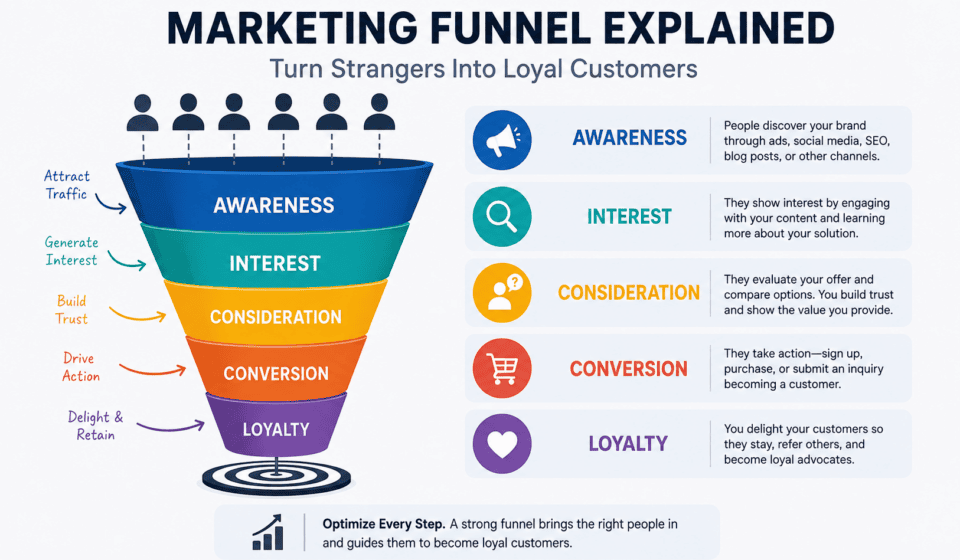
A traditional marketing funnel is usually divided into four major stages:
Awareness → Interest → Consideration → Conversion
After conversion, modern marketing strategies often add additional stages such as Retention and Advocacy.
Let’s look at each stage.
1. Awareness: Getting Attention
The awareness stage is the top of the funnel.
At this stage, people may not know your business, product, service, or brand.
Your goal is not necessarily to make an immediate sale. Instead, your goal is to attract the attention of people who could potentially become customers.
Examples of Awareness Marketing
You can generate awareness through:
- Blog posts
- Search engine optimization
- YouTube videos
- Facebook posts
- Instagram content
- LinkedIn posts
- TikTok videos
- Online communities
- Podcasts
- Google Ads
- Social media advertising
For example, imagine you are a web designer.
A potential client searches Google for:
“How much does a professional website cost?”
You publish an informative article answering that question.
The person discovers your website through search.
They may not hire you immediately, but they now know your business exists.
That is awareness.
Content Ideas for the Awareness Stage
Create content that answers beginner questions.
Examples include:
- What Is Web Design?
- What Is Digital Marketing?
- How Does SEO Work?
- How Much Does a Website Cost?
- What Is Google Ads?
- Why Does a Business Need a Website?
At this stage, focus on helping rather than aggressively selling.
2. Interest: Building Engagement
Once someone becomes aware of your business, the next goal is to generate interest.
The person may start following your social media account, reading your blog, watching your videos, or subscribing to your email list.
They are no longer simply a visitor. They are becoming an engaged prospect.
How to Generate Interest
You can encourage engagement through:
- Educational blog posts
- Email newsletters
- Free guides
- Checklists
- Tutorials
- Webinars
- Downloadable templates
- Social media content
- Online courses
- Free resources
For example, suppose someone reads your article about website design.
At the end of the article, you offer:
“Download our Free Website Planning Checklist.”
The visitor enters their email address to download it.
Now you have a lead.
Why Lead Magnets Matter
A lead magnet is a free resource offered in exchange for a visitor’s contact information, usually an email address.
Common lead magnets include:
- Free PDF guides
- Checklists
- Templates
- Worksheets
- Mini-courses
- Tutorials
- Free consultations
- Industry reports
The lead magnet should solve a small but meaningful problem for your target audience.
3. Consideration: Building Trust
The consideration stage is where potential customers seriously evaluate your business, product, or service.
They may compare you with competitors, research your reputation, read reviews, check pricing, and look for evidence that you can solve their problem.
At this stage, trust becomes extremely important.
Content for the Consideration Stage
Useful content includes:
- Case studies
- Customer testimonials
- Product comparisons
- Detailed guides
- Demonstrations
- Portfolio examples
- FAQs
- Reviews
- Webinars
- Free consultations
- Before-and-after examples
For example, a potential client may be looking for a digital marketing trainer.
They could compare several trainers based on:
- Experience
- Course content
- Student results
- Testimonials
- Pricing
- Teaching method
- Support
- Portfolio
Your job is to provide enough useful information to help them make a confident decision.
4. Conversion: Turning Prospects Into Customers
The conversion stage is where a prospect takes the desired action.
This could be:
- Buying a product
- Booking a service
- Registering for a course
- Signing a contract
- Booking a consultation
- Starting a free trial
- Requesting a quotation
Your goal is to make the conversion process simple.
Create Strong Calls to Action
A call to action, or CTA, tells the visitor what to do next.
Examples include:
- Buy Now
- Get Started
- Book a Free Consultation
- Enroll Today
- Request a Quote
- Download the Guide
- Start Your Free Trial
A good CTA should be clear and relevant to the visitor’s stage in the funnel.
For example, asking a first-time visitor to “Buy Now” may be too aggressive.
Instead, you could offer a useful free guide.
Someone who has already viewed your pricing page may be more ready for a stronger CTA such as “Book a Consultation.”
5. Retention: Keeping Customers
The funnel should not end after someone makes a purchase.
Customer retention is extremely important because existing customers can provide repeat business, referrals, reviews, and valuable feedback.
After conversion, focus on delivering an excellent customer experience.
Retention Strategies
You can use:
- Follow-up emails
- Customer support
- Tutorials
- Onboarding
- Exclusive content
- Loyalty programs
- Special offers
- Customer communities
- Product updates
- Educational resources
For example, if someone purchases your digital marketing course, don’t simply give them access and disappear.
Send helpful learning resources, answer questions, provide guidance, and encourage them to complete the course.
A good post-purchase experience can turn a customer into a long-term supporter.
6. Advocacy: Turning Customers Into Promoters
The final stage is advocacy.
A satisfied customer may recommend your business to friends, colleagues, or social media followers.
This can create a powerful cycle:
Customer → Satisfied Customer → Review → Referral → New Prospect
You can encourage advocacy by asking satisfied customers for:
- Google reviews
- Testimonials
- Video testimonials
- Case studies
- Referrals
- Social media recommendations
For service businesses, testimonials can be especially valuable because potential customers want evidence that your service produces results.
Marketing Funnel Example
Let’s create a simple example for a freelance web designer.
Stage 1: Awareness
The freelancer publishes a blog post:
“10 Signs Your Business Website Needs a Redesign.”
A business owner discovers the article through Google.
Stage 2: Interest
The article offers a free download:
“Website Redesign Checklist.”
The visitor provides their email address.
Now the visitor becomes a lead.
Stage 3: Consideration
The freelancer sends several helpful emails containing:
- Website improvement tips
- Case studies
- Client testimonials
- Website redesign examples
The lead starts considering the freelancer’s service.
Stage 4: Conversion
The freelancer sends an email offering:
“Book a Free 30-Minute Website Consultation.”
The prospect books a call.
After discussing the project, the prospect becomes a paying client.
Stage 5: Retention
After completing the website, the freelancer provides support and maintenance services.
Stage 6: Advocacy
The happy client leaves a testimonial and recommends the freelancer to another business owner.
This is a complete marketing funnel.
Marketing Funnel vs Sales Funnel
Marketing funnel and sales funnel are closely related, but they are not exactly the same.
A marketing funnel generally focuses on attracting people, creating awareness, generating interest, and nurturing prospects.
A sales funnel focuses more heavily on moving qualified prospects toward a purchase.
In many modern businesses, the two concepts overlap.
A simple way to think about it is:
Marketing creates interest. Sales converts interest into revenue.
However, successful businesses usually make both teams and processes work together.
How to Create a Marketing Funnel
Creating a funnel doesn’t have to be complicated.
Follow these steps.
Step 1: Define Your Target Audience
First, identify who you want to attract.
Ask:
- Who are they?
- What problem do they have?
- What are they trying to achieve?
- What questions do they ask?
- What prevents them from buying?
The more clearly you understand your audience, the better your funnel will perform.
Step 2: Define Your Offer
Decide exactly what you are selling.
Your offer could be:
- A service
- A course
- A product
- Coaching
- Consulting
- Software
- Membership
Make sure the offer solves a real problem.
Step 3: Create Awareness Content
Create content that attracts your target audience.
For example:
Blog → Google Search → Website Visitor
or:
Social Media Post → Landing Page → Lead
Choose channels that your audience actually uses.
Step 4: Create a Lead Magnet
Give potential customers a reason to provide their contact information.
For example:
Free SEO Checklist
Free Website Planning Template
Free Digital Marketing Guide
The resource should be useful and directly related to your paid offer.
Step 5: Build a Landing Page
A landing page is designed to encourage a specific action.
A basic landing page can include:
- A strong headline
- A clear explanation of the problem
- Benefits of your solution
- Supporting visuals
- Testimonials
- An offer
- A clear CTA
- A simple form
Avoid distracting visitors with unnecessary information.
Step 6: Nurture Your Leads
Not every lead is ready to buy immediately.
Use email marketing to provide helpful information.
For example:
Email 1: Deliver the free resource.
Email 2: Teach something useful.
Email 3: Explain a common mistake.
Email 4: Share a case study.
Email 5: Introduce your service.
Email 6: Provide a clear offer.
The goal is to build trust before asking for the sale.
Step 7: Measure Your Results
Track your funnel performance.
Important metrics include:
Conversion Rate
The percentage of people who complete a desired action.
Lead Conversion Rate
The percentage of visitors who become leads.
Sales Conversion Rate
The percentage of prospects who become customers.
Customer Acquisition Cost
How much it costs to acquire a customer.
Return on Investment
How much revenue you generate compared with your marketing investment.
Tracking these numbers helps you identify problems in your funnel.
Common Marketing Funnel Mistakes
Beginners often make several mistakes when creating funnels.
Mistake 1: Trying to Sell Immediately
Not every visitor is ready to purchase.
Give people useful information first.
Mistake 2: Creating Too Much Content Without a Strategy
Content should have a purpose.
Each piece of content should help move your audience toward the next appropriate step.
Mistake 3: Ignoring Mobile Users
A large portion of online activity happens on mobile devices.
Make sure your landing pages, forms, emails, and websites work well on smartphones.
Mistake 4: Using Weak Calls to Action
A visitor should understand exactly what to do next.
Instead of:
“Learn More”
try something more specific when appropriate:
“Download the Free Website Checklist.”
Mistake 5: Forgetting Existing Customers
Marketing shouldn’t stop after the sale.
Happy customers can generate repeat purchases, referrals, reviews, and testimonials.
Marketing Funnel Tools
You can build a funnel using different types of digital marketing tools.
Common categories include:
- Website platforms
- Landing page builders
- Email marketing platforms
- Customer relationship management systems
- Analytics tools
- Advertising platforms
- Social media platforms
- SEO tools
- Marketing automation software
You don’t need dozens of tools when you’re starting.
A simple website, landing page, email system, analytics setup, and useful content may be enough to build your first funnel.
Final Thoughts
A marketing funnel provides a simple framework for understanding how people move from discovering your business to becoming customers and loyal supporters.
The basic journey can be summarized as:
Awareness → Interest → Consideration → Conversion → Retention → Advocacy
The most important thing to remember is that people are at different stages of the buying journey.
Someone who has just discovered your brand may need education.
Someone who has been following you for months may need proof and reassurance.
Someone who has already purchased from you needs a great customer experience.
When you create the right content, offers, messages, and calls to action for each stage, your marketing becomes more organized and effective.
Whether you are a freelancer trying to get clients, a coach selling courses, a small business owner promoting services, or a digital marketer working with clients, understanding marketing funnels can help you build a more predictable path from traffic to leads and leads to customers.
Start simple. Define your audience, identify their problem, create valuable content, offer a useful lead magnet, nurture your leads, make your offer clear, and measure the results.
Your first funnel doesn’t need to be perfect.
Build it, measure it, improve it, and continue learning from your audience.
That is how a marketing funnel becomes a powerful part of a successful digital marketing strategy.