
Influencer marketing has become one of the most effective ways for businesses to reach targeted audiences, build trust, and promote products or services online. Instead of relying only on traditional advertisements, businesses collaborate with people who already have an engaged audience on social media, blogs, YouTube, podcasts, or other digital platforms.
Whether you are a small business owner, freelancer, startup founder, content creator, or digital marketer, understanding the basics of influencer marketing can help you create more authentic and effective marketing campaigns.
In this guide, you will learn what influencer marketing is, how it works, the different types of influencers, how to choose the right influencer, how much influencer marketing can cost, and how to create a successful influencer marketing campaign.
What Is Influencer Marketing?
Influencer marketing is a digital marketing strategy where a business collaborates with an influential content creator to promote a product, service, brand, or campaign to the creator’s audience.
An influencer does not necessarily need millions of followers. In many cases, smaller influencers with highly engaged and relevant audiences can produce better results than celebrities with huge but less-targeted audiences.
For example, a fitness equipment company might work with a fitness coach who has 20,000 highly engaged Instagram followers. The coach could create a workout video featuring the company’s equipment and explain how it is used.
The effectiveness of influencer marketing comes largely from trust. Followers often view influencers as knowledgeable, relatable, or trustworthy people rather than traditional advertisers.
Why Is Influencer Marketing Important?
Consumers are exposed to thousands of advertisements every day. Because of this, traditional advertising can sometimes struggle to capture attention.
Influencer marketing provides a more natural way to introduce products and services to potential customers.
Some major benefits include:
1. Builds Trust
People tend to trust recommendations from creators they regularly follow. An authentic recommendation can feel more personal than a traditional advertisement.
2. Reaches a Targeted Audience
Influencers usually create content around specific interests or industries. A beauty influencer, for example, may have an audience interested in skincare, makeup, and fashion.
This allows businesses to reach people who are already interested in their products.
3. Increases Brand Awareness
Influencers can introduce your business to thousands or even millions of potential customers.
Even when people do not immediately purchase, repeated exposure can help improve brand recognition.
4. Generates Content
Influencer collaborations can also provide businesses with high-quality user-generated or creator-generated content that may be useful on websites, social media pages, advertisements, and other marketing channels.
5. Supports Sales
A well-designed influencer campaign can generate website visits, leads, app downloads, product sales, and other conversions.
The key is to connect influencer activity with measurable business goals.
How Does Influencer Marketing Work?
A typical influencer marketing campaign follows several basic steps.
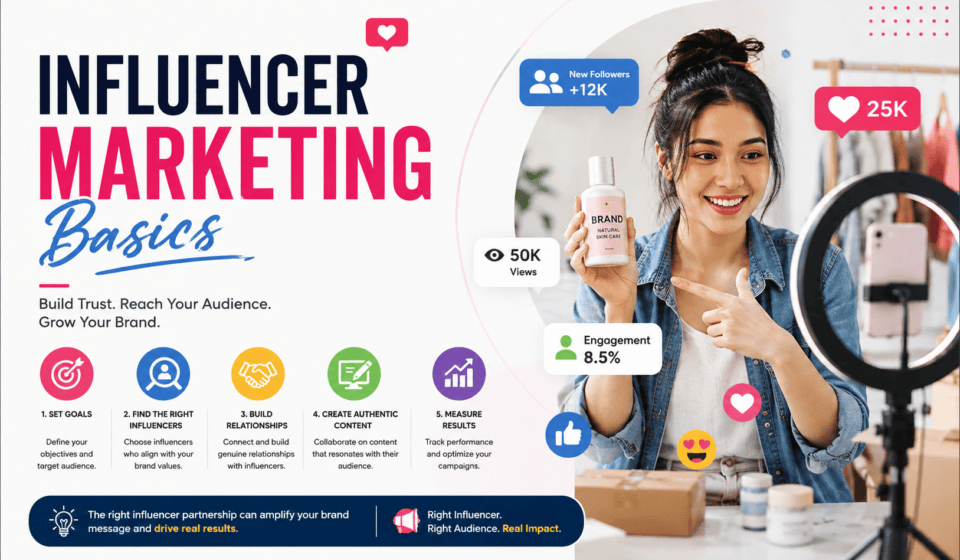
Step 1: Define Your Goal
Before contacting influencers, decide what you want to accomplish.
Your objective could be:
- Increase brand awareness
- Generate website traffic
- Promote a new product
- Increase sales
- Generate leads
- Grow social media followers
- Increase engagement
- Launch a new service
- Build credibility
- Generate content
Having a clear objective makes it easier to choose the right influencer and measure campaign performance.
Step 2: Identify Your Target Audience
Next, determine who you want to reach.
Consider factors such as:
- Age
- Gender
- Location
- Interests
- Profession
- Income level
- Purchasing behavior
- Online platforms
- Problems and needs
For example, a company selling professional web design courses may want to reach freelancers, students, entrepreneurs, and aspiring digital marketers.
Once you understand your audience, finding relevant influencers becomes much easier.
Step 3: Find Relevant Influencers
Search for creators who produce content related to your industry.
You can find influencers through:
- YouTube
- TikTok
- Blogs
- Podcasts
- Industry communities
Do not select an influencer based only on follower count.
Instead, examine their audience, content quality, engagement, reputation, and relevance to your brand.
Step 4: Evaluate the Influencer
Before starting a partnership, investigate the influencer carefully.
Look at:
- Follower count
- Engagement rate
- Content quality
- Audience demographics
- Average views
- Comments
- Previous brand partnerships
- Posting frequency
- Professional reputation
- Audience authenticity
A creator with 15,000 relevant followers may be more valuable to your business than someone with 500,000 followers who has little connection to your target market.
Step 5: Contact the Influencer
Create a professional collaboration proposal.
Explain:
- Who you are
- What your business does
- Why you selected them
- What product or service you want to promote
- What type of content you are interested in
- Campaign timeline
- Compensation or benefits
- Important requirements
Avoid sending generic messages to hundreds of influencers. Personalized outreach usually creates a better first impression.
Step 6: Create the Campaign
Once you agree on the collaboration, define the campaign details.
You should establish:
- Content format
- Number of posts
- Publishing dates
- Required links
- Discount codes
- Hashtags
- Brand guidelines
- Key messages
- Approval process
- Payment terms
- Disclosure requirements
Clear expectations can prevent misunderstandings later.
Step 7: Measure the Results
After the campaign is published, analyze its performance.
Track metrics such as:
- Reach
- Impressions
- Engagement
- Website traffic
- Leads
- Sales
- Click-through rate
- Conversion rate
- Cost per acquisition
- Return on investment
Use the results to improve future campaigns.
Types of Influencers
Influencers can be categorized by audience size, niche, and level of influence.
Nano Influencers
Nano influencers generally have relatively small audiences, often under 10,000 followers.
They can be valuable because their communities may be highly engaged and personal.
They are particularly useful for local businesses, niche products, and community-based campaigns.
Micro Influencers
Micro influencers typically have audiences ranging from around 10,000 to 100,000 followers.
They are popular among brands because they often combine reasonable reach with strong audience engagement.
For many small and medium-sized businesses, micro influencers can provide an excellent balance between cost and reach.
Macro Influencers
Macro influencers have larger audiences, often ranging from 100,000 to one million followers.
They can provide substantial exposure and are useful for larger campaigns focused on brand awareness.
However, their services are generally more expensive than those of smaller influencers.
Mega Influencers and Celebrities
Mega influencers and celebrities can have audiences of millions of people.
They can create enormous visibility for a brand, but working with them can require a significant budget.
Their audience may also be less specialized, so they are not automatically the best option for every campaign.
Choosing the Right Influencer
Choosing the right influencer is one of the most important parts of influencer marketing.
A good influencer should match your brand in several ways.
Audience Relevance
The influencer’s followers should overlap with your target customers.
If you sell website development services, partnering with a food influencer may generate visibility but probably will not generate many qualified leads.
Engagement
Look beyond follower numbers.
An influencer with a smaller but highly active audience can often create stronger results than an account with a large number of inactive followers.
Content Quality
Review the influencer’s previous content.
Ask yourself:
- Is the content professional?
- Is it original?
- Does it fit your brand?
- Does the creator communicate clearly?
- Would your target customers respond positively?
Brand Reputation
Your brand becomes associated with the influencer.
Therefore, research their previous posts, partnerships, public behavior, and overall reputation before signing an agreement.
Authenticity
Authenticity is extremely important.
If an influencer promotes dozens of unrelated products every week, followers may become less likely to trust their recommendations.
Look for creators who naturally discuss topics connected to your product or service.
Influencer Marketing Platforms
Different influencers specialize in different platforms.
Instagram is widely used for visual content, product demonstrations, lifestyle campaigns, Stories, Reels, and creator collaborations.
YouTube
YouTube is useful for detailed product reviews, tutorials, demonstrations, educational content, and long-form storytelling.
TikTok
TikTok is particularly useful for short-form, entertaining, educational, and trend-driven content.
LinkedIn can be effective for B2B influencer marketing, professional services, technology, business education, recruitment, and personal branding.
Blogs
Bloggers can provide long-form reviews, tutorials, comparisons, and articles that may continue generating search traffic over time.
The best platform depends on where your target audience spends time.
How Much Does Influencer Marketing Cost?
There is no single price for influencer marketing.
Pricing can depend on:
- Follower count
- Engagement
- Industry
- Platform
- Content format
- Number of posts
- Campaign duration
- Production requirements
- Exclusivity
- Usage rights
- Influencer reputation
Some creators may accept free products or services in exchange for content, while others charge a fixed fee.
For professional campaigns, always establish payment terms before content is created.
If your budget is limited, consider working with several smaller influencers instead of one large influencer.
This approach can help you test different audiences and content styles.
Influencer Marketing vs. Traditional Advertising
Traditional advertising usually involves directly paying a platform or media company to display an advertisement.
Influencer marketing works differently.
Instead of simply displaying an advertisement, the brand collaborates with a person who introduces the product to an existing audience.
Traditional advertising can provide greater control over targeting, placement, and messaging. Influencer marketing can provide stronger social proof and a more personal presentation.
The two strategies can also work together.
For example, a business could collaborate with a creator to produce content and then use that content in paid advertising.
Common Influencer Marketing Mistakes
Beginners often make several mistakes when launching influencer campaigns.
Choosing Influencers Based Only on Followers
A large audience does not guarantee results.
Always examine relevance and engagement.
Ignoring Fake Followers
Some accounts may have artificial or low-quality followers.
Look for suspicious engagement patterns, sudden follower increases, generic comments, or unusually low engagement compared with follower numbers.
Giving Creators Too Much or Too Little Control
Creators understand their audience better than most brands.
Give them clear objectives and brand requirements while allowing enough creative freedom to communicate naturally.
Failing to Set Clear Expectations
Make sure both parties understand what will be delivered and when.
Written agreements can help clarify responsibilities, payment, content usage, and deadlines.
Not Tracking Results
A campaign should not be considered successful simply because a post received many likes.
Connect the campaign to measurable business outcomes whenever possible.
How to Measure Influencer Marketing Success
Different campaigns require different metrics.
Reach
Reach tells you approximately how many people were exposed to your campaign.
Impressions
Impressions measure how many times content was displayed.
Engagement Rate
Engagement can include:
- Likes
- Comments
- Shares
- Saves
- Reactions
- Video interactions
Website Traffic
Use tracking links or analytics tools to determine how much traffic came from each influencer.
Leads
If your goal is lead generation, track form submissions, registrations, inquiries, or other desired actions.
Sales
Unique discount codes or tracked links can help identify sales generated by individual influencers.
Return on Investment
ROI compares the value generated by the campaign with its cost.
For example, if you spend $1,000 on an influencer campaign and generate $3,000 in attributable profit or revenue, you can evaluate the campaign based on the financial return and your chosen measurement method.
Tips for a Successful Influencer Marketing Campaign
Here are several practical tips beginners can follow:
Start with a clear objective. Know exactly what you want to achieve.
Choose relevance over popularity. The right audience is usually more valuable than the biggest audience.
Research before partnering. Review the influencer’s audience, content, engagement, and reputation.
Give creators creative freedom. Authentic content often performs better than content that feels like a scripted advertisement.
Create trackable campaigns. Use unique links, landing pages, discount codes, or campaign-specific tracking.
Build long-term relationships. Repeated collaborations can be more effective than one-time promotions because audiences become familiar with the partnership.
Test different creators. Experiment with several influencers and compare performance.
Repurpose successful content. With appropriate permission and usage rights, influencer content can potentially be reused across other marketing channels.
The Future of Influencer Marketing
Influencer marketing continues to evolve as social media platforms and consumer behavior change.
Brands are increasingly interested in authentic creators, niche communities, short-form video, educational content, and measurable business results.
The future of influencer marketing is likely to focus less on follower counts and more on audience quality, creator credibility, content performance, and conversions.
Artificial intelligence and analytics tools are also making it easier for marketers to discover relevant creators, analyze audiences, predict campaign performance, and measure results.
However, technology does not replace authenticity. People still respond to creators who understand their audience and communicate in a genuine way.
Conclusion
Influencer marketing is a powerful digital marketing strategy that allows businesses to connect with targeted audiences through trusted content creators.
The key to success is not simply finding someone with a large number of followers. Instead, businesses should focus on relevance, authenticity, engagement, content quality, clear objectives, and measurable results.
If you are new to influencer marketing, start small. Define your target audience, identify a few relevant influencers, create a clear campaign, track the results, and learn from the data.
With the right strategy, influencer marketing can help increase brand awareness, generate leads, drive website traffic, build trust, and increase sales.
Most importantly, remember that successful influencer marketing is about creating value for three groups: the brand, the influencer, and the audience. When all three benefit from the partnership, influencer marketing becomes much more than a simple promotional tactic—it becomes a powerful long-term marketing strategy.