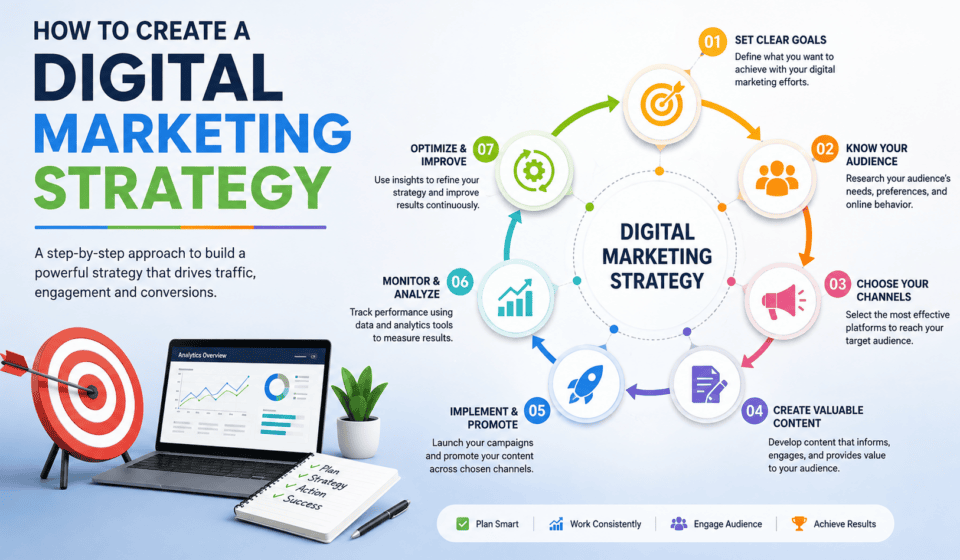

Digital marketing has become one of the most effective ways for businesses to attract customers, build brand awareness, and increase sales. However, simply posting on social media, running advertisements, or publishing blog articles does not guarantee success. To get consistent results, you need a clear digital marketing strategy.
A digital marketing strategy provides a roadmap for reaching your target audience through online channels. It helps you understand who your customers are, what they need, where they spend their time online, and how your business can turn visitors into loyal customers.
Whether you are a freelancer, small business owner, startup founder, marketer, or student learning digital marketing, knowing how to create a digital marketing strategy is an essential skill.
In this guide, you will learn how to create a practical digital marketing strategy from the ground up.
What Is a Digital Marketing Strategy?
A digital marketing strategy is a structured plan that explains how a business will use online channels to achieve specific marketing goals.
These channels can include:
- Search engine optimization (SEO)
- Content marketing
- Social media marketing
- Email marketing
- Pay-per-click (PPC) advertising
- Influencer marketing
- Video marketing
- Online communities
- Affiliate marketing
- Website and landing page optimization
A strategy connects these channels to specific business objectives.
For example, a business may have a goal of increasing online sales by 30%. Its digital marketing strategy could include SEO to attract organic traffic, content marketing to educate potential customers, social media to build awareness, and email marketing to convert leads into customers.
The important point is that digital marketing should not be a collection of random activities. Every activity should support a measurable business goal.
Why Do You Need a Digital Marketing Strategy?
Without a strategy, businesses often waste time and money on marketing activities that produce little or no return.
A well-planned strategy helps you:
1. Understand Your Target Audience
You can identify your ideal customers, their problems, interests, behaviors, and purchasing decisions.
2. Set Clear Goals
Instead of saying, “I want more traffic,” you can establish measurable objectives such as increasing organic traffic by 25% within six months.
3. Choose the Right Marketing Channels
You don’t need to use every digital marketing platform. A strategy helps you determine which channels are most appropriate for your audience.
4. Use Your Budget Effectively
A clear plan helps you prioritize activities and avoid spending money on channels that are not producing results.
5. Measure Your Performance
With defined goals and key performance indicators (KPIs), you can determine what is working and what needs improvement.
6. Build Long-Term Growth
Digital marketing is most effective when different channels work together. A strategy creates a sustainable marketing system instead of relying on individual campaigns.
Step 1: Define Your Business Goals
The first step in creating a digital marketing strategy is determining what you want to achieve.
Your marketing goals should support your overall business objectives.
Common digital marketing goals include:
- Increase website traffic
- Generate more leads
- Increase online sales
- Improve brand awareness
- Grow an email subscriber list
- Increase social media engagement
- Improve search engine rankings
- Generate more phone calls or inquiries
- Increase customer retention
- Build authority in your industry
Try to make your goals SMART:
- Specific – Clearly define what you want to accomplish.
- Measurable – Use numbers to track progress.
- Achievable – Make sure the goal is realistic.
- Relevant – Connect the goal to your business.
- Time-bound – Set a deadline.
For example, instead of saying:
“I want more website visitors.”
Create a SMART goal:
“Increase organic website traffic from 5,000 to 7,500 monthly visitors within six months.”
The second goal is much easier to measure and manage.
Step 2: Identify Your Target Audience
One of the biggest mistakes marketers make is trying to market to everyone.
Your business needs to understand exactly who it wants to reach.
Create an ideal customer profile by considering:
- Age
- Gender
- Location
- Education
- Occupation
- Income
- Interests
- Online behavior
- Problems and challenges
- Buying motivations
- Preferred communication channels
For example, imagine you are a web designer offering websites to small businesses.
Your target customer might be:
Business owners aged 25–50 who need a professional website but have limited technical knowledge and want an affordable solution.
Once you understand your audience, you can create content and advertising messages that directly address their needs.
Create Customer Personas
A customer persona is a fictional representation of your ideal customer.
For example:
Name: Sarah
Age: 34
Business: Small online clothing store
Problem: Her website receives traffic but generates few sales
Goal: Increase online sales
Challenge: Doesn’t understand website optimization or SEO
Preferred channels: Google, Facebook, Instagram, YouTube
This information helps you create marketing campaigns that are more relevant and persuasive.
Step 3: Analyze Your Competitors
Before developing your strategy, research your competitors.
Competitor analysis can reveal:
- What keywords they target
- What content they publish
- Which social platforms they use
- How they position their brand
- What products or services they promote
- What type of advertisements they run
- How their websites are structured
- What customers like or dislike about them
Start by identifying three to five competitors.
Then examine their websites, social media accounts, content, search visibility, offers, and customer reviews.
Don’t simply copy competitors.
Instead, look for opportunities to differentiate yourself.
For example, if competitors publish general web design articles, you could create detailed tutorials specifically for beginners, freelancers, or small businesses.
Step 4: Analyze Your Current Digital Presence
If your business already has an online presence, perform a digital marketing audit.
Review your:
- Website
- SEO performance
- Blog
- Social media accounts
- Email marketing
- Online advertising
- Google Business Profile
- Landing pages
- Conversion rates
- Existing content
Ask yourself:
What is working?
What is not working?
Where are the biggest opportunities?
For example, you might discover that your website receives 10,000 monthly visitors but generates only a small number of leads.
That suggests your biggest opportunity may not be getting more traffic. Instead, you may need to improve your landing pages, calls to action, forms, offers, and conversion process.
Step 5: Choose the Right Digital Marketing Channels
There are many digital marketing channels, but you don’t need to use all of them.
Choose channels based on your audience, goals, budget, and resources.
Search Engine Optimization
SEO helps your website appear in search engine results when people search for relevant information, products, or services.
SEO activities can include:
- Keyword research
- On-page SEO
- Technical SEO
- Internal linking
- Content creation
- Link building
- Website optimization
SEO is especially useful for businesses that want long-term organic traffic.
Content Marketing
Content marketing involves creating useful content that attracts and educates your target audience.
Examples include:
- Blog posts
- Tutorials
- Guides
- Case studies
- Videos
- Infographics
- Ebooks
- Checklists
High-quality content can help establish your brand as an authority while attracting potential customers.
Social Media Marketing
Social media can help businesses build relationships with their audience and increase brand awareness.
Popular platforms include:
- TikTok
- YouTube
- X
Don’t choose a platform simply because it is popular. Choose the platforms where your target customers are most active.
Email Marketing
Email marketing is an effective way to nurture leads and maintain relationships with existing customers.
You can use email campaigns to:
- Welcome new subscribers
- Share educational content
- Promote products
- Announce offers
- Send newsletters
- Recover abandoned carts
- Retain customers
Paid Advertising
Paid advertising can generate traffic and leads quickly.
Common advertising platforms include search ads, social media advertising, display advertising, and video advertising.
Paid advertising can be particularly useful when launching a product, promoting an offer, or testing a new market.
Step 6: Develop a Content Strategy
Content is one of the foundations of modern digital marketing.
However, successful content marketing requires more than publishing random articles.
Create content based on your audience’s questions and problems.
A useful content strategy can include four types of content:
Educational Content
Teach your audience something useful.
Examples:
- How to build a website
- How to perform keyword research
- How to create a social media strategy
Problem-Solving Content
Help customers overcome specific problems.
Examples:
- Why is my website slow?
- Why isn’t my website ranking?
- How can I increase online sales?
Comparison Content
Help customers make purchasing decisions.
Examples:
- WordPress vs. Shopify
- SEO vs. PPC
- Canva vs. Photoshop
Promotional Content
Explain your products or services and encourage people to take action.
A good content strategy balances educational and promotional content instead of constantly trying to sell.
Step 7: Create a Marketing Funnel
A digital marketing funnel describes the stages people go through before becoming customers.
A simple funnel includes:
Awareness → Interest → Consideration → Conversion → Retention
Awareness
At this stage, people may not know your business.
Use:
- SEO
- Social media
- Videos
- Blog posts
- Advertising
Interest
Visitors become interested in your solution.
Provide:
- Educational articles
- Videos
- Free guides
- Webinars
- Email newsletters
Consideration
Potential customers compare different solutions.
Use:
- Case studies
- Testimonials
- Product comparisons
- Demonstrations
- Detailed service pages
Conversion
The customer is ready to take action.
Use:
- Strong calls to action
- Landing pages
- Free trials
- Consultations
- Special offers
- Easy checkout processes
Retention
After someone becomes a customer, continue building the relationship.
Use:
- Email marketing
- Customer support
- Loyalty programs
- Educational content
- Personalized offers
A strong marketing strategy considers every stage of the customer journey.
Step 8: Create a Budget
Your digital marketing strategy should include a realistic budget.
Your budget may cover:
- Website development
- SEO tools
- Advertising
- Content creation
- Graphic design
- Video production
- Email marketing software
- Social media management
- Marketing freelancers or agencies
You don’t necessarily need a huge budget.
Small businesses can start with organic channels such as SEO, content marketing, social media, and email marketing before gradually investing more in paid advertising.
The key is to understand your return on investment (ROI).
If you spend $500 on a campaign and generate $2,000 in profit, the campaign may be worth expanding.
Step 9: Create a Marketing Calendar
A marketing calendar helps turn your strategy into consistent action.
Your calendar can include:
| Activity | Frequency | Goal |
|---|---|---|
| Blog post | 1–2 per week | SEO traffic |
| Social media posts | 3–5 per week | Engagement |
| Email newsletter | 1 per week | Lead nurturing |
| Video | 1 per week | Brand awareness |
| SEO optimization | Monthly | Search visibility |
| Paid campaign | As needed | Leads or sales |
Don’t create a schedule that is impossible to maintain.
Consistency is more important than publishing a large amount of content for a short period.
Step 10: Define Your Key Performance Indicators
KPIs help you determine whether your strategy is successful.
Different goals require different KPIs.
Website KPIs
- Website visitors
- Organic traffic
- Traffic sources
- Bounce or engagement metrics
- Conversion rate
- Time spent on important pages
SEO KPIs
- Keyword rankings
- Organic clicks
- Organic impressions
- Backlinks
- Indexed pages
Social Media KPIs
- Followers
- Engagement
- Reach
- Video views
- Click-throughs
- Leads
Email Marketing KPIs
- Subscriber growth
- Open rate
- Click-through rate
- Conversions
- Unsubscribe rate
Sales KPIs
- Leads generated
- Conversion rate
- Customer acquisition cost
- Revenue
- Return on ad spend
Choose KPIs that directly relate to your goals rather than tracking every available metric.
Step 11: Measure and Analyze Results
Launching your strategy is only the beginning.
You should regularly analyze your results.
Ask:
- Which campaigns performed best?
- Which content generated the most traffic?
- Which pages generated the most leads?
- Which keywords attracted visitors?
- Which social posts received the most engagement?
- Which advertising campaigns generated sales?
- Where are customers dropping out of the funnel?
Use your data to make better decisions.
For example, if a particular blog post generates significant organic traffic but few leads, you could improve its calls to action, add relevant lead magnets, or link visitors to a service page.
Step 12: Test and Improve Your Strategy
Digital marketing is not a one-time project.
Consumer behavior, technology, search algorithms, platforms, and competitors constantly change.
You should regularly test different approaches.
You can test:
- Headlines
- Landing page designs
- Calls to action
- Email subject lines
- Advertising copy
- Images
- Offers
- Content formats
- Social media strategies
This process is often called A/B testing or split testing.
Instead of guessing what your audience wants, use data to discover what performs best.
Common Digital Marketing Strategy Mistakes
Even businesses with good products can struggle because of poor marketing planning.
Here are some common mistakes to avoid.
1. Trying to Reach Everyone
A broad audience makes it difficult to create relevant marketing messages.
Focus on a specific ideal customer.
2. Using Too Many Platforms
Managing every social media platform can spread your resources too thin.
Start with the channels that matter most.
3. Focusing Only on Traffic
Traffic is useful, but traffic without conversions does not necessarily produce business growth.
Focus on qualified visitors and measurable business outcomes.
4. Ignoring SEO
Paid advertising can provide quick results, but SEO can help generate sustainable organic traffic over time.
5. Publishing Without a Plan
Random content often produces inconsistent results.
Create a content calendar based on customer needs and business goals.
6. Not Measuring Results
Without analytics, you don’t know which marketing activities are working.
Track your KPIs regularly.
7. Giving Up Too Early
Some digital marketing channels require time to produce results.
SEO and content marketing, in particular, often require consistent effort before significant results appear.
Example of a Simple Digital Marketing Strategy
Imagine you run an online training business that teaches web design and digital marketing to beginners.
Your strategy could look like this:
Goal: Generate 100 qualified student leads per month.
Target audience: Beginners, freelancers, students, and people who want to start a digital career.
SEO strategy: Publish beginner-friendly articles targeting searches related to web design, WordPress, SEO, and digital marketing.
Content strategy: Publish two detailed blog posts per week and one educational video.
Social media: Share tutorials, tips, student success stories, and short educational videos.
Email marketing: Offer a free digital marketing guide in exchange for an email address.
Lead nurturing: Send educational emails and course information to subscribers.
Paid advertising: Promote the most successful course or lead magnet through targeted advertising.
KPIs: Website traffic, email subscribers, qualified leads, course inquiries, enrollment rate, and revenue.
This example demonstrates how different channels can work together rather than operating independently.
How to Build a Digital Marketing Strategy That Works
A successful digital marketing strategy should be:
Customer-focused
Your strategy should begin with your customer’s needs, problems, questions, and goals.
Goal-oriented
Every major marketing activity should have a clear purpose.
Data-driven
Use analytics and performance data to make decisions.
Consistent
Marketing works better when you consistently publish, communicate, test, and improve.
Flexible
Be prepared to change your strategy when the market, audience, or performance data changes.
Sustainable
Don’t create a strategy that requires more time or money than your business can realistically provide.
Final Thoughts
Creating a digital marketing strategy doesn’t have to be complicated. The most important thing is to create a clear plan and connect your marketing activities to measurable business goals.
Start by defining your objectives and understanding your target audience. Analyze your competitors and current online presence. Then select the digital marketing channels that are most appropriate for your business.
Develop useful content, build a marketing funnel, establish a realistic budget, and track meaningful KPIs. Most importantly, regularly analyze your results and improve your strategy based on real data.
Remember that digital marketing is a long-term process. You may not see dramatic results immediately, but consistent execution, testing, optimization, and customer-focused content can create significant growth over time.
Whether you are a freelancer trying to attract clients, a small business owner looking for customers, or a digital marketing professional developing campaigns for clients, learning how to create and execute a strong digital marketing strategy is one of the most valuable skills you can develop.
Start with a simple strategy, measure your results, learn from your audience, and improve continuously. That’s how you turn digital marketing from a collection of online activities into a powerful system for business growth.
Quick Digital Marketing Strategy Checklist
Before launching your strategy, make sure you have:
- Defined clear business and marketing goals
- Identified your target audience
- Created customer personas
- Researched your competitors
- Audited your existing digital presence
- Selected the right marketing channels
- Created a content strategy
- Designed your marketing funnel
- Established a realistic budget
- Created a marketing calendar
- Defined your KPIs
- Set up analytics and tracking
- Planned regular performance reviews
- Created a process for testing and optimization
A well-planned strategy gives your digital marketing direction. Instead of simply asking, “What should I post today?” you will know who you are trying to reach, why you are reaching them, what action you want them to take, and how you will measure success.