
The freelance economy has grown rapidly, creating exciting opportunities for people who want to build careers outside traditional office jobs. Today, digital freelancers can work with clients from around the world and offer services such as web design, graphic design, digital marketing, content writing, SEO, video editing, social media management, and virtual assistance.
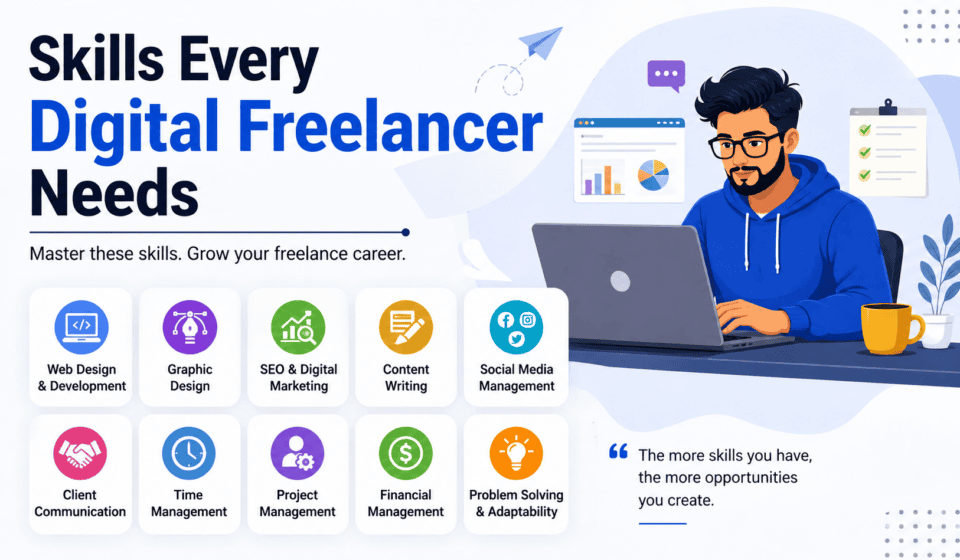
However, becoming a successful digital freelancer requires more than simply learning one technical skill. You also need communication, marketing, project management, problem-solving, time management, and business skills. The most successful freelancers combine technical expertise with strong professional and interpersonal skills.
If you are planning to start freelancing or want to grow your existing freelance career, developing the right skills can help you attract better clients, complete projects successfully, increase your income, and build a sustainable online business.
In this guide, we will explore the most important skills every digital freelancer needs and explain how each skill can contribute to long-term freelance success.
1. A Strong Digital Skill
The first and most important requirement for freelancing is having a skill that businesses or individuals are willing to pay for.
Your primary skill could be:
- Web design
- Web development
- Graphic design
- Digital marketing
- SEO
- Content writing
- Copywriting
- Video editing
- Social media management
- Email marketing
- WordPress development
- UI/UX design
- Virtual assistance
- Data analysis
- Online advertising
You do not need to learn everything at once. In fact, beginners often make the mistake of trying to become experts in too many areas simultaneously.
Instead, choose one primary skill and develop it deeply. Once you become comfortable with your main service, you can add related skills that make your services more valuable.
For example, a web designer could eventually learn SEO, WordPress development, conversion optimization, and digital marketing. These additional skills can make it possible to provide clients with a complete website marketing solution rather than only designing a website.
2. Communication Skills
Communication is one of the most important skills for every freelancer.
You may be highly talented technically, but poor communication can cause misunderstandings, unhappy clients, delays, and negative reviews.
Freelancers communicate with clients through email, messaging platforms, video meetings, project management systems, and freelance marketplaces. You should be able to explain your ideas clearly and professionally.
Good freelance communication includes:
- Asking the right questions
- Understanding client requirements
- Explaining technical concepts simply
- Providing regular project updates
- Responding professionally to feedback
- Confirming deadlines
- Discussing revisions clearly
- Handling disagreements professionally
You should also learn to listen carefully. Sometimes a client may not know exactly what they need. Your job is to understand their business goals and help identify the right solution.
3. Time Management
Freelancing gives you flexibility, but flexibility can become a problem without proper time management.
Unlike traditional employment, freelancers often manage their own schedules. You may have multiple clients, several projects, meetings, marketing activities, and administrative tasks happening at the same time.
Effective time management helps you complete projects on schedule without constantly feeling overwhelmed.
Useful techniques include:
- Creating daily task lists
- Setting weekly priorities
- Breaking large projects into smaller tasks
- Estimating project time realistically
- Using calendars and reminders
- Setting deadlines before the client’s deadline
- Avoiding unnecessary distractions
- Tracking time spent on projects
Do not accept more work than you can realistically complete. A freelancer who consistently misses deadlines can quickly lose client trust.
4. Project Management
Freelancers are often responsible for managing projects from beginning to end.
Project management involves planning the work, organizing tasks, communicating with clients, tracking progress, and delivering the final result.
For example, a website project might include:
- Client consultation
- Requirement gathering
- Sitemap planning
- Design
- Development
- Content integration
- Testing
- Revisions
- Launch
- Post-launch support
Without proper organization, projects can become confusing.
You can use project management tools, spreadsheets, calendars, or task-management applications to keep track of deadlines and responsibilities.
Good project management also helps you demonstrate professionalism to clients.
5. Problem-Solving Skills
Every freelance project eventually presents a problem.
A website may have a technical error. A client may change requirements. A marketing campaign may perform poorly. A design may not produce the expected results.
Successful freelancers do not panic when problems appear. They analyze the situation, identify possible solutions, and communicate with the client.
Strong problem-solving involves:
- Identifying the real problem
- Researching possible solutions
- Testing different approaches
- Evaluating the results
- Learning from mistakes
- Communicating limitations honestly
Clients value freelancers who can solve problems independently rather than asking for help with every small issue.
6. Client Management
Getting a client is only the beginning. Keeping clients happy is what can create long-term freelance success.
Client management means understanding expectations, communicating consistently, managing revisions, handling deadlines, and maintaining a professional relationship.
Before starting a project, make sure you understand:
- What the client wants
- What you will deliver
- What is not included
- The deadline
- The number of revisions
- The payment terms
- How communication will work
Clear expectations can prevent many problems later.
You should also avoid promising unrealistic results simply because you want to win a project. Honest freelancers often build stronger reputations than freelancers who make promises they cannot keep.
7. Personal Branding
In a competitive freelance market, personal branding can help you stand out.
Your personal brand is the way potential clients perceive you and your expertise.
A strong freelance brand can include:
- A professional website
- A clear profile
- A strong portfolio
- Professional social media profiles
- Helpful educational content
- Client testimonials
- Case studies
- A consistent visual identity
For example, instead of presenting yourself simply as a “freelancer,” you could position yourself as a “WordPress Web Designer for Small Businesses.”
A specific positioning statement makes it easier for potential clients to understand what you do and who you serve.
8. Portfolio Development
A portfolio is one of the most powerful marketing tools for a freelancer.
Clients want evidence that you can deliver quality work. A portfolio provides that evidence.
Your portfolio should showcase your best projects rather than every project you have ever completed.
For each project, consider explaining:
- The client’s problem
- Your role
- Your approach
- The services you provided
- The final result
- Any measurable improvement
If you are a beginner and do not have clients yet, create sample projects.
For example, an aspiring web designer can build demo websites for restaurants, local businesses, coaches, agencies, or online stores. These projects can demonstrate your capabilities even before you have paid clients.
9. Digital Marketing
A freelancer must know how to market their own services.
You cannot depend entirely on freelance marketplaces to provide clients.
Learning basic digital marketing can help you attract customers through:
- Search engines
- Social media
- Email marketing
- Content marketing
- Online communities
- Networking
- Referrals
- Paid advertising
You should understand who your target customer is, what problems they have, and how your service can solve those problems.
For example, a web designer targeting small businesses might create blog posts about website design, local SEO, website speed, conversion optimization, and online marketing.
Helpful content can attract potential clients while demonstrating expertise.
10. Search Engine Optimization Skills
SEO is particularly valuable for digital freelancers.
Even if SEO is not your primary service, understanding its fundamentals can improve your own website and make your services more valuable.
Important SEO concepts include:
- Keyword research
- Search intent
- On-page SEO
- Technical SEO
- Internal linking
- Content optimization
- Website speed
- Mobile optimization
- Local SEO
- Link building
- Search performance analysis
For example, a web designer who understands SEO can create websites that are not only attractive but also structured for search visibility.
This combination can differentiate you from competitors who only focus on visual design.
11. Sales and Negotiation
Many talented freelancers struggle because they do not know how to sell their services.
Selling does not mean pressuring people. It means understanding a client’s problem and explaining how your service can provide value.
You should learn how to:
- Write effective proposals
- Present your services
- Explain your value
- Discuss pricing
- Handle objections
- Negotiate professionally
- Follow up with prospects
Avoid competing only on price.
Instead of saying, “I am cheaper than other freelancers,” explain what makes your service valuable.
Clients often care about reliability, quality, communication, expertise, and business results—not just the lowest price.
12. Financial Management
Freelancing is also a business, so financial skills are essential.
You should understand how much you earn, how much you spend, and how much you need to save.
Track:
- Client payments
- Business expenses
- Software subscriptions
- Advertising costs
- Equipment expenses
- Taxes where applicable
- Savings
- Emergency funds
Do not spend all of your freelance income immediately. Freelance income can vary from month to month, so maintaining financial reserves can provide greater stability.
It is also useful to separate personal and business finances when possible.
13. Adaptability
The digital industry changes constantly.
New software, artificial intelligence tools, platforms, algorithms, marketing strategies, and technologies appear regularly.
A skill that is highly valuable today may change significantly in the future.
Successful freelancers continuously learn and adapt.
You should develop the habit of:
- Following industry developments
- Taking online courses
- Reading professional blogs
- Watching tutorials
- Experimenting with new tools
- Updating your portfolio
- Learning from other professionals
The goal is not to chase every trend. Instead, identify changes that are genuinely relevant to your field and learn how to use them effectively.
14. Artificial Intelligence Skills
AI is becoming an increasingly important part of digital work.
Freelancers can use AI tools to improve productivity, research ideas, generate drafts, analyze information, brainstorm concepts, automate repetitive tasks, and support creative workflows.
However, AI should not replace professional judgment.
A freelancer should know how to:
- Write effective prompts
- Verify AI-generated information
- Edit AI-generated content
- Protect confidential client information
- Combine AI with human creativity
- Identify inaccurate or low-quality output
The strongest freelancers will learn how to use AI as a productivity tool while maintaining human expertise and quality control.
15. Networking
Networking can create opportunities that you may never find through freelance platforms.
You can build professional relationships through:
- Industry communities
- Online groups
- Conferences
- Local business events
- Webinars
- Professional communities
- Existing clients
Networking should not be treated only as a way to ask people for work.
Instead, build genuine relationships. Share useful information, help others, communicate professionally, and stay connected.
Over time, these relationships can lead to referrals, partnerships, and new opportunities.
16. Writing Skills
Good writing is useful for almost every digital freelancer.
You may need to write:
- Emails
- Proposals
- Website copy
- Social media posts
- Project updates
- Reports
- Case studies
- Service descriptions
- Blog articles
Clear writing makes you look more professional and reduces misunderstandings.
You do not need to become a professional writer, but you should be able to communicate your ideas clearly and confidently.
17. Creativity
Creativity is especially important for designers, marketers, writers, video editors, and content creators.
Creativity helps you find unique solutions instead of simply copying what competitors are doing.
You can develop creativity by:
- Studying different industries
- Exploring new ideas
- Analyzing successful campaigns
- Experimenting with different designs
- Reading widely
- Learning from other creative professionals
- Practicing regularly
Creativity improves with practice. Do not wait for inspiration before working.
18. Professionalism
Professionalism can separate successful freelancers from beginners.
Professional freelancers:
- Meet deadlines
- Communicate clearly
- Keep commitments
- Respect client information
- Respond appropriately to feedback
- Maintain organized files
- Use professional documents
- Admit mistakes
- Take responsibility
You do not need a large company to behave professionally. Even a one-person freelance business can provide an excellent client experience.
19. Continuous Learning
The best freelance skill is arguably the ability to learn.
Digital freelancers operate in an industry where tools and techniques constantly change. Continuous learning allows you to remain competitive.
Create a learning routine. For example, you could spend a few hours each week learning something related to your profession.
Focus on skills that can improve your services or income rather than collecting certificates without practical experience.
The goal of learning should be application.
Learn something, practice it, create a project, and use the new skill with clients when appropriate.
20. Confidence and Persistence
Freelancing can be challenging, especially in the beginning.
You may receive rejected proposals, difficult feedback, slow months, or projects that do not go as planned.
Do not interpret every rejection as a sign that you cannot succeed.
Instead, use setbacks as feedback.
Ask yourself:
- Was my proposal clear?
- Was my portfolio strong enough?
- Was my pricing appropriate?
- Did I target the right clients?
- Did I communicate my value?
- What can I improve?
Freelancing is rarely an overnight success story. Building a reliable career takes time, practice, patience, and consistency.
How to Develop These Skills
You do not need to master all of these skills at the same time.
A practical learning path is to start with one primary technical skill.
For example:
Step 1: Choose your primary freelance skill.
Step 2: Learn the fundamentals thoroughly.
Step 3: Create several practical projects.
Step 4: Build a professional portfolio.
Step 5: Learn communication and client management.
Step 6: Learn basic sales and marketing.
Step 7: Start applying for suitable projects.
Step 8: Collect testimonials and case studies.
Step 9: Improve your services based on client feedback.
Step 10: Continue learning and specialize over time.
This approach is much more effective than trying to learn everything before taking your first project.
Final Thoughts
Successful digital freelancing requires much more than a technical skill.
You need a combination of technical expertise, communication, time management, project management, marketing, sales, problem-solving, financial awareness, adaptability, and professionalism.
Your technical skill may help you win your first client, but your communication, reliability, quality, and business skills can determine whether that client returns.
The digital freelance industry offers tremendous opportunities for people who are willing to learn and consistently improve. Start with one valuable skill, build practical experience, create a strong portfolio, learn how to communicate your value, and gradually develop the business skills needed to manage your career.
Most importantly, do not wait until you feel completely ready. Start learning, start practicing, build real projects, and improve with every experience.
The freelancers who continue learning, adapt to change, provide genuine value, and build strong relationships with clients are the ones most likely to create sustainable long-term careers in the digital economy.0