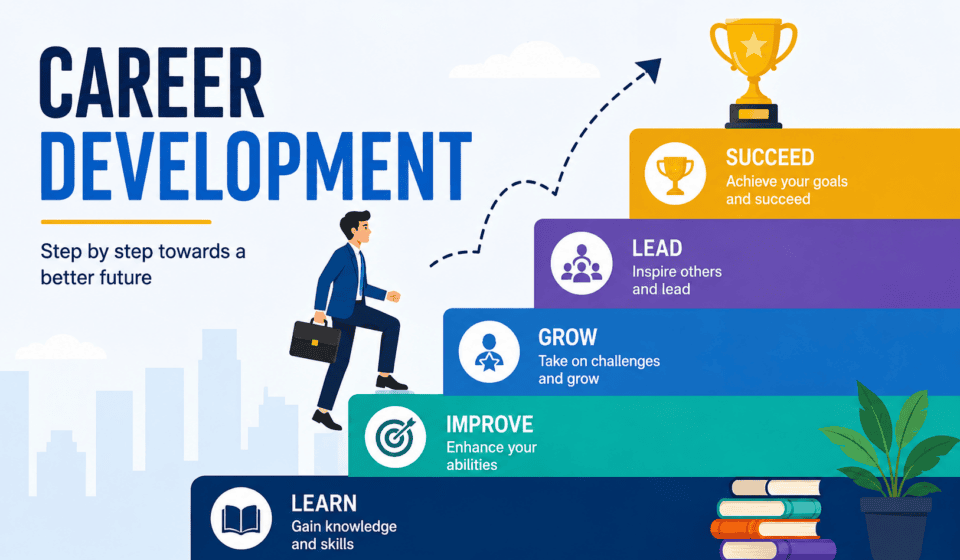

Career development is an ongoing process of improving your skills, knowledge, experience, and professional direction to achieve your career goals. Whether you are a student choosing your first career, a freelancer building a professional business, or an experienced employee looking for advancement, having a clear career development strategy can help you make better decisions and create more opportunities.
The modern job market is changing rapidly. New technologies, artificial intelligence, remote work, digital marketing, freelancing, and changing employer expectations have created both challenges and opportunities. Simply having a degree or completing a training course is often not enough. You need to continuously learn, adapt, build valuable skills, and understand where your career is going.
In this guide, we will explore what career development means, why it is important, the key stages of career development, essential skills to develop, and practical strategies you can use to build a successful and sustainable career.
What Is Career Development?
Career development is the process of managing and improving your professional life over time. It involves understanding your interests and strengths, setting career goals, learning new skills, gaining experience, building professional relationships, and making decisions that move you closer to your desired career.
Career development does not necessarily mean getting promoted or earning a higher salary. It can also mean changing careers, becoming a freelancer, starting a business, developing a specialization, improving your professional confidence, or finding work that provides greater satisfaction.
For example, a beginner interested in web design might start by learning HTML and CSS. After developing basic skills, they could learn WordPress, JavaScript, UI/UX design, SEO, and digital marketing. Eventually, they might build a portfolio, work with clients, become a freelancer, and later establish their own digital agency.
This is career development in action.
Why Is Career Development Important?
A strong career development plan can provide direction and help you avoid making professional decisions without a clear purpose.
1. It Gives You a Clear Direction
Many people spend years working without knowing what they actually want from their careers. Career development encourages you to identify your interests, strengths, values, and long-term goals.
When you know where you want to go, it becomes easier to decide which skills to learn and which opportunities to pursue.
2. It Helps You Build Valuable Skills
Successful careers require continuous learning. Technology and workplace requirements change frequently, so professionals need to update their skills.
For example, a digital marketer who learned only traditional SEO several years ago may now need knowledge of AI tools, content strategy, analytics, social media, automation, and search engine changes.
Continuous skill development keeps you competitive.
3. It Improves Your Career Opportunities
Employers and clients generally look for people who can demonstrate valuable skills and produce results.
Developing technical skills, communication abilities, problem-solving skills, leadership capabilities, and industry knowledge can increase the number of opportunities available to you.
4. It Builds Professional Confidence
Confidence often comes from preparation and experience.
When you consistently learn, practice, complete projects, and solve real problems, you become more confident in your abilities. This confidence can help you perform better during interviews, presentations, client meetings, and professional discussions.
5. It Helps You Adapt to Change
No career remains exactly the same forever. Industries evolve, technology changes, and new roles emerge.
Career development teaches you to remain flexible. Instead of being afraid of change, you can prepare for it by developing transferable skills and staying informed about your industry.
The Key Stages of Career Development
Career development can be viewed as a series of stages. Everyone’s career journey is different, but these stages provide a useful framework.
Stage 1: Self-Assessment
The first step is understanding yourself.
Ask questions such as:
- What am I good at?
- What activities do I enjoy?
- What subjects interest me?
- What type of work environment do I prefer?
- What are my strongest skills?
- What skills do I need to improve?
- What kind of lifestyle do I want?
- What professional achievements would make me proud?
Self-assessment helps you identify potential career paths that match your abilities and interests.
You can also review your previous experiences. Think about projects, assignments, jobs, or activities where you performed particularly well.
Stage 2: Career Exploration
Once you understand yourself better, explore different career options.
Research industries, job roles, required qualifications, salaries, skill requirements, career growth opportunities, and future demand.
For example, someone interested in technology could explore careers such as:
- Web designer
- Web developer
- UX/UI designer
- Software developer
- SEO specialist
- Digital marketer
- Data analyst
- Cybersecurity specialist
- AI specialist
- Technical writer
Career exploration helps you avoid choosing a career based only on assumptions.
Stage 3: Goal Setting
After exploring different options, establish specific career goals.
Instead of saying, “I want a successful career,” create measurable goals.
For example:
Short-term goal: Complete a professional web design course within three months.
Medium-term goal: Build a portfolio containing five professional projects within six months.
Long-term goal: Become a freelance web designer with a stable client base within two years.
Clear goals make your progress easier to measure.
Stage 4: Skill Development
Once your goals are clear, identify the skills required to achieve them.
Suppose your goal is to become a professional digital marketer. You might need to learn:
- Search engine optimization
- Content marketing
- Social media marketing
- Email marketing
- Analytics
- Paid advertising
- Conversion optimization
- AI-assisted marketing
- Marketing automation
Create a learning plan and focus on practical application rather than simply collecting certificates.
Stage 5: Gaining Experience
Knowledge becomes more valuable when you can apply it.
Students and beginners can gain experience through personal projects, internships, volunteer work, freelance projects, apprenticeships, and practical assignments.
For example, a beginner web designer can create websites for imaginary businesses or personal projects to demonstrate their abilities.
A portfolio can often communicate your skills more effectively than a list of courses.
Stage 6: Reviewing and Improving
Career development is not a one-time activity.
Regularly evaluate your progress. Ask:
- What have I achieved?
- Which skills have improved?
- What challenges am I facing?
- What should I learn next?
- Am I still interested in this career?
- Are my current goals still relevant?
Your career plan should evolve as your experience and circumstances change.
Essential Skills for Career Development
Modern professionals need a combination of technical and soft skills.
Technical Skills
Technical skills are abilities directly related to a particular profession.
Examples include:
- Web development
- Graphic design
- SEO
- Data analysis
- Programming
- Accounting
- Video editing
- Digital advertising
- Project management
- Software development
The specific technical skills you need depend on your career.
Communication Skills
Communication is valuable in almost every profession.
You may need to communicate with employers, coworkers, customers, clients, managers, or business partners.
Develop your ability to write professional emails, explain ideas clearly, listen carefully, give presentations, and communicate professionally online.
Problem-Solving Skills
Employers and clients value people who can identify problems and develop practical solutions.
Instead of only learning how to follow instructions, practice analyzing situations and finding better ways to accomplish goals.
Time Management
Poor time management can limit professional growth.
Learn to prioritize important tasks, create realistic schedules, avoid unnecessary distractions, and meet deadlines.
For freelancers, time management is particularly important because they often manage multiple clients and projects simultaneously.
Adaptability
The ability to adapt is increasingly important.
New software, technologies, business models, and workplace practices can appear quickly. Professionals who are willing to learn and adapt are better prepared for change.
Leadership
Leadership is not limited to managers.
You can demonstrate leadership by taking responsibility, helping colleagues, solving problems, communicating effectively, and taking initiative.
Developing leadership skills can prepare you for future management and business opportunities.
Career Development for Students
Students have an important advantage: time.
You can begin developing your career before graduating.
Start by exploring different career paths and identifying the skills employers value in your preferred field.
Create small projects related to your interests. If you want to become a web designer, build websites. If you want to become a writer, create articles. If you want to work in marketing, develop sample campaigns.
Internships and practical experience can also provide valuable insight into professional life.
Do not focus exclusively on academic results. Develop communication, teamwork, problem-solving, technology, and professional skills as well.
Career Development for Freelancers
Freelancing provides unique career development opportunities because you have greater control over your professional direction.
However, freelancers need more than technical skills.
You may need to develop:
- Personal branding
- Client communication
- Proposal writing
- Pricing
- Negotiation
- Project management
- Financial management
- Networking
- Marketing
- Sales
- Time management
A freelancer should also build a strong portfolio.
Instead of trying to offer every possible service, consider developing a specialization. For example, you could specialize in WordPress websites for small businesses, SEO for local businesses, or social media marketing for specific industries.
Specialization can make it easier to communicate your value to potential clients.
Career Development for Working Professionals
Career development does not stop after getting a job.
Professionals should continue developing their skills and preparing for future opportunities.
Talk with your manager about potential career paths within your organization. Identify skills required for higher-level positions and look for opportunities to take on additional responsibilities.
You can also participate in professional training, attend industry events, complete relevant certifications, and develop relationships with other professionals.
If your current career no longer matches your goals, consider whether you need to change your role, industry, specialization, or working environment.
How to Create a Career Development Plan
A career development plan does not need to be complicated.
Follow these steps:
Step 1: Define Your Career Goal
Write down what you want to achieve.
For example:
“I want to become a professional freelance web designer specializing in WordPress websites.”
Step 2: Identify the Required Skills
List the skills you need.
For a web designer, these might include:
- HTML
- CSS
- WordPress
- UI/UX design
- Responsive design
- SEO fundamentals
- Website performance
- Client communication
Step 3: Identify Your Skill Gaps
Compare your current abilities with the skills required for your goal.
Determine what you already know and what you need to learn.
Step 4: Create Learning Goals
Choose specific learning targets.
For example:
“Complete a responsive web design course within eight weeks.”
Step 5: Practice Through Projects
Apply what you learn.
Build websites, create campaigns, solve problems, or complete projects related to your target career.
Step 6: Build Your Professional Portfolio
Document your best work.
Your portfolio should demonstrate what you can actually do rather than simply describing your skills.
Step 7: Track Your Progress
Review your progress regularly.
You can use a simple spreadsheet, notebook, project management tool, or digital document to track your goals.
The Role of Networking in Career Development
Networking can create opportunities that are difficult to find through job applications alone.
Professional networking involves building genuine relationships with people in your industry.
You can network through:
- Professional events
- Conferences
- Online communities
- Workshops
- Training programs
- Freelance platforms
- Industry groups
Networking is not simply about asking people for jobs. Focus on learning, sharing knowledge, helping others, and developing meaningful professional relationships.
Over time, these relationships can lead to referrals, collaborations, job opportunities, clients, and valuable advice.
Using Technology and AI for Career Development
Technology is transforming how people learn and work.
AI tools can assist with research, brainstorming, writing, productivity, data analysis, learning, automation, and many other professional activities.
However, AI should be treated as a tool rather than a replacement for professional judgment.
Develop strong fundamentals first, then learn how technology and AI can improve your productivity.
For example, a digital marketer might use AI to generate ideas, analyze information, organize research, or automate repetitive tasks while still using human judgment to create strategy and make final decisions.
The professionals who learn to work effectively with emerging technology may have a significant advantage as industries continue to evolve.
Common Career Development Mistakes
Career growth can be slowed by several common mistakes.
Following Trends Without Research
A career may become popular because of social media, but popularity does not automatically mean it is right for you.
Research the field before investing significant time and money.
Learning Without Practicing
Watching courses without applying what you learn can create the illusion of progress.
Practice is essential.
Collecting Certificates Without Building Skills
Certificates can be useful, but employers and clients also want evidence that you can perform the work.
Build projects and develop a portfolio alongside your education.
Avoiding Networking
Some professionals believe their skills alone will create opportunities.
Skills matter, but relationships and professional visibility can also be extremely valuable.
Not Updating Your Skills
A skill that was highly valuable several years ago may become less competitive as technology changes.
Continue learning throughout your career.
Setting Unrealistic Goals
Career development takes time.
Avoid expecting to become an expert in a few weeks. Set realistic milestones and focus on consistent progress.
A Simple Career Development Strategy
If you are unsure where to start, use this simple framework:
Know Yourself → Choose a Direction → Learn Skills → Practice → Build Experience → Build Your Network → Create Opportunities → Review and Improve
You do not need to have your entire career planned from the beginning.
Your first goal is to choose a direction and take action. As you gain experience, you will learn more about what you enjoy, what you are good at, and what opportunities are available.
Final Thoughts
Career development is a lifelong journey rather than a single destination. Whether you are a student, freelancer, employee, entrepreneur, or career changer, you can improve your professional future by continuously learning, gaining experience, developing valuable skills, building relationships, and setting meaningful goals.
The most successful career development strategies are practical and flexible. Do not wait until you have the perfect plan before taking action. Start with a clear goal, identify the skills you need, practice consistently, and measure your progress.
The world of work will continue to change, especially as digital technologies and artificial intelligence reshape different industries. Your ability to learn, adapt, and apply new knowledge may become one of your most valuable professional assets.
Investing in yourself today can create opportunities tomorrow.
Start where you are, choose a direction, develop valuable skills, and keep moving forward. Your career is something you can actively build—one skill, one project, and one opportunity at a time.