
Starting freelancing with no experience may seem difficult, but it is absolutely possible. You do not need years of professional experience, a large portfolio, or hundreds of clients to get started. What you need is a marketable skill, a willingness to learn, a strong profile, and a consistent approach to finding your first clients.
Freelancing has become an attractive career option for students, job seekers, professionals, and people who want to build an independent income. You can work from home, choose the services you offer, work with clients from different countries, and gradually increase your income as your skills and reputation improve.
The biggest challenge for beginners is usually the same question: “How can I get clients if I have no experience?”
The answer is to focus on building proof of your ability rather than waiting until someone gives you professional experience.
In this guide, you will learn exactly how to start freelancing with no experience, what skills you can learn, how to create a portfolio, where to find clients, how to write proposals, and how to get your first freelance project.
What Is Freelancing?
Freelancing means working independently for clients instead of being permanently employed by one company. Freelancers provide specific services to individuals, businesses, agencies, startups, and organizations.
Depending on your skills, you might work as a:
- Web designer
- WordPress developer
- Graphic designer
- Digital marketer
- SEO specialist
- Content writer
- Video editor
- Social media manager
- Virtual assistant
- Data entry specialist
- Email marketer
- UI/UX designer
A freelancer may work with one client for a few hours or several months. Some projects are one-time jobs, while others become long-term relationships.
The great thing about freelancing is that you can start small and build your career gradually.
Can You Start Freelancing Without Experience?
Yes, you can start freelancing without previous professional experience.
However, there is an important distinction between having no professional experience and having no skills.
Clients generally want to know whether you can solve their problem. They may not care whether you previously worked for a company if you can demonstrate that you understand their requirements and can deliver quality work.
For example, if you want to become a freelance WordPress designer, you do not necessarily need to have worked for an agency. You can create several practice websites, improve them, and use those projects as examples in your portfolio.
Your first goal should therefore be:
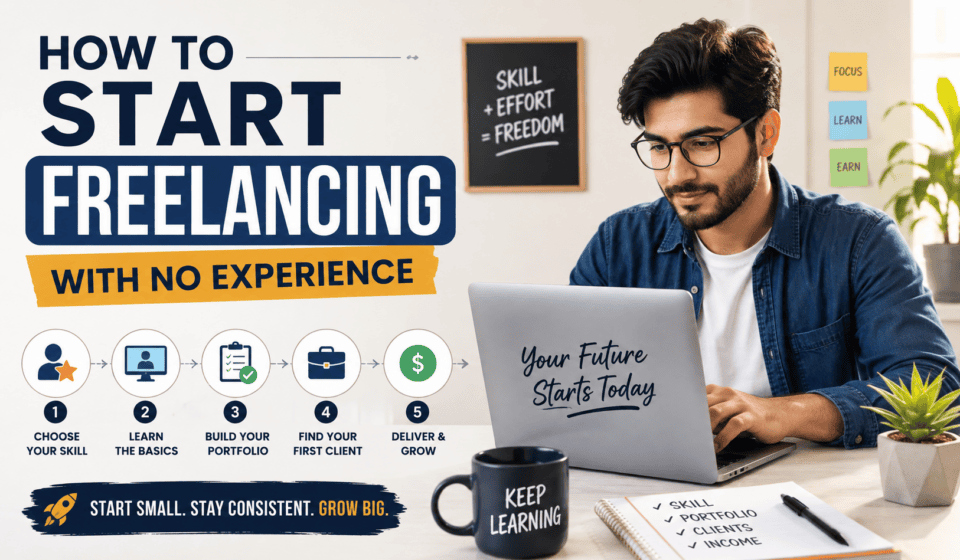
Learn → Practice → Create → Showcase → Find Clients → Deliver → Get Reviews → Grow.
This process allows you to build experience even when nobody has hired you yet.
Step 1: Choose One Freelancing Skill
The first mistake many beginners make is trying to learn everything at once.
They learn web design, SEO, graphic design, video editing, digital marketing, coding, and content writing simultaneously. After several months, they know a little about everything but are not confident enough to sell any particular service.
Instead, choose one primary skill.
Consider your interests, existing knowledge, and market demand.
Some beginner-friendly freelancing skills include:
Web Design
If you enjoy websites and technology, web design can be an excellent choice. You can learn WordPress, HTML, CSS, basic UX principles, landing page design, and website customization.
Graphic Design
Graphic designers create social media graphics, banners, advertisements, presentations, business cards, thumbnails, and other visual materials.
Content Writing
If you enjoy writing, you can offer blog writing, website content, product descriptions, email copy, and other writing services.
Digital Marketing
Digital marketing includes SEO, social media marketing, email marketing, content marketing, and paid advertising.
Video Editing
The demand for short-form videos, YouTube content, advertisements, and social media videos creates opportunities for video editors.
Virtual Assistance
Virtual assistants help businesses with administrative tasks, research, email management, scheduling, data entry, and customer support.
Choose one skill and become good enough to solve a specific client problem.
Step 2: Learn the Fundamentals
Once you choose your skill, start learning the fundamentals.
You do not need to know everything before getting started. In fact, waiting until you become an “expert” can prevent you from ever taking action.
Focus on learning the skills that clients actually need.
For example, if you choose WordPress web design, start with:
- WordPress basics
- Website structure
- Themes and plugins
- Page builders
- Responsive design
- Basic SEO
- Website speed
- Contact forms
- Security basics
- Mobile-friendly design
If you choose SEO, learn:
- Keyword research
- Search intent
- On-page SEO
- Technical SEO basics
- Internal linking
- Content optimization
- Basic analytics
- SEO reporting
Learn from courses, tutorials, documentation, books, practice projects, and real-world examples.
Most importantly, practice what you learn.
Step 3: Practice by Creating Your Own Projects
This is one of the most important steps for anyone wondering how to start freelancing with no experience.
If you have no clients, create projects yourself.
You can build sample projects based on imaginary businesses or personal ideas.
For example, a beginner web designer could create:
- A restaurant website
- A fitness trainer website
- A real estate website
- A personal portfolio website
- A small business landing page
These do not have to be real client projects.
Clearly label them as sample projects or practice projects. The purpose is to demonstrate your ability.
A portfolio containing five strong sample projects can be much more useful than a profile saying, “I am a beginner and I have no experience.”
Step 4: Build a Professional Portfolio
Your portfolio is your proof of ability.
A good freelance portfolio should answer three questions:
What can you do?
How good is your work?
How can someone hire you?
Your portfolio should include:
- A professional introduction
- Your primary service
- Your skills
- Sample projects
- A description of each project
- The problem you solved
- Screenshots or demonstrations
- Your contact information
- A clear call to action
For example, instead of simply writing:
“I create websites.”
Write something more specific:
“I design responsive WordPress websites for small businesses, coaches, freelancers, and service providers.”
Specific positioning makes it easier for potential clients to understand your service.
Step 5: Create Profiles on Freelance Platforms
Freelance marketplaces can help beginners find their first clients.
Popular platforms include:
- Upwork
- Fiverr
- Freelancer
- PeoplePerHour
Do not create profiles on every platform immediately.
Start with one or two platforms and learn how they work.
Your profile should contain a professional photo, a clear headline, a useful description, relevant skills, and your strongest portfolio examples.
Avoid writing a profile that focuses heavily on your lack of experience.
Instead of saying:
“I am new to freelancing and don’t have experience.”
Focus on what you can provide:
“I help small businesses create professional, mobile-friendly WordPress websites that are designed to provide a better experience for their customers.”
Clients are interested in solutions, not simply your employment history.
Step 6: Create a Strong Freelance Service Offer
Beginners often make their services too broad.
For example:
“I do digital marketing.”
This is vague.
A better offer might be:
“I will optimize your WordPress website for basic on-page SEO.”
Or:
“I will design a responsive WordPress landing page for your business.”
A specific service is easier to understand, market, price, and deliver.
When creating your service, identify:
Target client + Problem + Solution + Result
For example:
Target client: Small business owners
Problem: Their website looks outdated
Solution: Modern responsive WordPress redesign
Result: A professional website that works well on desktop and mobile
This makes your offer much stronger.
Step 7: Start With Small Projects
Your first freelance project does not have to be worth thousands of dollars.
Your initial goal should be to gain:
- Experience
- Client communication skills
- Testimonials
- Reviews
- Portfolio examples
- Confidence
Look for small projects that match your current abilities.
For example, instead of offering to build a complete e-commerce platform immediately, you might start by offering:
- Landing page design
- WordPress installation
- Website customization
- Basic SEO optimization
- Website speed improvements
- Social media graphics
- Blog formatting
Small projects allow you to learn how freelancing works while reducing the risk of making a major mistake.
Step 8: Write Better Freelance Proposals
When applying for freelance jobs, avoid sending the same generic proposal to every client.
A good proposal should show that you understand the client’s problem.
For example, instead of:
“Hello Sir, I am interested in your project. I am an expert and can do this job. Please hire me.”
Write something more relevant:
“I noticed that your website needs a cleaner mobile layout and clearer calls to action. I can redesign the key sections in WordPress and make sure the pages work smoothly across desktop and mobile devices.”
Then explain briefly how you would approach the project.
A strong proposal should generally include:
- A personalized opening
- Your understanding of the project
- Your proposed solution
- Relevant examples
- A simple next step
Keep proposals concise and client-focused.
Step 9: Learn How to Communicate With Clients
Freelancing is not only about technical skills.
Communication is equally important.
A client may choose a freelancer with slightly less technical experience if that freelancer communicates clearly, responds professionally, and understands the project.
Develop good habits such as:
- Responding professionally
- Asking clear questions
- Confirming requirements
- Meeting deadlines
- Giving progress updates
- Explaining technical issues simply
- Being honest about limitations
- Delivering files in an organized way
Never promise something you cannot deliver.
Professional communication can turn a small first project into a long-term client relationship.
Step 10: Get Your First Client Without a Portfolio
If you truly have no portfolio, you can still find opportunities.
Start with people and businesses you already know.
You might offer your services to:
- Local businesses
- Friends
- Family businesses
- Community organizations
- Small startups
- Coaches
- Freelancers
- Restaurants
- Online businesses
You can also contact businesses whose websites or social media presence could be improved.
Do not spam people.
Instead, identify a genuine problem and offer a useful solution.
For example:
“I noticed your business website isn’t displaying properly on mobile. I specialize in responsive WordPress design and would be happy to show you how I could improve it.”
This approach is much more professional than simply saying:
“Do you need a website?”
Step 11: Use LinkedIn and Social Media
Freelancing does not have to depend entirely on freelance marketplaces.
You can build your personal brand through platforms such as LinkedIn, Facebook, Instagram, and other professional communities.
Share useful content related to your skill.
For example, a web designer can post:
- Website design tips
- Before-and-after redesigns
- WordPress tutorials
- Landing page examples
- Common website mistakes
- Mobile design tips
- SEO tips
Over time, your content can demonstrate your expertise and attract potential clients.
Think of social media as a way to show what you know before someone hires you.
Step 12: Set Your Freelance Pricing Carefully
Pricing is one of the most confusing topics for beginners.
Some beginners charge extremely low prices because they think they have no experience.
This can create problems.
Very low prices can attract difficult clients, create unrealistic expectations, and make it difficult to maintain your business.
Instead, research the market and consider:
- Project complexity
- Time required
- Your skill level
- Client requirements
- Value delivered
- Revisions
- Communication time
When starting out, you can offer competitive beginner pricing while gradually increasing your rates as your skills and reputation improve.
Do not remain at beginner rates forever.
Step 13: Deliver Excellent Work
Getting a client is only the beginning.
Your real opportunity comes from delivering excellent work.
Before submitting a project, check:
- Did you follow the instructions?
- Did you complete all requested tasks?
- Are there spelling mistakes?
- Does everything work correctly?
- Is the design responsive?
- Are files organized?
- Did you test the final result?
- Did you meet the deadline?
A client who is satisfied with your work may provide a testimonial, leave a positive review, recommend you to someone else, or hire you again.
That is how your freelance career begins to grow.
Step 14: Collect Testimonials and Reviews
Once you complete a project successfully, ask the client for feedback.
A testimonial can help future clients trust you.
If you work through a freelance marketplace, positive reviews can also strengthen your profile.
Your first few projects are particularly valuable because they help you move from:
No experience → Some experience → Proven results.
After completing several successful projects, you will no longer need to describe yourself as someone with “no experience.”
You will have real examples of your work.
Common Mistakes Freelancing Beginners Should Avoid
Starting freelancing can be exciting, but avoid these common mistakes.
Trying to Learn Everything
Focus on one skill instead of becoming overwhelmed by dozens of subjects.
Waiting Until You Are Perfect
You can continue learning while taking suitable beginner-level projects.
Creating a Weak Portfolio
A portfolio should demonstrate your abilities, not simply list your skills.
Sending Generic Proposals
Personalize your applications based on the client’s actual requirements.
Taking Every Client
Not every client is a good client. Learn to identify unrealistic expectations and unclear projects.
Missing Deadlines
Reliability is one of the most valuable qualities a freelancer can have.
Working Without Clear Requirements
Always confirm what the client expects before starting.
Undercharging Forever
Beginner pricing can help you enter the market, but your rates should increase as your experience and value increase.
How Long Does It Take to Start Freelancing?
There is no fixed timeline.
Some people may find their first project within weeks, while others may take several months.
Your progress depends on factors such as:
- The skill you choose
- How quickly you learn
- The quality of your portfolio
- How many applications you send
- Your communication skills
- Your pricing
- Market demand
- Your consistency
Do not judge your progress based on someone else’s timeline.
Instead, focus on improving every week.
A Simple 30-Day Freelancing Plan for Beginners
If you are unsure where to start, follow this simple plan.
Week 1: Choose and Learn
Choose one freelancing skill and study its fundamentals.
Spend time learning and practicing every day.
Week 2: Build Projects
Create two or three sample projects that demonstrate your ability.
Focus on quality rather than quantity.
Week 3: Build Your Profile
Create your portfolio and professional freelance profile.
Write a clear service description and prepare examples of your work.
Week 4: Find Clients
Start applying for relevant jobs and contacting potential clients.
Aim for consistent activity rather than expecting immediate success.
For example, you could spend each day:
- 1 hour learning
- 1 hour improving your portfolio
- 1 hour searching for opportunities
- 1 hour sending personalized proposals
The exact schedule is less important than consistency.
What Should You Do After Getting Your First Client?
Your first client should not be the end of your learning process.
After completing the project, review what happened.
Ask yourself:
- What did I do well?
- What problems did I encounter?
- What did the client teach me?
- What could I improve?
- Can I turn this project into a portfolio case study?
- Can I offer a related service?
Use every project as a learning opportunity.
Gradually, you can specialize in a niche, increase your prices, improve your portfolio, and develop long-term client relationships.
Final Thoughts
Starting freelancing with no experience is challenging, but it is not impossible.
You do not need to wait for a company to give you experience. You can start building your experience today by learning a valuable skill, creating practice projects, developing a professional portfolio, and actively looking for clients.
The most important thing is to stop thinking:
“I have no experience, so nobody will hire me.”
Instead, think:
“What can I create today that proves I can solve a client’s problem?”
Your first project may be small. Your first client may not pay a huge amount. Your first proposal may be rejected. Your first portfolio may not be perfect.
That’s okay.
Every successful freelancer started somewhere.
Learn one skill. Practice consistently. Build proof of your ability. Find your first client. Deliver excellent work. Collect feedback. Improve your skills. Then repeat the process.
With patience, consistency, and continuous learning, freelancing can grow from a beginner experiment into a professional career.
Your freelancing journey doesn’t begin when you get your first client. It begins when you decide to start.