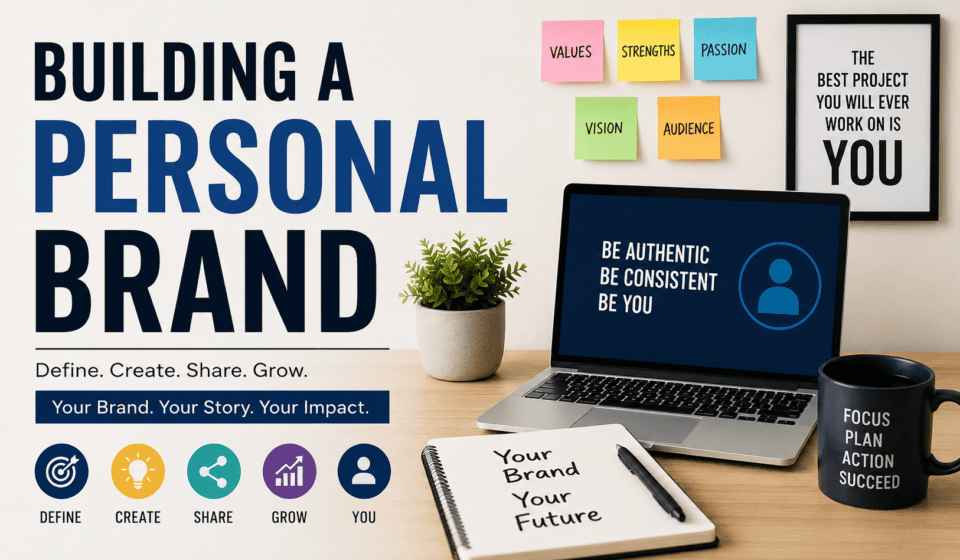

In today’s digital world, having skills is important—but knowing how to present those skills is equally important. Whether you are a freelancer, entrepreneur, student, coach, web designer, digital marketer, or content creator, building a personal brand can help you attract opportunities, establish credibility, and stand out from the competition.
A personal brand is more than a logo, professional photo, or social media profile. It is the way people recognize, understand, and remember you. Your knowledge, skills, personality, communication style, values, experience, and online presence all contribute to your personal brand.
The good news is that you do not need to be famous to build a strong personal brand. You simply need to communicate what you know, demonstrate your expertise, provide value, and consistently show people why they should trust you.
In this guide, you will learn what personal branding is, why it matters, how to define your brand, how to build an online presence, what content to create, and how to grow your personal brand over time.
What Is Personal Branding?
Personal branding is the process of intentionally presenting your skills, expertise, personality, values, and experience so that people develop a clear understanding of who you are and what you can offer.
Think of your personal brand as your professional reputation in the digital world.
For example, someone may become known as:
- A web designer who creates high-converting websites
- A digital marketer who specializes in SEO
- A freelancer who helps small businesses grow online
- A career coach who helps beginners find remote jobs
- A content creator who teaches social media marketing
- A developer who explains complicated technology simply
Your personal brand should answer three important questions:
Who are you?
What do you do?
Why should people trust you?
When people can answer these questions quickly, your personal brand becomes easier to understand and remember.
Why Is Personal Branding Important?
The internet has made it easier than ever to showcase your work and connect with potential clients, employers, students, and business partners. However, it has also created enormous competition.
There may be thousands of people offering services similar to yours.
A strong personal brand can help you differentiate yourself.
1. It Builds Trust
People prefer working with professionals they trust. When you consistently share useful information, demonstrate your knowledge, and communicate professionally, people become more familiar with you.
Over time, familiarity can develop into trust.
For freelancers and service providers, trust is particularly important because potential clients often need evidence that you can solve their problems before they hire you.
2. It Helps You Stand Out
Suppose ten freelancers offer similar services. If all of them have similar websites, profiles, and messages, it can be difficult for clients to choose.
A strong personal brand gives people a reason to remember you.
Your unique combination of skills, experience, personality, values, and approach can become your competitive advantage.
3. It Creates Career Opportunities
Personal branding isn’t only useful for freelancers and business owners.
Students and professionals can also benefit from it.
Recruiters, companies, event organizers, publishers, and potential business partners often search online before making decisions. A professional online presence can help you make a stronger first impression.
4. It Can Attract Clients
Instead of constantly searching for clients, a strong personal brand can help potential clients discover you.
For example, if you regularly publish articles about website design and SEO, someone searching for information about those subjects may discover your content and eventually become a client.
This is one reason content marketing and personal branding work so well together.
5. It Establishes Authority
When you consistently demonstrate your knowledge, people may begin to see you as an expert in your field.
You don’t need to know everything.
Instead, focus on becoming highly useful within a specific area.
For example, rather than trying to become known for “digital marketing,” you could focus on:
- SEO for small businesses
- Local SEO
- WordPress marketing
- Content marketing
- Social media for freelancers
- Email marketing
- Website conversion optimization
A specific area makes it easier to establish authority.
How to Build a Personal Brand Step by Step
Building a personal brand takes time. It is not something you create overnight.
The following steps can help you build a strong foundation.
1. Define Your Expertise
Start by identifying what you know and what you can help people with.
Make a list of your:
- Professional skills
- Technical skills
- Work experience
- Education
- Personal interests
- Achievements
- Problems you can solve
- Topics you enjoy teaching
You don’t have to choose only one skill, but your audience should be able to understand your main area of expertise.
For example:
“I help small businesses build professional WordPress websites and attract customers through SEO.”
This is much clearer than simply saying:
“I am a digital marketer.”
The first statement tells people who you help, what you do, and the result you provide.
2. Identify Your Target Audience
A personal brand becomes stronger when you know exactly who you want to reach.
Ask yourself:
- Who needs my skills?
- What problems do they have?
- What information are they searching for?
- What results do they want?
- Where do they spend time online?
- What type of content do they prefer?
Your audience might include freelancers, students, entrepreneurs, small business owners, job seekers, or marketing professionals.
Trying to appeal to everyone can make your brand unclear.
Instead, choose a primary audience and create content specifically for them.
3. Create Your Personal Brand Statement
A personal brand statement is a short explanation of who you are, what you do, who you help, and the value you provide.
A useful formula is:
I help [target audience] achieve [desired result] through [your expertise].
For example:
“I help freelancers and small businesses build professional online brands through WordPress, web design, and digital marketing.”
Your statement can appear on your website, LinkedIn profile, social media profiles, and professional introduction.
4. Build a Professional Website
Your website should be the central home of your personal brand.
Social media platforms can change their algorithms, features, and policies. Your website gives you greater control over your professional presence.
A personal branding website can include:
- Homepage
- About page
- Services
- Portfolio
- Blog
- Testimonials
- Case studies
- Contact page
- Resources
- Courses or training
Your homepage should immediately communicate who you are and how you help people.
Avoid making visitors search for this information.
A strong homepage might include a clear headline, short introduction, professional photograph, services, evidence of your expertise, testimonials, selected work, and a clear call to action.
5. Develop a Consistent Visual Identity
Your personal brand should look professional and consistent across platforms.
You don’t necessarily need an expensive brand identity package.
Start with simple elements such as:
- Professional profile photo
- Consistent name
- Simple color palette
- Easy-to-read typography
- Consistent graphic style
- Professional website design
- Consistent social media imagery
Consistency makes your content easier to recognize.
However, remember that personal branding is not primarily about design. A beautiful website cannot compensate for weak communication, poor-quality content, or a lack of expertise.
6. Optimize Your Social Media Profiles
Choose social platforms based on where your target audience spends time.
Depending on your profession, you might use platforms such as LinkedIn, Facebook, Instagram, YouTube, TikTok, or X.
Don’t feel pressured to be active everywhere.
It is usually better to manage two platforms consistently than to create six profiles and rarely post on any of them.
Your profile should clearly communicate:
- Your name
- Your profession
- Your expertise
- Who you help
- What you offer
- A link to your website
Use the same professional identity across platforms whenever possible.
7. Create Valuable Content
Content is one of the most powerful tools for personal branding.
You can demonstrate your expertise by creating:
- Blog articles
- Tutorials
- Videos
- Case studies
- Social media posts
- Infographics
- Checklists
- Guides
- Podcasts
- Newsletters
- Online courses
Your content should solve real problems.
Instead of constantly saying, “I am an expert,” demonstrate your expertise by teaching people something useful.
For example, a web designer could publish:
- How to Choose a WordPress Theme
- Common Website Design Mistakes
- How to Improve Website Speed
- How to Create a Mobile-Friendly Website
- Landing Page Design Best Practices
This type of content can attract people who are already interested in your expertise.
8. Tell Your Story
People connect with people, not just professional qualifications.
Your story can make your personal brand more memorable.
You can share:
- How you started
- Challenges you experienced
- Lessons you learned
- Mistakes you made
- Skills you developed
- Projects you completed
- Problems you solved
- Goals you are working toward
You don’t need to share every detail of your personal life.
Instead, share experiences that help your audience understand your journey and learn from it.
A story such as “How I Got My First Freelance Client” can be more engaging than a generic article about freelancing.
9. Demonstrate Your Results
One of the strongest ways to build credibility is to show evidence of your work.
Don’t simply tell people what you can do.
Show them.
Create a portfolio that includes your best projects.
Whenever possible, explain:
The problem → Your solution → The result
For example:
A business had an outdated website that was difficult to use on mobile devices. I redesigned the website with a responsive layout, clearer navigation, and stronger calls to action.
Case studies can be particularly effective because they demonstrate your problem-solving ability.
10. Collect Testimonials
Positive feedback from clients, students, employers, or collaborators can strengthen your credibility.
Ask satisfied clients for testimonials after completing successful projects.
A useful testimonial should explain:
- What problem you solved
- What the experience was like
- What result they achieved
Specific testimonials are generally more useful than vague statements such as “Great service!”
For example:
“The new website made it much easier for our customers to find our services and contact us.”
This gives potential clients a better understanding of your value.
What Content Should You Publish?
A strong personal brand needs a content strategy.
One simple approach is to divide your content into four categories.
Educational Content
Teach your audience something.
Examples:
- Tutorials
- How-to guides
- Tips
- Checklists
- Step-by-step instructions
Inspirational Content
Share lessons, experiences, success stories, and motivation.
Personal Content
Show the person behind the professional brand.
You could share your workspace, learning process, professional journey, or behind-the-scenes experiences.
Promotional Content
Explain your services, courses, products, consulting, or other offers.
Avoid making every post promotional. A useful rule is to provide significant value before asking people to buy something.
Personal Branding and SEO
Search engine optimization can help people discover your personal brand through Google and other search engines.
Create content around topics your audience searches for.
For example, if you are a WordPress trainer, you could target topics such as:
- How to Create a WordPress Website
- Best WordPress Plugins for Beginners
- How to Improve WordPress Website Speed
- WordPress SEO Guide
- How to Build a Freelance Portfolio Website
Optimize your articles with:
- Relevant keywords
- Descriptive headings
- Helpful content
- Internal links
- Clear URLs
- Descriptive image alt text
- Strong titles and meta descriptions
- Useful external references when appropriate
Most importantly, write for people first.
Search engines increasingly reward content that genuinely helps users.
Common Personal Branding Mistakes
Building a personal brand can be exciting, but several mistakes can slow your progress.
Trying to Be Everywhere
You don’t need to use every social platform.
Focus on the channels where your audience is most active.
Copying Other People
Learn from successful professionals, but don’t copy their personality, content, or identity.
Your experiences and perspective are what make your brand unique.
Focusing Only on Yourself
Personal branding is not about constantly talking about yourself.
Your audience cares about what you can do for them.
Focus on solving their problems.
Inconsistent Publishing
Posting five times one week and disappearing for three months makes it difficult to build momentum.
Create a realistic publishing schedule.
Even one useful article per week can become a substantial content library over time.
Pretending to Know Everything
You don’t need to present yourself as an expert in everything.
If you don’t know something, say so.
Being honest can increase credibility rather than reduce it.
Ignoring Your Reputation
Every public interaction contributes to your personal brand.
Think carefully before posting angry comments, misleading information, offensive content, or unprofessional responses.
Your digital reputation can influence professional opportunities.
How Long Does It Take to Build a Personal Brand?
There is no fixed timeline.
Some people begin seeing results within a few months, while others need years to establish significant authority.
The most important factor is consistency.
Think of personal branding as a long-term investment.
One article probably won’t transform your career.
One social media post probably won’t make you famous.
But hundreds of useful articles, videos, projects, conversations, and professional interactions can create a powerful reputation.
A Simple Personal Branding Strategy
If you’re just starting, don’t overcomplicate the process.
Follow this simple plan:
Step 1: Choose your area of expertise.
Step 2: Define your target audience.
Step 3: Create a personal brand statement.
Step 4: Build a professional website.
Step 5: Optimize your social media profiles.
Step 6: Publish useful content consistently.
Step 7: Build a portfolio.
Step 8: Collect testimonials and case studies.
Step 9: Network with people in your industry.
Step 10: Review your progress and improve continuously.
You can start with one website and one social media platform. As your audience grows, you can expand.
Final Thoughts
Building a personal brand is one of the most valuable long-term investments you can make in your professional career.
Whether you are a freelancer looking for clients, a student trying to establish a career, an entrepreneur growing a business, or a professional looking for new opportunities, your personal brand can help people understand your expertise and remember your name.
The key is to focus on authenticity, consistency, expertise, and value.
Don’t wait until you have perfect skills.
Don’t wait until you have thousands of followers.
Don’t wait until your website is perfect.
Start with what you know.
Share what you learn.
Help people solve problems.
Show your work.
Build relationships.
Improve continuously.
Over time, these small actions can turn your online presence into a powerful professional asset.
Your personal brand is ultimately the reputation you build through your actions and the value you provide. Build it intentionally, protect it carefully, and use it to create opportunities that support your long-term goals.