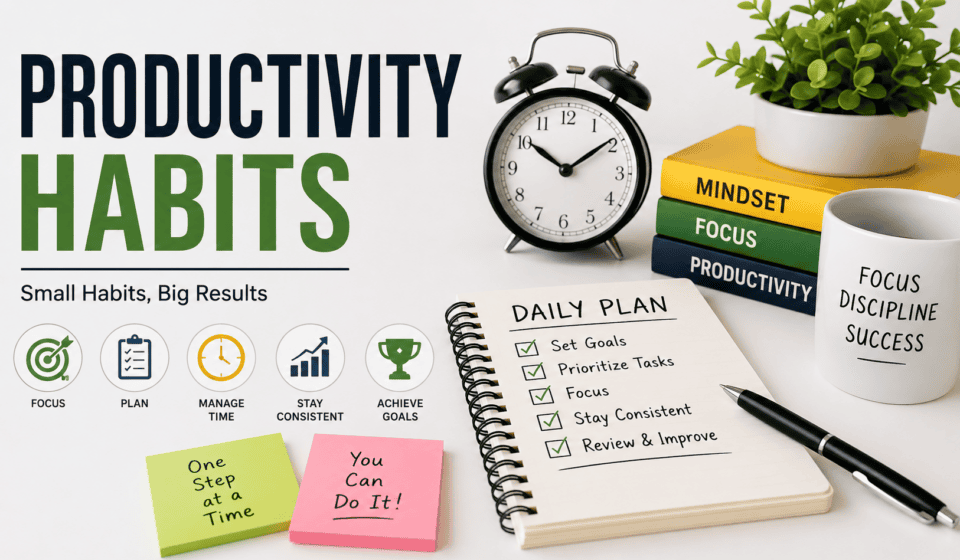

Being productive is not about working longer hours or constantly staying busy. True productivity means using your time, energy, and attention wisely so you can accomplish meaningful goals without unnecessary stress.
In today’s busy world, distractions are everywhere. Social media notifications, emails, meetings, messages, and endless tasks can make it difficult to focus on what really matters. Developing the right productivity habits can help you work more efficiently, stay organized, and create more time for the things that are important to you.
Whether you are a freelancer, student, entrepreneur, employee, or digital professional, small changes in your daily routine can make a significant difference.
In this guide, you’ll discover 15 powerful productivity habits that can help you manage your time, improve your focus, reduce procrastination, and get more done every day.
What Are Productivity Habits?
Productivity habits are repeated behaviors and routines that help you use your time, energy, and resources effectively.
For example, planning your day the night before, creating a prioritized task list, limiting distractions, taking regular breaks, and setting specific goals are all productivity habits.
The goal isn’t to fill every minute of your day with work. Instead, productivity is about making sure your effort is directed toward tasks that create meaningful results.
A productive person understands what needs to be done, prioritizes important activities, focuses on one task at a time, and avoids wasting unnecessary time and energy.
Why Are Productivity Habits Important?
Good productivity habits can improve both your professional and personal life.
When you develop effective habits, you can:
- Complete important tasks faster
- Reduce stress and overwhelm
- Improve concentration
- Avoid procrastination
- Manage deadlines more effectively
- Create more free time
- Make consistent progress toward your goals
- Improve your work quality
- Develop better self-discipline
- Maintain a healthier work-life balance
The key is consistency. You don’t need to completely change your lifestyle overnight. Start with one or two habits and gradually build a productive routine.
1. Start Your Day With a Clear Plan
One of the simplest productivity habits is planning your day.
Before you begin working, identify the tasks you need to complete. Without a plan, you may spend your morning reacting to emails, messages, notifications, and other people’s priorities.
Create a short list of your most important tasks.
For example:
- Finish website homepage
- Write 1,000 words for a blog post
- Respond to important client emails
- Review marketing campaign results
A clear plan gives your day direction and helps you avoid unnecessary activities.
You can prepare your plan either the night before or at the beginning of each morning.
2. Prioritize Your Most Important Tasks
Not every task has the same level of importance.
One of the biggest productivity mistakes people make is spending too much time on easy tasks while postponing important work.
Use the priority principle: identify the tasks that will have the biggest impact and complete them first.
Ask yourself:
“If I could complete only three tasks today, which ones would matter most?”
Those tasks should receive your best time and attention.
For example, if you are a freelancer, completing an important client project may be more valuable than spending an hour organizing your desktop files.
Focus on results, not just activity.
3. Use Time Blocking
Time blocking is a powerful technique for organizing your day.
Instead of creating a simple task list, divide your day into specific blocks of time and assign each block a particular activity.
For example:
- 8:00–9:00 AM — Planning and email
- 9:00–11:00 AM — Client project
- 11:00–11:30 AM — Break
- 11:30 AM–1:00 PM — Content creation
- 2:00–3:00 PM — Marketing
- 3:00–4:00 PM — Administrative tasks
Time blocking helps you decide in advance what you should work on and when.
It also reduces the temptation to switch between unrelated tasks.
4. Eliminate Unnecessary Distractions
Distractions are one of the biggest enemies of productivity.
A five-minute social media check can easily become 30 minutes of scrolling. Frequent notifications can also interrupt your concentration.
When working on an important task:
- Turn off unnecessary notifications
- Put your phone away
- Close unrelated browser tabs
- Avoid unnecessary social media
- Use website blockers when necessary
- Keep your workspace organized
Create an environment that makes focused work easier.
Remember, you don’t always need more motivation. Sometimes you simply need fewer distractions.
5. Practice Single-Tasking
Many people believe multitasking makes them more productive. In reality, constantly switching between tasks can make it harder to concentrate and may reduce the quality of your work.
Instead of working on five things simultaneously, choose one important task and give it your full attention.
For example, if you’re writing an article, focus only on writing. Don’t repeatedly check email or social media while working.
Complete the current task before moving to another whenever possible.
Single-tasking can help you maintain deeper concentration and produce better results.
6. Use the Two-Minute Rule
The two-minute rule is a simple way to prevent small tasks from accumulating.
If something can be completed in approximately two minutes, consider doing it immediately rather than adding it to your task list.
Examples include:
- Replying to a short message
- Filing a document
- Sending a quick confirmation
- Putting something away
- Scheduling a simple appointment
However, don’t use this rule as an excuse to constantly interrupt important work.
If you’re in the middle of deep work, record the task and handle it during your designated administrative time.
7. Take Regular Breaks
Working continuously for hours may seem productive, but your concentration naturally decreases over time.
Regular breaks can help you refresh your mind and maintain your energy.
During a break, step away from your computer. Walk around, stretch, drink water, or simply rest your eyes.
You can experiment with productivity techniques such as working for a focused period followed by a short break.
The exact timing isn’t as important as finding a rhythm that works for you.
The goal is to maintain sustainable productivity instead of exhausting yourself.
8. Avoid Procrastination
Procrastination happens when you delay an important task even though you know it needs to be completed.
Instead of waiting until you feel motivated, make the task easier to start.
Break a large project into smaller steps.
For example, instead of writing:
“Create a website.”
Break it into:
- Choose a website structure
- Create the homepage
- Write the About page
- Create the services page
- Add contact information
- Optimize the website for mobile devices
- Test the website
A large project can feel overwhelming. Smaller actions make it easier to begin.
Sometimes the hardest part is simply starting.
9. Set Specific Goals
Productivity becomes much easier when you know exactly what you’re trying to accomplish.
Instead of setting a vague goal such as:
“I want to improve my website.”
Create a specific goal:
“I will publish two SEO-optimized blog posts this week.”
Specific goals provide clarity and make progress easier to measure.
You can use daily, weekly, monthly, and yearly goals depending on your needs.
Make sure your goals are realistic enough to be achievable but challenging enough to encourage growth.
10. Create a Morning Routine
A consistent morning routine can help you start your day with structure.
Your routine doesn’t need to be complicated.
It could include:
- Waking up at a consistent time
- Drinking water
- Reviewing your goals
- Planning the day’s priorities
- Exercising or stretching
- Reading
- Starting your most important task
Avoid immediately opening social media or spending excessive time checking notifications.
Instead, give yourself a few minutes to decide how you want to use your day.
11. Keep Your Workspace Organized
Your environment can influence your ability to concentrate.
A cluttered desk, unnecessary browser tabs, and disorganized files can create mental distractions.
Spend a few minutes organizing your workspace.
Keep only the items you need nearby. Organize important digital files into clearly labeled folders and remove unnecessary applications or browser tabs.
A clean workspace doesn’t guarantee productivity, but it can make focused work easier.
12. Learn to Say No
One of the most overlooked productivity habits is learning to say no.
Every new commitment requires time and energy.
If you accept every request, meeting, project, or invitation, your schedule can quickly become overwhelming.
Before accepting something, ask:
“Does this support my current priorities?”
If the answer is no, consider declining it or postponing it.
Saying no isn’t being unhelpful. It can be a way of protecting your time and focusing on what matters most.
13. Limit Unnecessary Meetings
Meetings can consume a significant amount of working time.
Before scheduling or attending a meeting, consider whether the information could be communicated through an email, message, or shared document.
If a meeting is necessary, establish a clear purpose and agenda.
Try to keep meetings focused and avoid unnecessary discussions.
For freelancers and business owners, reducing unnecessary meetings can create more time for productive work.
14. Review Your Day
At the end of each day, take a few minutes to review what you accomplished.
Ask yourself:
- What did I complete today?
- What didn’t I finish?
- What distracted me?
- What worked well?
- What should I improve tomorrow?
- What is the most important task for tomorrow?
This simple reflection can help you continuously improve your productivity system.
You don’t need to spend an hour analyzing your day. Even five minutes can be useful.
15. Protect Your Sleep and Energy
Productivity isn’t only about calendars and task lists. Your physical and mental energy also matters.
When you’re exhausted, it becomes harder to concentrate, make decisions, and complete complex tasks.
Make quality sleep, regular movement, healthy meals, hydration, and sufficient rest part of your overall productivity strategy.
Don’t measure productivity by how many hours you spend working.
Instead, consider the quality and importance of the results you produce.
A rested person can often accomplish more in a focused period than an exhausted person working for many hours.
How to Build Productivity Habits That Last
Knowing productivity techniques is easy. Consistently applying them is much harder.
The best approach is to start small.
Don’t try to implement all 15 habits at once. Choose one or two habits that could make the biggest difference in your current situation.
For example, you might start with:
Week 1: Plan your day every morning.
Week 2: Add time blocking.
Week 3: Reduce phone and social media distractions.
Week 4: Add an end-of-day review.
After several weeks, these actions can become natural parts of your routine.
Remember that habits are built through repetition.
If you miss a day, don’t consider yourself a failure. Simply return to the habit the next day.
A Simple Daily Productivity Routine
Here’s an example of a simple productivity routine you can customize:
Morning
- Review your goals
- Identify your three most important tasks
- Start with the highest-priority task
- Avoid unnecessary notifications
Midday
- Take a proper break
- Review your progress
- Complete your next priority
- Handle emails and administrative tasks
Afternoon
- Continue focused work
- Complete smaller tasks
- Respond to important messages
- Prepare unfinished tasks for the next day
Evening
- Review what you accomplished
- Identify unfinished priorities
- Prepare tomorrow’s task list
- Disconnect from work when appropriate
The purpose of this routine isn’t to create a rigid schedule. It’s to give your day structure.
Productivity Habits for Freelancers
Freelancers often have to manage multiple responsibilities at the same time. They may need to find clients, communicate with customers, complete projects, create content, manage finances, and market their services.
Some particularly useful productivity habits for freelancers include:
- Set clear project deadlines
- Separate client work from administrative work
- Track time spent on projects
- Schedule focused work sessions
- Create reusable templates
- Limit unnecessary client meetings
- Maintain a daily task list
- Schedule marketing activities
- Take regular breaks
- Review business performance weekly
Good systems can help freelancers spend less time managing their workload and more time producing valuable work.
Common Productivity Mistakes to Avoid
Even people with good productivity systems can develop habits that reduce efficiency.
Avoid these common mistakes:
Trying to Do Everything
You cannot complete every task immediately. Prioritize what matters most.
Constantly Checking Notifications
Notifications encourage task switching and can interrupt deep concentration.
Creating Extremely Long To-Do Lists
A list containing 30 tasks can create unnecessary pressure. Focus on your most important priorities.
Skipping Breaks
Rest is part of sustainable productivity.
Working Without Clear Goals
If you don’t know what you’re trying to accomplish, it’s easy to spend time on low-value activities.
Confusing Busyness With Productivity
Being busy doesn’t necessarily mean you’re making progress.
Final Thoughts
Developing effective productivity habits can transform the way you work and manage your time. You don’t need an expensive productivity system or complicated software. What you need is a clear understanding of your priorities and consistent daily actions.
Start by planning your day, prioritizing important tasks, eliminating distractions, using focused work sessions, taking regular breaks, and reviewing your progress.
Most importantly, remember that productivity isn’t about doing more and more work.
It’s about doing the right work with focus, consistency, and purpose.
Choose a few habits from this guide and practice them consistently. Over time, small improvements can create significant results in your career, business, education, and personal life.
The best productivity system is the one you can actually maintain.
Start small, stay consistent, and make every day count.