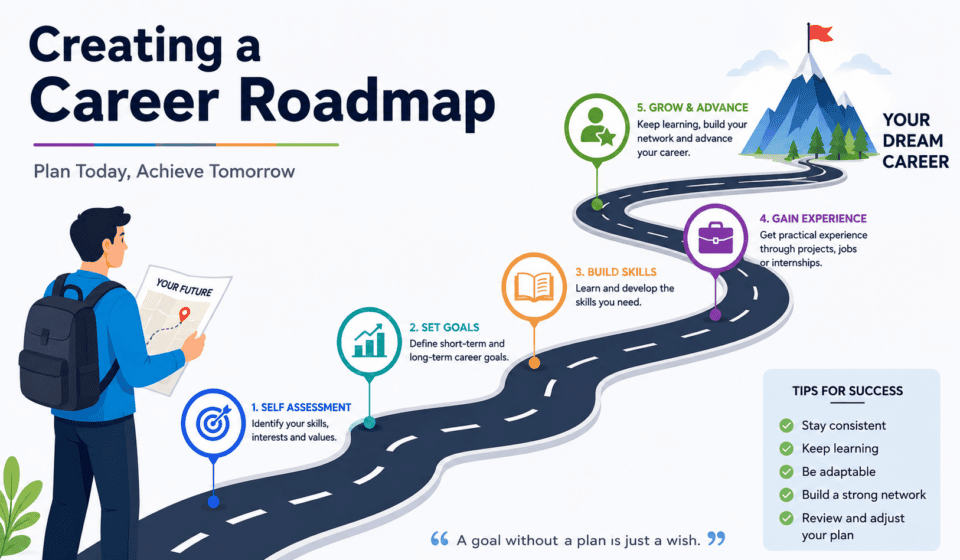

Building a successful career does not happen by accident. While opportunities, networking, and a little luck can play a role, having a clear direction can make your journey much easier. A career roadmap gives you a practical plan for where you want to go, what skills you need, and what steps you should take to reach your professional goals.
Whether you are a student, beginner, freelancer, career changer, or experienced professional, creating a career roadmap can help you make better decisions and stay focused.
In this guide, you will learn what a career roadmap is, why it matters, how to create one, what to include, and how to keep your roadmap updated as your career develops.
What Is a Career Roadmap?
A career roadmap is a structured plan that outlines your professional goals and the steps required to achieve them. It connects your current situation with your desired career destination.
Think of it like a GPS for your professional life. Before a GPS can give you directions, it needs to know where you are and where you want to go. Your career roadmap works in a similar way.
For example, someone who wants to become a professional web designer might create a roadmap like this:
Beginner → Learn HTML and CSS → Learn WordPress → Build Portfolio → Complete Small Projects → Get Freelance Clients → Develop Advanced Skills → Build a Professional Career
Your roadmap does not have to be complicated. The goal is to make your career direction easier to understand and follow.
Why Is a Career Roadmap Important?
Many people work hard but still feel confused about their careers. They learn random skills, apply for unrelated jobs, change directions frequently, or spend years without developing a clear specialization.
A career roadmap can help solve these problems.
1. It Gives You Direction
A roadmap helps you understand what you are working toward. Instead of asking, “What should I learn next?” you can look at your plan and identify the next step.
2. It Helps You Set Goals
Career goals become easier to manage when they are divided into smaller objectives. Instead of having a vague goal such as “I want a successful career,” you can create specific targets.
For example:
- Learn a new professional skill within three months.
- Build five portfolio projects.
- Create a professional resume.
- Apply for 10 suitable jobs each week.
- Get your first freelance client.
- Increase your income by a specific percentage.
3. It Helps You Identify Skill Gaps
Your dream job may require skills you do not currently have. A career roadmap allows you to compare your current abilities with the requirements of your target career.
4. It Keeps You Motivated
Career development can take time. When your final goal feels far away, smaller milestones can help you see your progress.
5. It Helps You Make Better Decisions
When you have a clear career direction, you can evaluate opportunities more effectively. You can ask, “Will this opportunity help me move toward my long-term goal?”
Step 1: Understand Yourself
The first step in creating a career roadmap is understanding your current situation.
Before deciding where you want to go, determine where you are starting.
Consider your:
- Education
- Professional experience
- Technical skills
- Soft skills
- Interests
- Strengths
- Weaknesses
- Values
- Work preferences
- Financial goals
Ask yourself questions such as:
What am I good at?
Identify activities and skills that come naturally to you or that you have developed through experience.
What do I enjoy doing?
Your career does not need to be based entirely on your hobbies, but enjoying your work can make long-term development easier.
What skills do I already have?
Create a list of your current technical and professional abilities.
What areas do I need to improve?
Be honest about your weaknesses. Identifying a weakness is not a failure. It gives you a starting point for improvement.
Step 2: Define Your Long-Term Career Goal
Once you understand yourself, decide what you want to achieve.
Your long-term goal might be:
- Becoming a web designer
- Becoming a digital marketer
- Starting a freelance business
- Becoming a software developer
- Getting a management position
- Starting your own company
- Becoming a professional trainer
- Moving into a new industry
Try to make your goal specific.
Instead of saying:
“I want to work online.”
You could say:
“I want to become a professional freelance web designer and build a stable client base within three years.”
A specific goal gives you something measurable to work toward.
Step 3: Research Your Target Career
Before committing to a career path, research it carefully.
Learn about the industry, common job roles, required skills, salary ranges, career progression, and future opportunities.
Look at job descriptions for positions you eventually want to obtain. Pay attention to the skills employers frequently mention.
For example, if you want to become a digital marketer, you may discover that employers commonly look for knowledge of:
- Search engine optimization
- Content marketing
- Social media marketing
- Email marketing
- Analytics
- Paid advertising
- Copywriting
- Marketing strategy
This research helps you build a roadmap based on real career requirements rather than assumptions.
Step 4: Identify Your Skill Gaps
Now compare your current skills with the skills required for your target career.
Create two lists:
Skills I Have
- Basic HTML
- WordPress
- Basic graphic design
- Communication
Skills I Need
- Advanced CSS
- Responsive web design
- SEO
- JavaScript fundamentals
- User experience design
- Conversion optimization
- Client management
The difference between these lists represents your skill gap.
Your career roadmap should include specific actions for closing that gap.
Step 5: Divide Your Goal Into Milestones
A large career goal can feel overwhelming. Breaking it into milestones makes it easier to manage.
For example, someone who wants to become a freelance web designer could create these milestones:
Milestone 1: Build the Foundation
Learn:
- HTML
- CSS
- Basic JavaScript
- Website structure
- Design principles
Milestone 2: Learn Professional Tools
Become comfortable with:
- WordPress
- Website builders
- Design software
- Image optimization tools
- SEO tools
- Analytics platforms
Milestone 3: Build a Portfolio
Create several projects that demonstrate your abilities.
Your portfolio might include:
- Business websites
- Personal websites
- Landing pages
- Blog websites
- E-commerce websites
Milestone 4: Find Clients
Start networking, creating professional profiles, contacting potential clients, and applying for suitable freelance projects.
Milestone 5: Develop Your Career
After gaining experience, improve your services, increase your rates, specialize in profitable areas, and develop long-term client relationships.
Step 6: Create Short-Term Goals
Long-term goals are important, but short-term goals turn your roadmap into action.
Create goals for:
- This week
- This month
- The next three months
- The next six months
- The next year
For example, your monthly goal might be:
“Complete a responsive web design course and build two practice websites.”
Your weekly goals could include:
- Study CSS for five hours.
- Complete three lessons.
- Build one landing page.
- Review one professional website.
- Practice responsive layouts.
Small actions eventually create significant results.
Step 7: Use the SMART Goal Method
One effective way to create career goals is to use the SMART framework.
SMART stands for:
- Specific
- Measurable
- Achievable
- Relevant
- Time-bound
Instead of writing:
“I want to improve my web design skills.”
Create a SMART goal:
“I will complete an advanced responsive web design course and create three portfolio websites within the next 12 weeks.”
This goal is specific, measurable, realistic, relevant to the career, and connected to a deadline.
Step 8: Build a Learning Plan
Your career roadmap should explain how you will develop the skills you need.
Choose learning methods that fit your situation.
You could use:
- Online courses
- Books
- Tutorials
- Workshops
- Mentorship
- Practical projects
- Professional communities
- Industry events
- Certifications
- Real-world work
However, avoid spending all your time consuming educational content without practicing.
A useful rule is:
Learn → Practice → Build → Get Feedback → Improve
For example, after learning how to create a landing page, actually build one. After learning SEO, optimize a real website or practice project.
Practical experience is one of the best ways to turn knowledge into professional ability.
Step 9: Build a Professional Portfolio
A portfolio is particularly important for careers where employers or clients want to see evidence of your abilities.
Do not wait until you feel like an expert.
Start building projects while you are learning.
Your portfolio can demonstrate:
- Your technical skills
- Your creativity
- Your problem-solving ability
- Your communication
- Your attention to detail
- Your understanding of clients’ needs
Quality is more important than quantity. Five strong projects can be more valuable than 20 unfinished or poorly presented projects.
For each project, explain:
The Problem → Your Approach → Your Solution → The Result
This makes your portfolio more professional and helps potential employers or clients understand your value.
Step 10: Develop Soft Skills
Technical skills are only part of career success.
You should also develop soft skills such as:
- Communication
- Time management
- Problem-solving
- Teamwork
- Leadership
- Adaptability
- Negotiation
- Presentation
- Professional writing
For freelancers and entrepreneurs, soft skills can be especially important because success often depends on communicating with clients and managing projects effectively.
A highly skilled professional who cannot communicate clearly may struggle to advance.
Step 11: Build Your Professional Network
Networking can create opportunities that you may never find through traditional job applications.
Connect with:
- Industry professionals
- Employers
- Freelancers
- Business owners
- Mentors
- Trainers
- Potential clients
- Professional communities
You can network through professional platforms, events, online communities, conferences, workshops, and personal connections.
Remember that networking is not simply asking people for jobs. Build genuine professional relationships and look for ways to provide value to others.
Step 12: Gain Real-World Experience
Knowledge becomes much more valuable when you can apply it.
Look for opportunities such as:
- Internships
- Freelance projects
- Volunteer work
- Personal projects
- Part-time work
- Apprenticeships
- Small business projects
- Collaborative projects
If you are a beginner without professional experience, personal projects can help demonstrate what you can do.
For example, an aspiring digital marketer could create a practice website and develop an SEO strategy for it. An aspiring web designer could create several fictional business websites for a portfolio.
Step 13: Track Your Progress
A career roadmap is not useful if you never review it.
Create a simple progress tracker.
You might track:
| Goal | Target Date | Progress | Status |
|---|---|---|---|
| Complete web design course | March | 80% | In Progress |
| Build portfolio | April | 3/5 projects | In Progress |
| Create professional website | May | 100% | Complete |
| Get first client | June | 0/1 | Not Started |
Review your progress regularly.
A weekly review can take only 15–30 minutes.
Ask:
- What did I accomplish?
- What did I learn?
- What slowed me down?
- What should I improve?
- What should I do next?
Step 14: Review and Update Your Roadmap
Your career roadmap should not be permanent.
Your interests may change. Industries evolve. New technologies appear. New opportunities become available.
Review your roadmap every few months.
You might discover that:
- You enjoy a different specialization.
- A particular skill is more valuable than expected.
- Your original career goal no longer interests you.
- A new opportunity has appeared.
- You need additional training.
- Your financial goals have changed.
Updating your roadmap does not mean you failed. It means you are adapting to new information.
Example of a Simple Career Roadmap
Imagine that your goal is to become a successful freelance digital marketer.
Your roadmap might look like this:
Stage 1: Foundation
Learn marketing fundamentals, communication, content creation, SEO, and social media.
↓
Stage 2: Specialization
Choose a specific area such as SEO, paid advertising, content marketing, or social media marketing.
↓
Stage 3: Practice
Create campaigns, optimize websites, develop content strategies, and analyze results.
↓
Stage 4: Portfolio
Document successful projects and create professional case studies.
↓
Stage 5: Client Acquisition
Build your professional profile, network with potential clients, use freelance platforms, and develop outreach strategies.
↓
Stage 6: Growth
Increase your expertise, improve your services, raise your rates, build long-term relationships, and develop a sustainable business.
This structure gives you a clear path while leaving room for adjustment.
Common Career Roadmap Mistakes to Avoid
Creating a roadmap is useful, but there are several mistakes you should avoid.
Trying to Learn Everything
You do not need to master every skill in your industry. Start with the skills that have the greatest impact on your target career.
Setting Unrealistic Goals
Ambitious goals can be motivating, but unrealistic deadlines can create frustration. Create challenging yet achievable milestones.
Never Taking Action
Planning is important, but action creates results. Do not spend months designing your roadmap without implementing it.
Copying Someone Else’s Career
Your career should fit your own interests, abilities, circumstances, and goals. Someone else’s path may not be right for you.
Ignoring Soft Skills
Technical expertise alone does not guarantee career success. Communication, reliability, adaptability, and professionalism matter.
Refusing to Change Direction
A roadmap is a guide, not a prison. If your interests or circumstances change, adjust your plan.
How to Stay Motivated While Following Your Roadmap
Career development can take years, so maintaining motivation is important.
Celebrate small achievements. Completing a course, finishing a portfolio project, getting your first interview, receiving positive feedback, or landing your first client are all meaningful milestones.
Keep evidence of your progress. Save completed projects, certificates, positive feedback, and measurable results.
You can also find a mentor, accountability partner, or professional community to help you stay focused.
Most importantly, remember that progress does not always happen quickly. Consistency is often more important than speed.
Final Thoughts
Creating a career roadmap can transform a confusing career journey into a structured plan.
Start by understanding where you are today. Define your long-term career goal, research your target industry, identify skill gaps, and divide your goal into manageable milestones. Then create short-term goals, develop your skills, gain practical experience, build your portfolio, network with professionals, and regularly measure your progress.
Your first roadmap does not need to be perfect. It simply needs to give you a direction and a next step.
As you learn and gain experience, your goals may change—and that is completely normal. The most successful professionals continue learning, adapting, and improving throughout their careers.
Your career roadmap is not about predicting your entire future. It is about knowing where you want to go, understanding what you need to learn, and taking the next meaningful step toward your goal.
Quick Career Roadmap Checklist
Before you start, make sure you can answer these questions:
- What career do I want?
- Why do I want this career?
- What skills do I already have?
- What skills am I missing?
- What should I learn first?
- What projects can I build?
- How will I gain real-world experience?
- How will I build my professional network?
- What are my short-term goals?
- What is my long-term goal?
- How will I measure progress?
- When will I review my roadmap?
If you can answer these questions, you already have the foundation for a practical and achievable career roadmap.