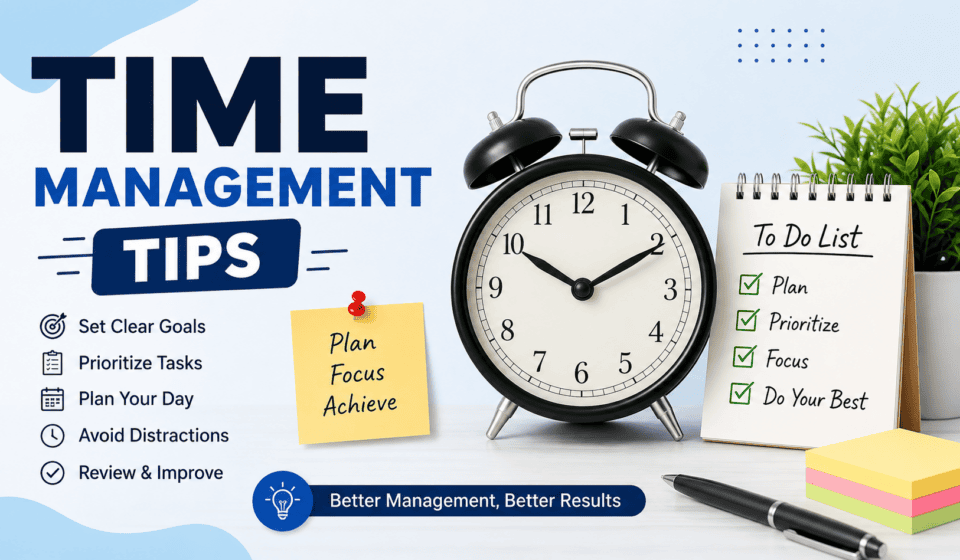

Time is one of the most valuable resources we have. Unlike money or other resources, we cannot save unused time and use it later. Everyone gets the same 24 hours each day, but how we use those hours can make a major difference in our personal and professional lives.
Whether you are a student, freelancer, entrepreneur, employee, or business owner, effective time management can help you accomplish more while reducing stress. The good news is that time management is not about working every minute of the day. It is about using your available time intentionally and focusing on the activities that matter most.
In this guide, you will discover practical time management tips that can help you organize your day, improve productivity, avoid procrastination, and make consistent progress toward your goals.
What Is Time Management?
Time management is the process of planning, organizing, and controlling how you spend your time on different activities.
Good time management helps you decide:
- What needs to be done first
- How much time each task requires
- Which activities are most important
- When you should work and take breaks
- Which tasks can be delegated or eliminated
- How to avoid unnecessary distractions
Effective time management does not mean filling your schedule with tasks. Instead, it means making deliberate decisions about where your time and attention should go.
For example, spending three hours answering unnecessary messages may feel productive, but completing an important project during those three hours could provide much greater value.
Why Is Time Management Important?
Poor time management can lead to missed deadlines, stress, unfinished projects, and lower-quality work. On the other hand, managing your time effectively can improve both productivity and overall quality of life.
1. Helps You Become More Productive
When you know exactly what you need to accomplish, you spend less time wondering what to do next. A clear plan allows you to focus on completing important tasks.
2. Reduces Stress
A disorganized schedule can make everything feel urgent. Planning your tasks in advance gives you greater control and reduces the pressure of last-minute work.
3. Helps You Meet Deadlines
Breaking large projects into smaller tasks makes deadlines easier to manage. Instead of trying to complete everything at once, you can make steady progress.
4. Creates More Free Time
Good time management can actually give you more personal time. When you finish important work efficiently, you have more opportunities to spend time with family, relax, exercise, or pursue hobbies.
5. Improves Work Quality
Rushing through tasks because of poor planning often leads to mistakes. Proper scheduling gives you enough time to review and improve your work.
15 Practical Time Management Tips
1. Set Clear Goals
The first step toward better time management is knowing what you want to accomplish.
Set specific goals rather than vague goals. Instead of saying, “I want to improve my website,” define the outcome more clearly:
“I will publish three optimized blog posts this week.”
Clear goals make it easier to determine which tasks deserve your attention.
You can divide your goals into:
- Daily goals
- Weekly goals
- Monthly goals
- Long-term goals
Make sure your daily activities support your larger objectives.
2. Prioritize Your Tasks
Not every task deserves the same level of attention.
One effective method is to divide tasks into four categories:
- Important and urgent
- Important but not urgent
- Urgent but less important
- Neither important nor urgent
Complete important and urgent tasks first. Then schedule important but non-urgent tasks before they become emergencies.
For example, completing a project due tomorrow is urgent and important. Learning a new skill may not be urgent, but it can be important for your long-term career.
3. Create a Daily To-Do List
A simple to-do list can make your day much more organized.
At the beginning or end of each day, write down the tasks you need to complete. However, avoid creating an unrealistic list containing dozens of tasks.
Choose a manageable number of priorities.
A simple daily list might look like:
- Finish client homepage design
- Write one blog post
- Respond to important emails
- Review project requirements
- Spend 30 minutes learning a new skill
Crossing completed tasks off your list can also provide a sense of progress and motivation.
4. Plan Your Day in Advance
Planning your day before it begins can save valuable time.
Spend 10–15 minutes each evening reviewing the next day’s responsibilities. Decide which tasks are most important and when you will work on them.
You can also prepare your workspace, files, notes, and resources ahead of time.
This reduces decision-making in the morning and allows you to start working faster.
5. Use Time Blocking
Time blocking is a powerful technique where you assign specific periods to specific activities.
For example:
- 8:00–9:00 — Planning and email
- 9:00–11:00 — Deep work
- 11:00–11:30 — Break
- 11:30–1:00 — Client project
- 2:00–3:00 — Content creation
- 3:00–4:00 — Meetings and communication
The goal is to prevent your entire day from being controlled by incoming requests.
When a task has a specific time slot, you are more likely to complete it.
6. Avoid Multitasking
Many people believe multitasking helps them accomplish more. In reality, constantly switching between tasks can reduce concentration and efficiency.
For example, writing an article while checking social media, answering messages, and watching videos creates constant distractions.
Instead, focus on one important task at a time.
Complete it or reach a logical stopping point before moving to another activity.
Single-tasking often produces better results than trying to do everything simultaneously.
7. Eliminate Distractions
Distractions are one of the biggest enemies of productivity.
Common distractions include:
- Social media
- Unnecessary notifications
- Phone calls
- Instant messaging
- Random internet browsing
- Unplanned meetings
- Excessive email checking
Turn off unnecessary notifications while doing focused work.
If possible, keep your phone away from your workspace or use a focus mode.
Even small interruptions can make it difficult to regain concentration.
8. Use the Pomodoro Technique
The Pomodoro Technique is a simple productivity method based on focused work sessions and short breaks.
A traditional approach is:
- Work for 25 minutes.
- Take a 5-minute break.
- Repeat four times.
- Take a longer break of around 15–30 minutes.
You can adjust the intervals according to your work style.
For example, experienced professionals may prefer 50 minutes of focused work followed by a 10-minute break.
The important principle is to create periods of uninterrupted concentration.
9. Learn to Say No
One of the most important time management skills is learning to say no.
Every time you accept an unnecessary commitment, you are giving away time that could be used for something more important.
You do not have to accept every meeting, request, project, or invitation.
Before saying yes, ask:
“Does this support my priorities?”
If the answer is no, consider declining, postponing, or delegating the task.
10. Break Large Projects Into Smaller Tasks
Large projects can feel overwhelming because the final goal seems too far away.
Instead of thinking:
“I need to build a complete website.”
Break the project into smaller steps:
- Research requirements
- Create sitemap
- Prepare wireframes
- Design homepage
- Design inner pages
- Develop website
- Add content
- Test functionality
- Optimize performance
- Launch website
Smaller tasks are easier to understand, schedule, and complete.
They also make progress more visible.
11. Avoid Procrastination
Procrastination means delaying an important task even though you know it needs to be completed.
A useful way to overcome procrastination is to start with a very small action.
If you need to write an article, do not think about writing 2,000 words immediately.
Instead, tell yourself:
“I will write the introduction first.”
Once you start, continuing is usually easier.
You can also use the two-minute rule: if something takes approximately two minutes or less, complete it immediately rather than adding it to your task list.
12. Learn Your Most Productive Hours
Everyone has periods when they feel more focused and energetic.
Some people are highly productive in the morning, while others work better later in the day.
Identify your most productive hours and reserve them for your most important tasks.
For example, if you are most focused between 9:00 AM and 12:00 PM, use that period for activities requiring deep concentration.
Save easier tasks, such as routine emails or administrative work, for lower-energy periods.
13. Delegate When Possible
You do not have to do everything yourself.
If another person can complete a task effectively, consider delegating it.
For example, a business owner might delegate:
- Administrative tasks
- Customer support
- Data entry
- Graphic design
- Routine research
- Social media scheduling
Delegation allows you to focus your time on higher-value responsibilities.
The goal is not simply to work harder. It is to spend your time where your skills provide the greatest value.
14. Take Regular Breaks
Working continuously for hours does not necessarily mean you are being productive.
Your brain and body need recovery.
Short breaks can help restore concentration and reduce mental fatigue.
During a break, step away from your computer. Walk around, drink water, stretch, or simply rest your eyes.
Avoid turning every break into a long social media session, because that can make it harder to return to focused work.
15. Review Your Time at the End of the Day
At the end of each day, spend a few minutes reviewing how you used your time.
Ask yourself:
- What did I accomplish?
- Which tasks remain unfinished?
- What distracted me?
- What took longer than expected?
- What should I change tomorrow?
This simple review helps you identify patterns.
For example, you may discover that checking email every 15 minutes consumes a large portion of your day.
Once you identify the problem, you can create a better system.
Common Time Management Mistakes to Avoid
Even people who use productivity tools can struggle with time management.
Here are some common mistakes.
Creating an Unrealistic Schedule
Planning 20 major tasks for one day is usually unrealistic. Give yourself enough time to complete important work properly.
Spending Too Much Time Planning
Planning is useful, but planning should not become another form of procrastination. Keep your system simple.
Ignoring Breaks
Skipping breaks may temporarily increase work time but can eventually lead to fatigue and reduced concentration.
Checking Notifications Constantly
Notifications encourage task switching and can destroy periods of deep focus.
Focusing Only on Urgent Tasks
Urgent tasks are not always the most important tasks. Make time for activities that contribute to your long-term goals.
Time Management for Freelancers
Freelancers often have to manage multiple responsibilities at the same time.
They may need to handle clients, projects, marketing, communication, finances, learning, and administration.
A useful freelance schedule might separate the day into focused blocks.
For example:
Morning: Client projects and deep work
Afternoon: Meetings, communication, and revisions
Late afternoon: Marketing, learning, and administrative tasks
Freelancers should also avoid accepting more projects than they can realistically complete.
A clear project calendar can help prevent overlapping deadlines.
Time Management for Students
Students can benefit greatly from effective time management.
Instead of studying only before exams, create a consistent study schedule.
For example:
- Set weekly learning goals.
- Break subjects into smaller topics.
- Schedule focused study sessions.
- Remove phone distractions.
- Take regular breaks.
- Review material regularly.
Students should also balance study time with sleep, exercise, social activities, and relaxation.
Good time management is about creating a sustainable routine rather than studying constantly.
Useful Tools for Time Management
Technology can make time management easier when used correctly.
Useful categories of tools include:
- Digital calendars
- Task management apps
- Note-taking applications
- Project management platforms
- Focus timers
- Habit trackers
- Time-tracking software
However, you do not need dozens of productivity applications.
A simple system using a calendar, task list, and timer can be enough.
The best productivity system is the one you will consistently use.
Create a Simple Time Management System
If you are new to time management, start with a simple system.
Step 1: Identify Your Goals
Write down your most important goals.
Step 2: List Your Responsibilities
Write down everything you need to accomplish.
Step 3: Choose Your Priorities
Identify the tasks that have the greatest impact.
Step 4: Schedule Your Work
Assign specific times to important tasks.
Step 5: Remove Distractions
Create an environment that supports concentration.
Step 6: Track Your Progress
Review what you accomplish each day.
Step 7: Improve Your System
Adjust your schedule based on what works and what does not.
Remember that effective time management is a skill. You do not have to create a perfect system immediately.
Final Thoughts
Effective time management is not about trying to fit more and more tasks into your day. It is about making better decisions about how you spend your limited time.
Start by setting clear goals, identifying priorities, planning your day, eliminating distractions, and focusing on one task at a time. Use techniques such as time blocking and the Pomodoro Technique to create periods of focused work. At the same time, remember to take breaks and leave room for rest.
Most importantly, create a system that fits your lifestyle and responsibilities.
You do not need to become productive overnight. Start with one or two time management tips, practice them consistently, and gradually improve your approach.
When you learn to manage your time effectively, you gain more than productivity. You gain greater control over your work, reduce unnecessary stress, and create more opportunities to achieve the goals that matter most.
Your time is limited. Use it intentionally.