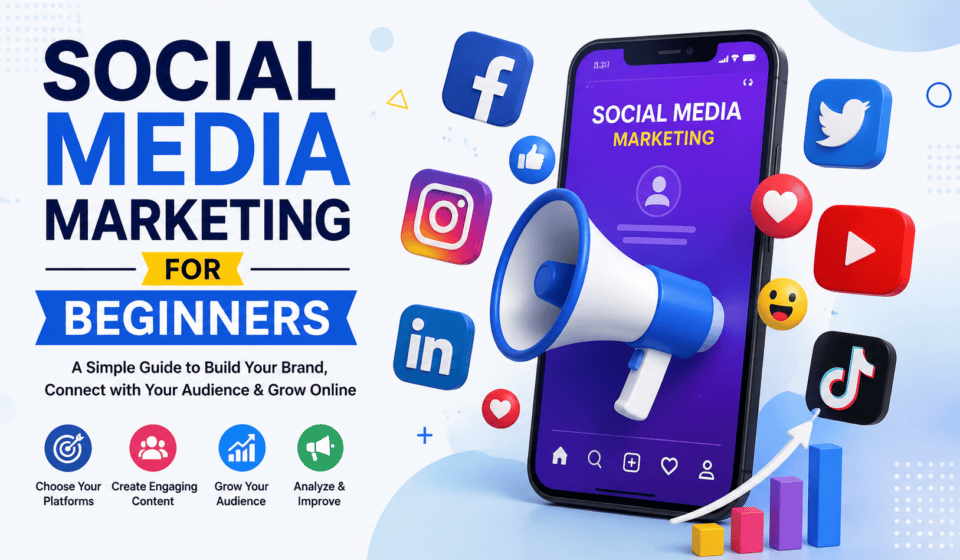

Social media has changed the way businesses, freelancers, entrepreneurs, and personal brands connect with their audiences. Today, platforms such as Facebook, Instagram, LinkedIn, TikTok, YouTube, and Pinterest provide powerful opportunities to build an audience, promote products and services, generate leads, and increase brand awareness.
But if you are new to digital marketing, social media can feel overwhelming. You may wonder which platform to use, what type of content to create, how often to post, or how to get followers without spending a lot of money.
The good news is that you do not need to be an expert to get started.
In this beginner-friendly guide, you will learn what social media marketing is, why it matters, how different platforms work, what content you should create, how to build a social media strategy, and how to measure your results.
What Is Social Media Marketing?
Social media marketing is the process of using social media platforms to promote a business, product, service, website, personal brand, or organization.
It involves creating and sharing useful content, communicating with followers, building relationships, increasing brand visibility, driving website traffic, generating leads, and ultimately achieving business goals.
For example, a web designer might use LinkedIn to share website design tips, Instagram to showcase completed projects, and Facebook to communicate with potential customers.
A freelancer could use social media to demonstrate expertise and attract clients.
A small business could use Facebook or Instagram to promote products and communicate with customers.
In simple terms, social media marketing is about using social platforms to reach the right people with the right message and encourage them to take action.
Why Is Social Media Marketing Important?
Social media marketing is important because billions of people use social media every day. Your potential customers may already be spending time on these platforms.
Instead of waiting for customers to discover your business, social media allows you to actively reach and communicate with them.
Here are some of the major benefits.
1. Builds Brand Awareness
Regularly publishing useful and valuable content helps people become familiar with your brand.
For example, if you consistently publish web design tutorials, your audience may begin to recognize you as someone knowledgeable about web design.
Over time, repeated exposure can help build trust and recognition.
2. Helps You Reach Your Target Audience
Social media allows you to target specific groups of people based on factors such as interests, location, profession, demographics, and online behavior.
This can make social media particularly useful for small businesses and freelancers that want to reach a specific audience.
3. Generates Website Traffic
Social media can send visitors to your website, blog, landing pages, online store, or portfolio.
For example, you could publish a short educational post and direct interested readers to a detailed article on your website.
4. Generates Leads and Customers
Social media can help turn followers into potential customers.
You can encourage people to contact you, sign up for a newsletter, download a free resource, request a quotation, or purchase a product.
5. Builds Customer Relationships
Social media is not only about promotion.
It gives businesses an opportunity to answer questions, respond to comments, collect feedback, and communicate directly with customers.
This two-way communication can help create stronger relationships.
6. Can Be Cost-Effective
Creating an organic social media presence does not necessarily require a large advertising budget.
You can create educational posts, videos, graphics, and other content using relatively inexpensive or free tools.
Paid advertising can be added later when you have a better understanding of your audience.
Popular Social Media Platforms for Beginners
One of the biggest mistakes beginners make is trying to use every social media platform at once.
Instead, start with one or two platforms where your target audience is most active.
Facebook is useful for businesses, communities, local services, personal brands, and many types of content.
Businesses can use Facebook Pages and Groups to share articles, images, videos, announcements, offers, and educational content.
Facebook can also be useful for building a community around a business or topic.
Instagram is highly focused on visual content.
It can be especially useful for photographers, designers, restaurants, fashion businesses, creators, coaches, and brands that can communicate effectively through images and video.
Instagram content can include posts, Stories, Reels, and other visual formats.
LinkedIn is particularly useful for professionals, freelancers, consultants, agencies, trainers, coaches, and B2B businesses.
You can use LinkedIn to share professional knowledge, case studies, industry insights, career information, and educational content.
For freelancers, LinkedIn can also be a valuable platform for networking and finding potential clients.
YouTube
YouTube is one of the most powerful platforms for educational and video content.
Tutorials, product demonstrations, reviews, interviews, courses, and how-to videos can continue attracting viewers long after they are published.
For example, a digital marketing trainer could create videos about SEO, WordPress, social media marketing, and freelancing.
TikTok
TikTok focuses heavily on short-form video content.
It can be useful for educational videos, entertainment, tutorials, demonstrations, tips, and personal-brand content.
The key is to understand the type of content that your target audience enjoys.
How to Create a Social Media Marketing Strategy
Posting randomly is not a strategy.
Before you start publishing content, create a simple plan.
Step 1: Define Your Goal
First, determine what you want social media to accomplish.
Your goal could be:
- Increase brand awareness
- Generate leads
- Get website visitors
- Find freelance clients
- Sell products
- Promote a course
- Build an online community
- Increase engagement
- Establish yourself as an expert
Try to focus on a specific primary goal.
For example, instead of saying, “I want more followers,” you could set a goal such as:
“I want to generate 20 qualified leads per month through LinkedIn.”
A specific goal makes it easier to measure success.
Step 2: Identify Your Target Audience
You need to understand who you are trying to reach.
Ask yourself:
- Who are my ideal customers?
- What problems do they have?
- What questions do they ask?
- What are their interests?
- What type of content do they consume?
- Which social platforms do they use?
For example, a trainer teaching digital marketing to beginners might target students, freelancers, job seekers, and small business owners.
Knowing your audience helps you create content that is relevant to them.
Step 3: Choose the Right Platforms
Do not feel pressured to be active everywhere.
Choose platforms based on your target audience and content strengths.
If you are a professional consultant, LinkedIn may be a strong choice.
If your business depends heavily on visual content, Instagram may be useful.
If you enjoy teaching through videos, YouTube could be an excellent option.
Start small and expand when you have the resources to manage additional platforms effectively.
Types of Social Media Content
Creating content consistently is one of the most important parts of social media marketing.
However, not every post should directly promote your product or service.
A strong content strategy includes different types of content.
Educational Content
Educational content teaches your audience something useful.
Examples include:
- How-to guides
- Tutorials
- Tips
- Checklists
- Mistakes to avoid
- Industry explanations
- Step-by-step instructions
Educational content is particularly useful for building authority.
Entertaining Content
Entertainment can help increase engagement and make your brand more memorable.
Examples include:
- Short videos
- Memes
- Interesting stories
- Behind-the-scenes content
- Fun questions
- Challenges
The content should still make sense for your brand and audience.
Inspirational Content
Inspirational content can include success stories, motivational messages, customer achievements, or personal experiences.
For example, a freelancer could share the story of how they completed their first major project.
Promotional Content
Promotional content directly promotes your product or service.
Examples include:
- Product announcements
- Special offers
- Course launches
- Service packages
- Discounts
- Free consultations
Promotion is important, but your entire social media presence should not feel like one continuous advertisement.
User-Generated Content
User-generated content is created by your customers or audience.
It could include reviews, testimonials, photographs, videos, or social media posts about your product.
With permission, sharing this content can provide valuable social proof.
The 80/20 Approach to Social Media Content
A useful approach for beginners is to avoid making every post promotional.
For example, you could use approximately:
- 80% educational, entertaining, inspirational, or community-focused content
- 20% promotional content
This is not a strict rule. The ideal balance depends on your business and audience.
The important idea is to provide value before constantly asking people to buy something.
When people consistently receive useful information from you, they have more reasons to follow and trust your brand.
How Often Should You Post?
There is no universal number of posts that guarantees success.
Consistency is generally more important than posting a huge amount of content for a short period and then disappearing.
As a beginner, create a schedule that you can realistically maintain.
For example:
Monday: Educational post
Wednesday: Short video or tip
Friday: Personal or behind-the-scenes post
Sunday: Promotional or helpful resource
You can adjust the schedule based on your results.
It is better to publish three quality posts every week consistently than to publish 20 posts one week and nothing for the next month.
How to Create Engaging Social Media Posts
Good social media content should capture attention quickly.
Here are several techniques you can use.
Start With a Strong Hook
The first sentence or visual should make people want to continue reading.
For example:
“5 Common Website Mistakes That Could Be Costing You Customers”
This is more attention-grabbing than:
“Website Design Tips.”
Keep Your Message Clear
Avoid unnecessary complexity.
Write in simple language and focus on one main idea per post.
Use Visuals
Images, graphics, screenshots, animations, and videos can make your content easier to understand and more attractive.
Ask Questions
Questions encourage people to participate.
For example:
“What is the biggest challenge you face when learning digital marketing?”
Questions can also help you understand your audience better.
Include a Call to Action
A call to action, commonly called a CTA, tells your audience what to do next.
Examples include:
- Visit our website
- Download the guide
- Send us a message
- Leave a comment
- Save this post
- Share this with a friend
- Book a consultation
A simple CTA can help turn passive viewers into active participants.
Hashtags and Keywords
Depending on the platform, hashtags and keywords can help categorize and discover content.
For example, a digital marketing post might use relevant terms such as:
#DigitalMarketing #SocialMediaMarketing #SEO #ContentMarketing
However, do not add irrelevant hashtags simply because they are popular.
Use terms that are genuinely related to your content and audience.
Also pay attention to natural keywords in captions, titles, descriptions, and video content where appropriate.
Organic Social Media Marketing vs Paid Advertising
Social media marketing generally includes both organic and paid activities.
Organic Marketing
Organic marketing refers to unpaid activities such as:
- Regular posts
- Videos
- Stories
- Comments
- Community engagement
- Educational content
Organic marketing can take time but is valuable for building long-term relationships.
Paid Social Media Advertising
Paid advertising involves spending money to show your content or offers to selected audiences.
You can use paid campaigns to promote products, services, lead-generation forms, websites, or other offers.
Beginners should first understand their audience and organic content before spending significant amounts on advertising.
If you do run paid campaigns, start with a manageable budget and track the results carefully.
Social Media Analytics: Measure Your Results
One of the most important skills in social media marketing is understanding data.
Do not judge your strategy only by the number of followers you have.
Depending on your goal, useful metrics can include:
- Reach
- Impressions
- Engagement
- Comments
- Shares
- Saves
- Video views
- Website clicks
- Leads
- Conversions
- Sales
For example, if your goal is generating website traffic, website clicks may be more important than follower growth.
If your goal is building brand awareness, reach and impressions may be more useful.
Use your data to discover what works and improve your future content.
Common Social Media Marketing Mistakes Beginners Should Avoid
1. Trying to Be Everywhere
Managing five or six platforms at the beginning can become overwhelming.
Start with one or two platforms and become consistent.
2. Posting Only Promotional Content
People do not follow businesses simply to see advertisements.
Give your audience useful information, entertainment, inspiration, and opportunities to participate.
3. Ignoring Comments and Messages
Social media is designed for communication.
If people take the time to comment or message you, respond whenever possible.
4. Buying Followers
Large follower numbers may look impressive, but fake or irrelevant followers do not necessarily generate customers or meaningful engagement.
Focus on attracting a genuine audience.
5. Copying Competitors
You can study competitors for ideas, but do not simply copy everything they do.
Develop your own voice, visual identity, expertise, and perspective.
6. Giving Up Too Quickly
Social media growth often takes time.
A few unsuccessful posts do not necessarily mean your strategy is failing.
Analyze the results, improve your content, and continue experimenting.
A Simple 30-Day Social Media Marketing Plan
If you are completely new to social media marketing, here is a simple starting plan.
Week 1: Build the Foundation
- Define your target audience.
- Choose one or two social platforms.
- Optimize your profile.
- Write a clear bio.
- Add your website or relevant contact information.
- Research competitors and successful accounts.
- Create a list of content ideas.
Week 2: Start Publishing
Create and publish several useful posts.
Experiment with:
- Educational content
- Short videos
- Questions
- Tips
- Personal stories
- Industry information
Pay attention to which topics receive the most interest.
Week 3: Increase Engagement
Start actively communicating with your audience.
Respond to comments and messages.
Comment thoughtfully on relevant accounts.
Ask questions.
Encourage discussion.
The goal is to build relationships rather than simply increase numbers.
Week 4: Analyze and Improve
Review your performance.
Identify:
- Your best-performing posts
- Your most engaging topics
- Your strongest formats
- Your most active audience
- Your highest-performing CTAs
Then use these insights to create your next month’s content strategy.
Social Media Marketing Tools for Beginners
Several types of tools can make social media management easier.
You may use:
- Graphic design tools for creating visual content
- Video editing tools for short-form videos
- Social media scheduling tools for planning posts
- Analytics tools for measuring performance
- Keyword and hashtag research tools
- AI tools for brainstorming content ideas
However, tools do not replace strategy.
A beautifully designed post will not automatically succeed if it is aimed at the wrong audience or communicates an irrelevant message.
Strategy should come first, tools second.
Final Thoughts
Social media marketing can be an excellent opportunity for beginners, freelancers, entrepreneurs, and businesses to build an online presence and connect with potential customers.
The most important thing is not to become obsessed with follower numbers.
Instead, focus on understanding your audience, creating valuable content, communicating consistently, and measuring your results.
Start with one or two platforms. Define a clear goal. Learn what your audience needs. Create helpful content. Engage with people. Analyze your performance and improve over time.
You do not need a huge budget or thousands of followers to begin.
You simply need a clear strategy, useful content, consistency, and a willingness to learn.
As you gain experience, you can experiment with more platforms, advanced content strategies, paid advertising, influencer collaborations, and sophisticated analytics.
Start small, provide value, stay consistent, and keep improving. That is the foundation of successful social media marketing.
Frequently Asked Questions About Social Media Marketing
What is social media marketing for beginners?
Social media marketing for beginners means using platforms such as Facebook, Instagram, LinkedIn, YouTube, or TikTok to build an audience, share useful content, promote a business, generate leads, and communicate with potential customers.
Which social media platform is best for beginners?
There is no single best platform for everyone. The best platform depends on your target audience, industry, goals, and content style. Beginners should usually start with one or two platforms rather than trying to manage every platform.
Can I do social media marketing for free?
Yes. You can create an organic social media presence without paying for advertising. You can publish posts, videos, educational content, and engage with your audience for free, although creating professional content may involve some optional tools or expenses.
How long does social media marketing take to work?
Results vary depending on the platform, industry, content quality, audience, consistency, and strategy. Some content can produce results quickly, while building a trusted audience and generating consistent leads can take considerably longer.
How many times should I post on social media?
There is no universal posting frequency. Choose a schedule you can maintain consistently. For many beginners, starting with several quality posts per week is more practical than trying to publish multiple times every day.
Do I need thousands of followers to make money?
No. A smaller audience that is highly relevant and engaged can be more valuable than a large audience that has little interest in your products or services. Focus on attracting the right people rather than simply increasing follower numbers.
What should I post on social media?
You can publish educational tips, tutorials, videos, industry insights, customer stories, behind-the-scenes content, questions, inspirational posts, case studies, and occasional promotional content. The best topics are those that solve problems or provide value to your target audience.