
Digital marketing has become one of the most important ways businesses reach customers, build their brands, and generate sales. Whether you run a small local business, an online store, a personal brand, or a large company, having a strong digital marketing strategy can help you reach the right people at the right time.
But what exactly is digital marketing? How does it work? What are the different types of digital marketing, and why is it so important for businesses today?
In this complete beginner’s guide, we’ll explain what digital marketing is, how it works, its major types, benefits, examples, and how you can get started with digital marketing.
What Is Digital Marketing?
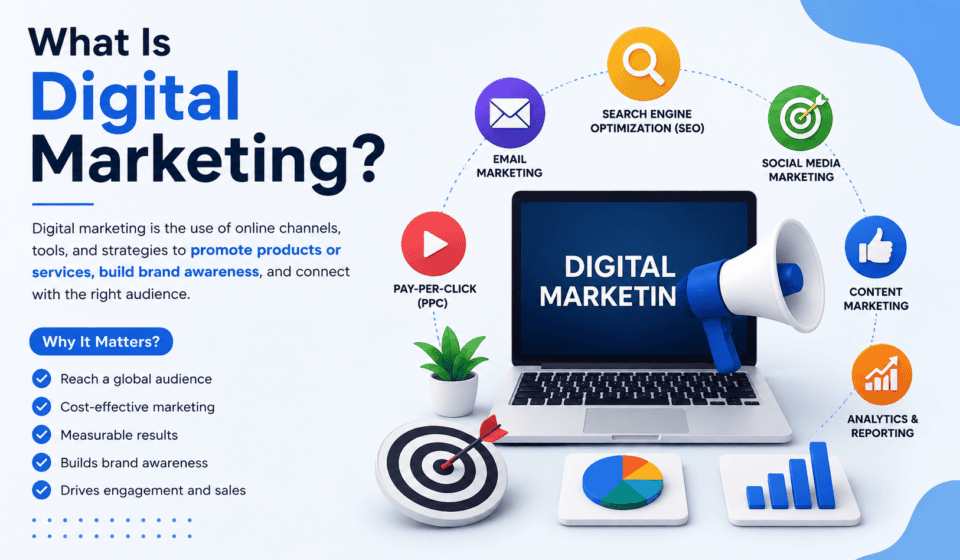
Digital marketing is the process of promoting products, services, brands, or businesses using digital channels and technologies.
Unlike traditional marketing methods such as newspapers, television, radio, and printed advertisements, digital marketing uses online platforms such as search engines, websites, social media, email, mobile apps, and online advertising networks.
For example, when you search for a product on Google and see an advertisement, receive a promotional email from a company, watch a sponsored video on YouTube, or discover a business through Facebook, you are experiencing digital marketing.
The main goal of digital marketing is to connect businesses with their target audience through digital channels and encourage them to take valuable actions, such as visiting a website, signing up for a service, contacting a business, downloading a resource, or making a purchase.
Why Is Digital Marketing Important?
The internet has changed the way people discover information, communicate with businesses, compare products, and make purchasing decisions.
Today, potential customers often research a product or service online before buying it. They may search Google, check social media, read reviews, watch videos, or visit a company’s website.
This creates a huge opportunity for businesses.
Digital marketing allows businesses to:
- Reach a large audience
- Target specific groups of customers
- Build brand awareness
- Generate website traffic
- Increase leads and sales
- Communicate directly with customers
- Measure marketing performance
- Build long-term customer relationships
Even small businesses can compete online with larger companies when they use the right strategy.
How Does Digital Marketing Work?
Digital marketing generally follows a simple process:
Research → Strategy → Content → Promotion → Engagement → Conversion → Analysis
First, a business identifies its target audience and understands their needs, problems, interests, and online behavior.
Next, the business creates a digital marketing strategy. This strategy determines which platforms and marketing methods should be used.
The business then creates useful content or promotional campaigns and distributes them through appropriate digital channels.
After reaching potential customers, the business tries to turn them into leads or customers.
Finally, marketing performance is measured using data and analytics. The business can then improve its strategy based on the results.
This process is continuous. Successful digital marketers constantly test, analyze, and improve their campaigns.
Major Types of Digital Marketing
Digital marketing includes many different strategies. Some of the most important types are discussed below.
1. Search Engine Optimization (SEO)
Search Engine Optimization, or SEO, is the process of improving a website so that it can appear higher in search engine results.
Search engines such as Google use complex algorithms to determine which pages should appear for particular searches.
For example, imagine someone searches for:
“Best web design course for beginners”
If you have a well-optimized article or landing page targeting this topic, your website may appear in the search results.
SEO can involve:
- Keyword research
- Content optimization
- Technical SEO
- Website speed optimization
- Mobile optimization
- Internal linking
- Backlink building
- Image optimization
- Improving user experience
SEO is particularly valuable because it can generate organic traffic without paying for every individual click.
2. Content Marketing
Content marketing involves creating and distributing valuable content to attract and educate a target audience.
Instead of directly telling people to buy something, content marketing focuses on providing useful information that solves problems or answers questions.
Common content formats include:
- Blog posts
- Articles
- Videos
- Ebooks
- Guides
- Infographics
- Case studies
- Tutorials
- Podcasts
- Social media content
For example, a web design trainer might publish an article titled “10 Common Website Design Mistakes Beginners Should Avoid.”
Someone searching for information about website design may discover the article, visit the website, and eventually become interested in the trainer’s courses or services.
Content marketing can therefore help businesses attract customers throughout the buying journey.
3. Social Media Marketing
Social media marketing involves using platforms such as Facebook, Instagram, LinkedIn, TikTok, and other social networks to promote a business and communicate with an audience.
Businesses can use social media to:
- Build brand awareness
- Share educational content
- Promote products and services
- Engage with followers
- Generate leads
- Drive website traffic
- Build communities
- Provide customer support
Social media marketing can be organic or paid.
Organic social media involves publishing posts and engaging with followers without paying for advertising.
Paid social media marketing involves running advertisements to reach specific audiences based on characteristics such as interests, demographics, location, or online behavior.
4. Search Engine Marketing (SEM) and Pay-Per-Click Advertising
Paid search advertising allows businesses to display advertisements when people search for particular keywords.
One common model is Pay-Per-Click (PPC) advertising, where advertisers generally pay when someone clicks their advertisement.
For example, a business selling online courses might create an advertisement targeting searches such as:
- “digital marketing course”
- “learn SEO online”
- “web design training”
Paid advertising can produce traffic quickly, making it useful for businesses that want immediate visibility.
However, effective PPC requires careful keyword selection, compelling advertisements, optimized landing pages, and ongoing performance analysis.
5. Email Marketing
Email marketing involves sending targeted messages to people through email.
Businesses can use email marketing to:
- Welcome new subscribers
- Share educational content
- Promote products
- Announce offers
- Send newsletters
- Follow up with leads
- Build customer relationships
For example, a digital marketing trainer could offer a free SEO checklist in exchange for a visitor’s email address. The trainer could then send useful SEO tips through a series of emails and eventually introduce a paid course.
Email marketing is powerful because it allows businesses to communicate directly with people who have already shown interest.
6. Affiliate Marketing
Affiliate marketing is a performance-based marketing method where individuals or organizations promote another company’s products or services and earn a commission when their promotion generates a desired result.
For example, a blogger may review a web hosting service and include an affiliate link. If a reader purchases hosting through that link, the blogger may receive a commission.
Affiliate marketing can benefit both businesses and content creators.
Businesses gain additional promotional channels, while affiliates can earn income by recommending products they believe are useful.
7. Influencer Marketing
Influencer marketing involves working with individuals who have an established audience and influence within a particular niche.
An influencer might promote a product through:
- Instagram posts
- YouTube videos
- TikTok videos
- Blog articles
- Live streams
- Product reviews
The effectiveness of influencer marketing depends heavily on audience trust and relevance.
A smaller influencer with a highly engaged audience can sometimes be more valuable than a celebrity with millions of followers but little connection to the product.
8. Video Marketing
Video has become a major part of digital marketing.
Businesses can use video to educate, entertain, demonstrate products, answer questions, and build trust.
Popular video platforms include YouTube, Facebook, Instagram, and TikTok.
Examples of marketing videos include:
- Product demonstrations
- Tutorials
- Customer testimonials
- Educational videos
- Behind-the-scenes videos
- Interviews
- Short-form videos
- Online courses
For example, a web design trainer can create a YouTube tutorial showing beginners how to create a WordPress website. Viewers who find the tutorial useful may later become interested in the trainer’s services or courses.
9. Mobile Marketing
Mobile marketing focuses on reaching customers through smartphones and other mobile devices.
Examples include:
- SMS marketing
- Mobile applications
- Push notifications
- Mobile-friendly websites
- Mobile advertising
- Location-based marketing
Since a large percentage of internet users access websites through mobile devices, businesses should ensure that their websites and campaigns provide a good mobile experience.
10. Online Reputation Management
Online reputation management focuses on monitoring and improving how a business, brand, or individual is perceived online.
Customers may look at:
- Google reviews
- Social media comments
- Online ratings
- Blog articles
- Discussion forums
- Customer testimonials
Businesses should monitor their online reputation and respond professionally to customer feedback.
Positive reviews can increase trust, while unresolved negative experiences can discourage potential customers.
Benefits of Digital Marketing
Digital marketing provides several advantages compared with many traditional marketing methods.
Global Reach
A business can reach customers around the world using a website, social media, search engines, and other online platforms.
A small business in one country can potentially attract customers from many different markets.
Precise Audience Targeting
Digital platforms allow marketers to target specific audiences based on factors such as:
- Age
- Location
- Interests
- Search behavior
- Demographics
- Online activity
This can help businesses deliver relevant messages to people who are more likely to be interested in their products or services.
Cost-Effective Marketing
Digital marketing can be accessible to businesses of different sizes.
For example, creating an organic social media post or publishing a blog article may cost very little compared with traditional advertising.
Paid campaigns can also be started with relatively small budgets and adjusted based on performance.
Measurable Results
One of the biggest advantages of digital marketing is measurement.
Marketers can track metrics such as:
- Website visitors
- Traffic sources
- Click-through rates
- Conversion rates
- Leads
- Sales
- Engagement
- Advertising costs
This data helps businesses understand what is working and what needs improvement.
Better Customer Engagement
Digital marketing allows businesses to communicate directly with customers.
Customers can comment on social media posts, send messages, respond to emails, leave reviews, or contact businesses through websites.
This creates opportunities to build stronger relationships.
Digital Marketing vs. Traditional Marketing
Traditional marketing includes methods such as television advertising, radio, newspapers, magazines, billboards, and printed brochures.
Digital marketing uses online channels such as websites, search engines, email, social media, video platforms, and digital advertising.
The biggest difference is often how businesses reach and interact with their audience.
Traditional advertising can reach large audiences, but measuring exactly how many people took action can sometimes be difficult.
Digital marketing provides detailed data that helps marketers measure user behavior and campaign performance.
However, traditional marketing and digital marketing do not have to compete with each other. Businesses can use both depending on their audience, goals, and budget.
Examples of Digital Marketing
Let’s look at a simple example.
Imagine a company sells online graphic design courses.
The company could use digital marketing in the following way:
- Publish SEO-friendly blog articles about graphic design.
- Create YouTube tutorials for beginners.
- Share design tips on social media.
- Offer a free downloadable design guide.
- Collect email subscribers.
- Send educational newsletters.
- Run Google or social media advertisements.
- Direct visitors to a course landing page.
- Convert interested visitors into students.
- Analyze the results and improve future campaigns.
This is an example of how different digital marketing channels can work together.
What Skills Do You Need for Digital Marketing?
Digital marketing is a broad field, so you do not need to master everything immediately.
Important skills include:
- SEO
- Content writing
- Social media marketing
- Email marketing
- Copywriting
- Website management
- Analytics
- Online advertising
- Graphic design
- Basic HTML and CSS
- Conversion optimization
- Communication
You can start by learning one area and gradually expand your skills.
For example, beginners interested in websites might start with WordPress and SEO, while others may begin with social media marketing, content creation, or paid advertising.
How to Start Learning Digital Marketing
If you’re a beginner, don’t try to learn every digital marketing technique at once.
Start with the fundamentals.
Step 1: Understand Marketing Basics
Learn about target audiences, customer needs, branding, positioning, and the marketing funnel.
Step 2: Learn One Core Skill
Choose an area such as SEO, social media marketing, content marketing, email marketing, or PPC.
Step 3: Build a Website
Creating your own website gives you a place to practice SEO, content creation, analytics, and conversion optimization.
Step 4: Create Real Projects
Theory is useful, but practical experience is extremely important.
Create a blog, build a small business website, manage a social media page, or develop a simple marketing campaign.
Step 5: Measure Your Results
Learn how to use analytics tools and understand important marketing metrics.
Step 6: Keep Learning
Digital marketing changes continuously. Search engines, social media platforms, advertising systems, technologies, and customer behavior evolve over time.
Successful marketers continue learning and adapting.
Is Digital Marketing a Good Career?
Yes, digital marketing can be a valuable career field for people who enjoy technology, communication, creativity, research, and business.
Businesses across many industries need people who can help them attract customers online.
Digital marketing professionals can work as:
- SEO specialists
- Social media managers
- Content marketers
- PPC specialists
- Email marketers
- Digital marketing executives
- Content strategists
- Affiliate marketers
- Digital marketing consultants
- Freelancers
- Trainers and coaches
Digital marketing skills can also support entrepreneurship because you can use them to promote your own products, services, website, or personal brand.
Final Thoughts
So, what is digital marketing?
Digital marketing is the use of digital channels and technologies to promote businesses, products, services, and brands while connecting with potential customers online.
It includes many different strategies, including SEO, content marketing, social media marketing, email marketing, PPC advertising, affiliate marketing, influencer marketing, video marketing, and mobile marketing.
The most effective digital marketing strategy is not necessarily about using every available platform. Instead, it is about understanding your audience, choosing the right channels, creating valuable content, measuring results, and continuously improving.
For beginners, the best approach is to learn the fundamentals, choose one or two areas to focus on, and gain practical experience through real projects.
Whether you want to grow a business, become a freelancer, build a personal brand, or start a career in marketing, learning digital marketing can give you valuable skills for today’s increasingly digital world.
Start small, keep learning, practice consistently, and use data to improve. That’s the foundation of successful digital marketing.