
How to Design a High-Converting Landing Page
A landing page is one of the most powerful tools in digital marketing. Whether you’re selling a product, promoting a service, collecting leads, or encouraging users to sign up for a course, a well-designed landing page can significantly increase your conversion rate.
However, many businesses make the mistake of treating a landing page like a regular website page. A homepage may contain dozens of links and distractions, but a landing page has only one purpose: to convert visitors into customers.
Studies show that companies with optimized landing pages generate more leads, lower advertising costs, and achieve higher returns on investment (ROI). The difference between a successful campaign and a failed one often comes down to the quality of the landing page.
In this guide, you’ll learn exactly how to design a high-converting landing page, from choosing the right layout to writing persuasive copy and optimizing for mobile users.
What Is a Landing Page?
A landing page is a standalone web page designed specifically for a marketing campaign. Visitors “land” on this page after clicking an advertisement, email link, social media post, or search result.
Unlike a traditional website page, a landing page focuses on a single objective, such as:
- Generating leads
- Selling products
- Promoting a webinar
- Getting email subscribers
- Booking consultations
- Downloading eBooks
- Registering for courses
The goal is simple: encourage visitors to take one specific action.
Why Landing Pages Matter
A high-converting landing page offers several advantages:
- Increases conversion rates
- Improves return on ad spend (ROAS)
- Generates high-quality leads
- Reduces customer acquisition costs
- Builds trust and credibility
- Provides measurable results
Without an optimized landing page, businesses often waste money on advertising because visitors leave without taking action.
Essential Elements of a High-Converting Landing Page
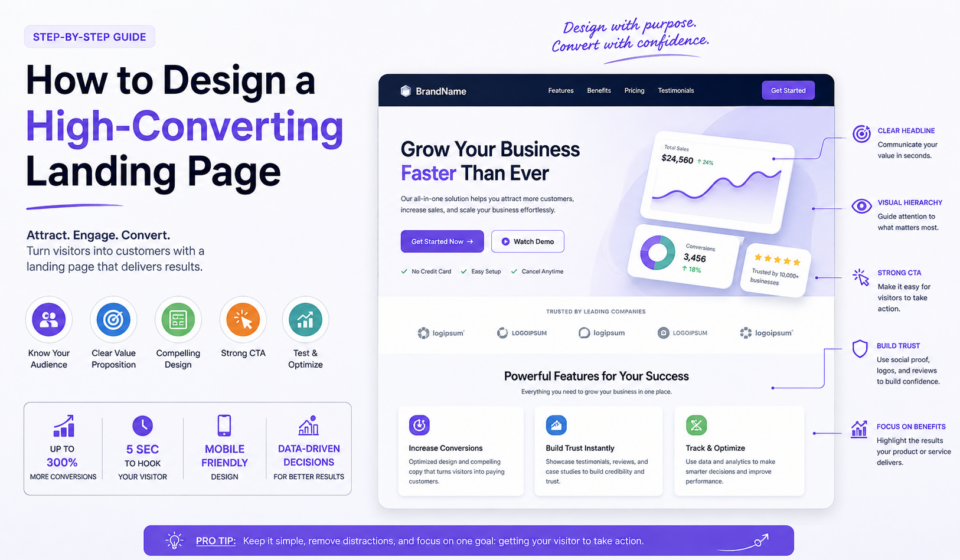
1. A Powerful Headline
The headline is the first thing visitors see. You have only a few seconds to grab their attention.
A good headline should:
- Clearly explain the offer
- Focus on benefits
- Create curiosity
- Solve a problem
Examples:
- Design Stunning Websites Without Coding
- Learn Digital Marketing in 30 Days
- Increase Your Sales by 200%
Formula:
Benefit + Timeframe + Desired Result
Example:
“Build Your Freelancing Career in Just 60 Days.”
2. An Engaging Subheadline
The subheadline supports your main headline and explains the offer in more detail.
Example:
“Join over 10,000 students who have successfully started their online careers through our step-by-step training program.”
Keep it concise and benefit-focused.
3. Use High-Quality Images and Videos
Visual content increases engagement and trust.
You can include:
- Product screenshots
- Course previews
- Demo videos
- Team photos
- Customer success stories
- Portfolio samples
Videos are particularly effective because they explain complex ideas quickly and increase conversions.
Best practices:
- Use professional images.
- Optimize image size for speed.
- Add captions where necessary.
- Keep videos short.
4. Clear Call-to-Action (CTA)
Your call-to-action button is the most important element on the page.
Examples:
- Get Started Now
- Download Free Guide
- Book a Free Consultation
- Enroll Today
- Start Learning
CTA best practices:
- Use action words.
- Make buttons large and visible.
- Use contrasting colors.
- Keep the text short.
- Repeat the CTA throughout the page.
Avoid generic text like “Submit.”
5. Focus on Benefits, Not Features
Many businesses talk too much about features and forget the benefits.
Feature:
“Includes 20 video lessons.”
Benefit:
“Learn practical skills that help you earn online.”
Visitors care more about outcomes than specifications.
Ask yourself:
How will this improve the customer’s life?
The Perfect Landing Page Structure
A high-converting landing page usually follows this structure:
Hero Section
Include:
- Headline
- Subheadline
- CTA button
- Image or video
Problem Section
Explain the visitor’s pain points.
Examples:
- Struggling to get clients?
- Low website traffic?
- Poor conversion rates?
Show that you understand their problem.
Solution Section
Present your product or service as the solution.
Explain:
- How it works
- Why it works
- What makes it different
Benefits Section
Highlight key benefits.
Example:
- Increase sales
- Save time
- Improve productivity
- Build skills
- Grow your business
Use bullet points for readability.
Social Proof
People trust other people.
Include:
- Testimonials
- Reviews
- Ratings
- Client logos
- Case studies
- Success stories
Example:
“I increased my income by 300% after completing this course.”
Social proof reduces doubts and builds trust.
FAQ Section
Address common concerns.
Examples:
- Is this beginner-friendly?
- How long does it take?
- Is there a refund policy?
- Do I get lifetime access?
Removing objections increases conversions.
Final CTA
End with a strong call-to-action.
Examples:
- Join Today
- Get Started
- Claim Your Discount
- Register Now
Make the next step obvious.
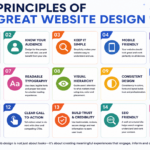
Design Principles for High Conversions
Keep It Simple
Avoid unnecessary elements.
Remove:
- Extra menus
- Too many links
- Distracting animations
- Complex layouts
Simplicity improves conversions.
Use White Space
White space makes content easier to read.
Benefits:
- Better readability
- Cleaner design
- More focus on CTA
- Improved user experience
Do not overcrowd your page.
Use Contrasting Colors
Your CTA button should stand out.
Examples:
- Blue background + orange button
- White background + green button
- Dark background + yellow button
Use contrast to guide users’ attention.
Create Visual Hierarchy
Guide visitors through the page using:
- Large headlines
- Bold text
- Images
- Colors
- Spacing
The most important information should appear first.
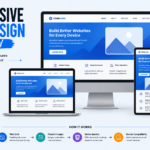
Mobile Optimization Is Essential
More than half of web traffic comes from mobile devices.
Your landing page must be mobile-friendly.
Checklist:
- Responsive design
- Large buttons
- Easy navigation
- Fast loading speed
- Readable fonts
- Optimized images
Always test your landing page on smartphones and tablets.
Improve Page Speed
Slow websites lose customers.
Ways to improve speed:
- Compress images
- Use caching
- Minify CSS and JavaScript
- Use a CDN
- Choose fast hosting
- Remove unnecessary plugins
Aim for a loading time of under three seconds.
Psychological Triggers That Increase Conversions
Scarcity
Examples:
- Limited seats available
- Offer ends tonight
- Only five spots left
Scarcity creates urgency.
Social Proof
People follow the actions of others.
Examples:
- Trusted by 50,000 users
- 4.9-star rating
- 10,000 happy customers
Authority
Show expertise through:
- Certifications
- Awards
- Media mentions
- Client logos
- Experience
Authority builds credibility.
Reciprocity
Offer something valuable for free:
- Free checklist
- Free consultation
- Free template
- Free webinar
People are more likely to take action after receiving value.
A/B Testing Your Landing Page
Never assume your first design is perfect.
Test different versions of:
- Headlines
- Images
- CTA buttons
- Colors
- Pricing
- Forms
- Layouts
Track:
- Conversion rate
- Bounce rate
- Click-through rate
- Time on page
Small changes can produce significant improvements.
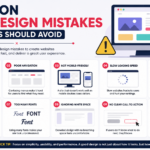
Common Landing Page Mistakes to Avoid
Avoid these mistakes:
- Too much text
- Weak headlines
- Slow loading speed
- Multiple CTAs
- Poor mobile design
- Complicated forms
- Lack of testimonials
- Distracting navigation
- Unclear value proposition
Fixing these issues can dramatically improve results.
Best Tools for Building Landing Pages in WordPress
If you’re using WordPress, these tools can help:
Page Builders
- Elementor
- Gutenberg
- Beaver Builder
- Divi
- Bricks Builder
Form Plugins
- WPForms
- Fluent Forms
- Contact Form 7
Optimization Tools
- Rank Math SEO
- Yoast SEO
- LiteSpeed Cache
- WP Rocket
Analytics Tools
- Google Analytics
- Google Tag Manager
- Microsoft Clarity
These tools make it easier to build and optimize landing pages without coding.
Landing Page SEO Tips
To improve search rankings:
- Use your target keyword in headings.
- Optimize images.
- Write a compelling meta description.
- Add internal links.
- Use schema markup.
- Improve page speed.
- Optimize for mobile.
- Use descriptive URLs.
SEO brings long-term traffic to your landing page.
Final Thoughts
A high-converting landing page is not just about attractive design. It combines persuasive copywriting, strategic layouts, compelling visuals, and strong calls to action.
Remember these key principles:
- Keep the design simple.
- Focus on one goal.
- Write benefit-driven copy.
- Use social proof.
- Optimize for mobile.
- Improve page speed.
- Test continuously.
When all these elements work together, your landing page becomes a powerful conversion machine that generates leads, sales, and business growth.
Start implementing these strategies today, and you’ll be well on your way to creating landing pages that deliver exceptional results.
